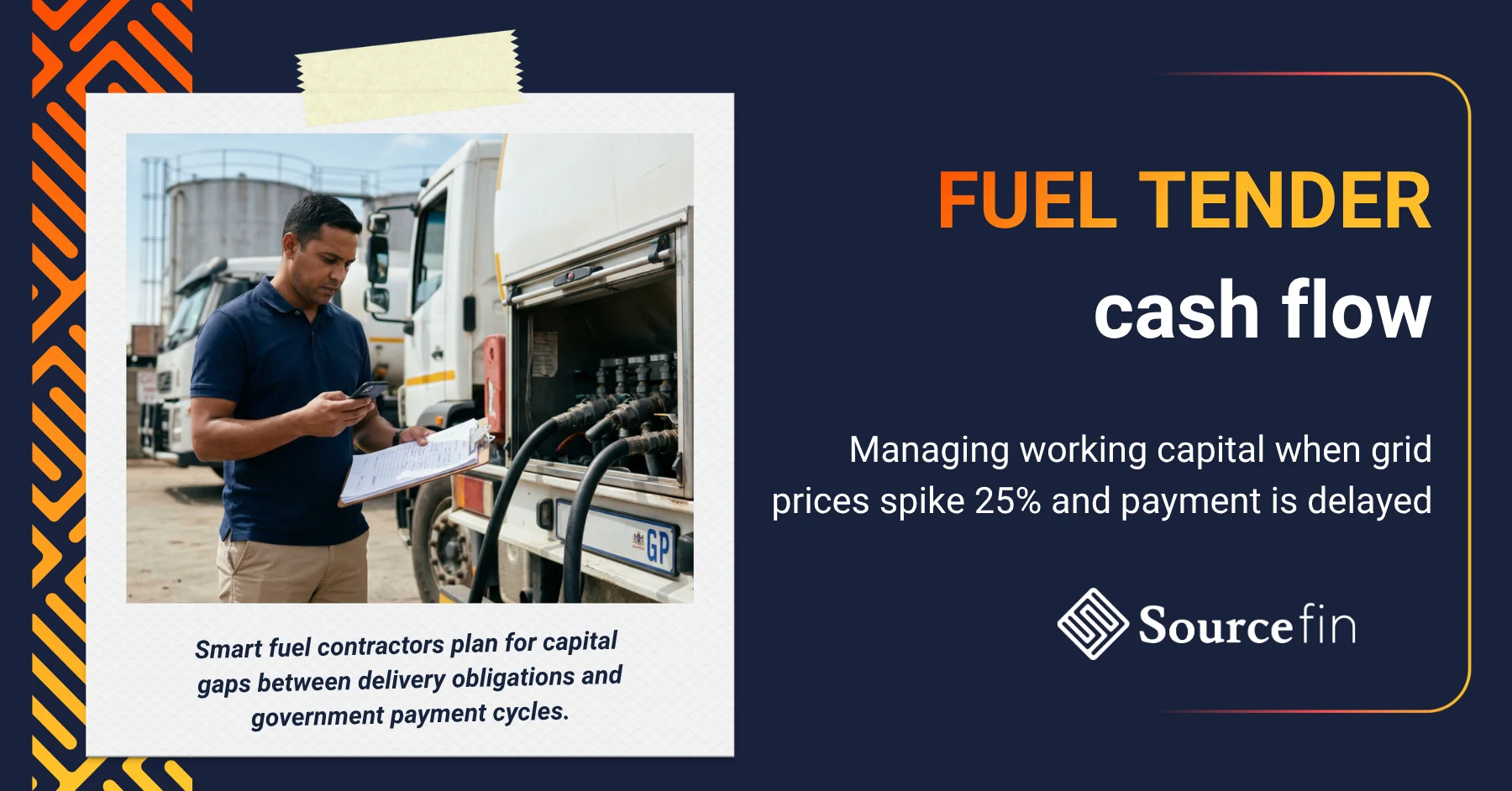

Fuel tender cash flow management South Africa requires businesses to balance upfront fuel procurement costs against 30-60 day payment cycles from government clients. Strategic approaches include timing inventory purchases to beat price increases, using invoice discounting to accelerate receivables, and securing purchase order funding to bridge capital gaps during diesel price volatility.
When you win a fuel supply tender in South Africa, you’re committing to deliver at agreed prices regardless of what happens to diesel costs. That worked fine when fuel prices moved predictably. It became a crisis in April 2026 when diesel jumped by R7.37 per litre – the single largest monthly increase in South African history.
Businesses with fixed-price fuel tenders suddenly faced a cash flow equation that didn’t balance. You still needed to purchase diesel inventory upfront to fulfil contracts. Your clients still paid 30 to 60 days after delivery. But your fuel procurement costs just spiked by nearly 40% overnight. That gap between what you spend today and what you receive next month creates immediate working capital pressure that threatens contract delivery. Effective fuel tender cash flow management South Africa strategies became essential for business survival.
The Cash Flow Challenge for Fuel Tender Businesses
Fuel tender cash flow management South Africa businesses face comes down to timing. You win a contract to supply diesel to a government department or SOE. The tender specifies pricing, volume, and delivery schedule. You’re locked in. When diesel was R18 per litre in your pricing, you could buy inventory, deliver to your client, and wait for payment knowing your margins held.
When diesel hits R25.51 per litre – as it did in April 2026 – those margins collapse. A business supplying 50,000 litres monthly at the old pricing now pays an additional R368,500 upfront just to purchase the same inventory. If your client pays in 60 days, you’re carrying that extra cost for two months before revenue arrives. For businesses operating on thin margins, that’s not sustainable.
Government payment terms compound the pressure. Most public sector entities pay within 30 days of invoice submission – that’s National Treasury policy. Reality often runs longer. When you’re already stretched thin from higher procurement costs, waiting 45 or 60 days for payment creates a cash flow crunch that stops operations.
Why Fixed-Price Fuel Tenders Create Vulnerability
The structure of fuel tenders builds in vulnerability to price volatility. Tenders typically run for 12 to 36 months with pricing fixed at contract award. Some include escalation clauses tied to official fuel price adjustments, but many don’t. Even with escalation clauses, there’s often a lag – you absorb April’s price increase until May’s escalation kicks in.
This creates asymmetric risk. When fuel prices rise, your costs increase immediately. Your revenue doesn’t adjust until the next billing cycle or escalation period. That gap – sometimes weeks or months – requires working capital to bridge. Small and medium businesses rarely have R300,000 to R500,000 sitting idle to absorb sudden cost spikes.
April 2026 demonstrated this perfectly. Brent Crude jumped from $69 to $94 per barrel due to Strait of Hormuz supply disruptions. The government implemented a temporary R3 per litre relief measure from April 1 through May 5, but diesel still increased by R7.37 per litre for low-sulphur fuel. Businesses with fuel tenders had no advance warning and no time to adjust.
Strategic Timing: When to Purchase Fuel Inventory
Smart fuel tender operators learned to watch price signals. South Africa’s monthly fuel price adjustments happen on the first Wednesday of each month, announced by the Department of Mineral and Petroleum Resources. The Central Energy Fund publishes daily under- or over-recovery data showing where prices are heading.
When under-recovery data shows a large increase coming, businesses with available capital front-load their purchases. Buy this month’s allocation plus next month’s volume before the price adjusts. You lock in current pricing and avoid the increase entirely. That strategy requires working capital you might not have budgeted for, but it protects margins.
The opposite works when prices fall. Delay purchases until after the adjustment. Buy minimally in the expensive month, then stock up when prices drop. This tactical inventory management directly impacts your cash position and contract profitability.
Invoice Discounting to Accelerate Receivables
Invoice discounting turns your unpaid invoices into immediate working capital. Here’s how it works for fuel tender businesses: you deliver diesel to your client and issue an invoice. Normally you’d wait 30 to 60 days for payment. With invoice discounting, a funder advances 75% to 85% of the invoice value within 24 to 48 hours. You receive the remaining balance when your client pays, minus the funder’s fee.
This solves the fuel tender cash flow management South Africa challenge by compressing your cash conversion cycle. Instead of waiting two months to receive payment while diesel prices potentially increase again, you get funds immediately. Use that capital to purchase inventory at today’s prices before the next increase hits.
The Sourcefin approach to invoice discounting focuses on the strength of your client relationship and invoice quality rather than perfect credit history. Government invoices and SOE contracts typically qualify because the end buyer’s ability to pay is strong, even if your business has limited track record.
Purchase Order Funding for Upfront Capital
When you win a fuel tender but lack capital to purchase initial inventory, purchase order funding provides the solution. This works differently from invoice discounting. Instead of advancing against completed work, the funder provides upfront capital to fulfil the purchase order.
A typical structure: you win a R1.2 million fuel supply tender over 12 months. You need R300,000 immediately to purchase the first quarter’s diesel allocation. Traditional lenders want collateral and lengthy approval processes. Purchase order funders assess three things – can they trust you, can the goods be delivered, and will the end buyer pay.
For fuel tenders, delivery is straightforward and government buyers have strong payment capacity. The funder provides capital to purchase diesel inventory, you deliver to your client, and the funder receives payment when your client pays. You keep your contracted margin without needing upfront capital.
Supplier Relationship Management During Volatility
Your relationship with fuel suppliers directly impacts your cash flow options. Suppliers who know your business and trust your payment history offer more flexibility when prices surge. Some suppliers extend payment terms for established clients – 14 or 21 days instead of immediate payment. That two-week buffer creates breathing room to collect from your clients before settling supplier invoices.
Bulk purchase discounts become more valuable during price volatility. If you can negotiate 2% to 3% off per-litre pricing by committing to larger volumes, that discount offsets some of the margin pressure from price increases. The trade-off is higher working capital requirements – you’re buying more inventory upfront.
Communication matters when prices spike. Suppliers understand the market dynamics affecting fuel tender operators. If cash flow tightens, have the conversation early. Suppliers would rather work out a payment plan than chase bad debt or lose a reliable customer. Transparency builds trust that pays dividends when you need flexibility.
Payment Term Negotiation Strategies
Government payment terms are theoretically fixed at 30 days from invoice receipt, per National Treasury regulations. Reality allows some negotiation, especially with municipalities and smaller departments. When fuel tender cash flow management South Africa tightens, consider these approaches.
Request milestone-based payments for larger contracts. Instead of one invoice at month-end for 50,000 litres, submit weekly invoices for 12,500-litre deliveries. This accelerates cash inflow without changing the actual payment terms – you just receive money more frequently throughout the month.
For private sector clients, payment term negotiation is more flexible. Offer early payment discounts: 2% discount if paid within 7 days, 1% within 14 days. This incentivises faster payment and improves your cash position. The discount costs less than carrying working capital debt or missing out on bulk purchase savings.
Some clients accept supply agreements with advance payment arrangements. You receive 30% to 50% upfront when the purchase order is issued, with the balance paid on delivery or monthly invoicing. This flips the cash flow dynamic – the client’s advance payment covers your fuel procurement costs.
Building Cash Flow Resilience for Future Volatility
April 2026’s diesel price shock won’t be the last. Middle East supply disruptions, exchange rate volatility, and domestic policy changes all affect fuel pricing. Businesses managing fuel costs for transport fleets or supply contracts need built-in resilience. Proactive fuel tender cash flow management South Africa approaches prepare businesses for the next price surge.
Establish a working capital facility before you need it. When cash flow is comfortable, approach funders to set up pre-approved tender funding limits. If diesel prices spike again, you draw down immediately instead of scrambling for emergency financing. The facility sits idle when not needed but provides crucial speed when markets move against you.
Build escalation clauses into new tender agreements. Fixed-price contracts expose you entirely to fuel volatility risk. Pricing that adjusts monthly based on official fuel price changes transfers that risk to the buyer. Not all clients accept escalation clauses, but those who do make fuel tender cash flow management South Africa sustainable long-term.
Diversify revenue beyond fuel supply. Businesses that only provide fuel become entirely dependent on margin-per-litre economics. Add complementary services – fleet management, fuel card systems, consumption analytics. These services generate revenue streams not tied to commodity pricing volatility and improve overall business resilience.
Navigating Cash Flow Pressure
Fuel tender businesses in South Africa face structural cash flow challenges magnified by price volatility. You commit to supply at fixed prices while your procurement costs fluctuate. Clients pay 30 to 60 days after delivery while suppliers expect payment on receipt. When diesel prices jump R7 per litre overnight, that equation breaks.
Strategic cash flow management combines tactical inventory timing, invoice discounting to accelerate receivables, and purchase order funding to eliminate upfront capital barriers. Strong supplier relationships and flexible payment terms from clients reduce pressure during volatile periods.
The businesses navigating this successfully aren’t hoping for stable prices. They’re building cash flow resilience through funding partnerships that let them focus on contract delivery rather than constantly chasing capital. At Sourcefin, we’ve backed South African SMMEs with over R2.6 billion in funding because we understand that when your business has solid opportunities, working capital shouldn’t be the constraint.
Sources & References
Government announcements: Department of Mineral and Petroleum Resources (DMPR) fuel price adjustments (April 1, 2026), National Treasury fuel levy reduction statement (March 31, 2026)
Market data: Central Energy Fund daily fuel price calculations, Brent Crude price data (February-March 2026 review period)
Industry analysis: South African Petroleum Retailers Association (SAPRA) supply statements, Business Day diesel price analysis
FAQs
What is fuel tender cash flow management?
Fuel tender cash flow management refers to the strategies businesses use to balance upfront fuel procurement costs against delayed payment from clients. When you supply fuel under tender contracts, you purchase diesel inventory immediately but receive payment 30 to 60 days later. Managing this gap – especially during price volatility – requires strategic timing of purchases, accelerated receivables through invoice discounting, or upfront capital via purchase order funding.
How do fuel price increases affect tender contracts?
Fuel price increases create immediate margin pressure for businesses operating under fixed-price tender agreements. When diesel costs jump unexpectedly, your procurement expenses rise but your contracted selling price remains unchanged. This squeezes profit margins and increases working capital requirements since you’re spending more upfront while waiting the same 30 to 60 days for client payment. Businesses without cash reserves or funding arrangements struggle to maintain contract delivery during significant price spikes.
Can I negotiate payment terms with government clients?
Government payment terms are officially set at 30 days from invoice receipt per National Treasury regulations. Whilst these terms are rarely negotiable directly, you can structure invoicing to improve cash flow. Submit milestone-based invoices for large contracts rather than single monthly invoices, which accelerates payment frequency. Some government entities accept advance payment arrangements for strategic suppliers, though this requires strong relationships and proven track record. Private sector clients offer more flexibility for payment term negotiation.
What is invoice discounting for fuel tenders?
Invoice discounting converts unpaid fuel tender invoices into immediate working capital. After delivering diesel and issuing an invoice to your client, a funder advances 75% to 85% of the invoice value within 24 to 48 hours. You receive the remaining balance when your client pays, minus the funder’s fee. This accelerates your cash conversion cycle from 30-60 days down to 1-2 days, providing capital to purchase inventory before the next fuel price increase hits.
How does purchase order funding work for fuel supply contracts?
Purchase order funding provides upfront capital to fulfil fuel tender obligations when you lack working capital. Instead of advancing against completed work, the funder assesses the purchase order’s viability and provides capital to procure diesel inventory. You deliver fuel to your client, and the funder receives payment when your client settles the invoice. This eliminates the barrier of needing R250,000 to R500,000 upfront capital to execute profitable tender contracts.
Should I stock up on fuel before price increases?
Stocking up before announced price increases protects margins if you have available working capital. South Africa’s monthly fuel price adjustments are announced in advance, and the Central Energy Fund publishes daily under-recovery data showing the likely direction of price changes. Purchasing extra inventory before a large increase locks in current pricing. The trade-off is higher immediate capital requirements and storage capacity limitations. This strategy works best when paired with invoice discounting or facilities that provide working capital flexibility.
What funding options exist for businesses with fuel tenders?
South African businesses with fuel tenders can access invoice discounting to accelerate receivables from completed deliveries, purchase order funding to secure upfront capital for tender fulfilment, or working capital facilities that provide pre-approved funding limits to draw down during price volatility. Sourcefin specialises in these funding solutions for SMMEs, assessing deals based on tender viability and client payment capacity rather than requiring perfect credit history or extensive collateral. Funding decisions typically happen within 24 to 48 hours, with capital deployed within 5 to 10 working days for first-time clients.