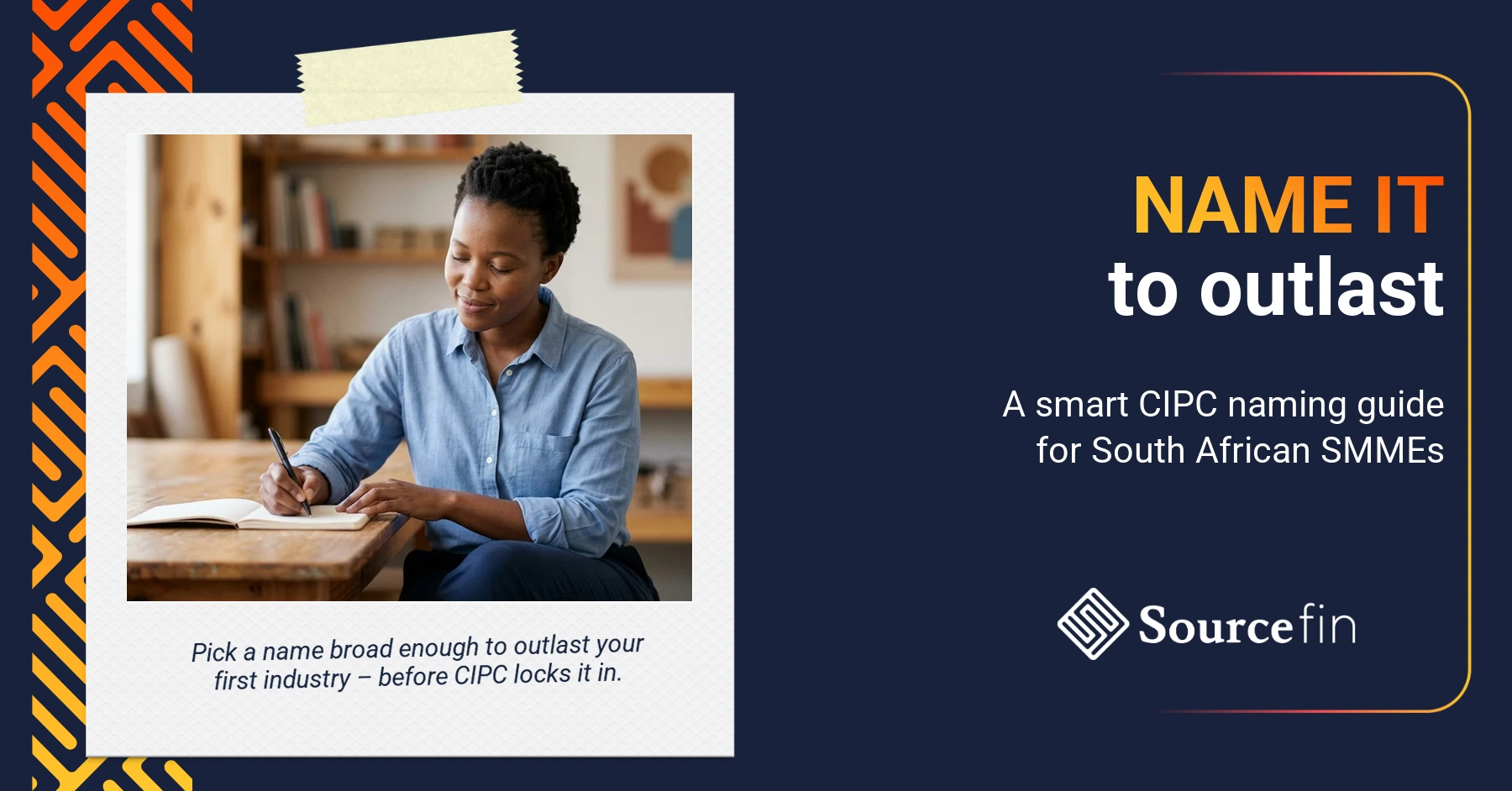

Choosing company name South Africa is one of the smallest decisions at registration time and one of the most consequential later. A CIPC name costs R50 to reserve, but a name that boxes you into a single industry can cost years of rebranding work when the business diversifies. Pick a name broad enough to outlast your first industry – and remember that a CIPC name is not a trademark.
Key Takeaways
- Name reservation at CIPC costs R50 per application. You may submit up to three names in order of preference. The reservation is valid for six months.
- A CIPC company name and a registered trademark are two completely different things. The CIPC Companies Register and the CIPC Trade Marks Register are separate and not cross-referenced.
- An industry-specific name (such as “Lerato’s Cleaning Solutions”) boxes the company into that single sector. When you diversify, the name becomes a marketing liability.
- You can trade under a different “trading as” name without changing your CIPC registration, but trading-as does not provide trademark protection.
- Real brand protection requires a separate trademark registration via CIPC’s Intellectual Property department, governed by the Trade Marks Act.
- If you do not want to pick a name immediately, you can register a Pty Ltd for R125 with no name reservation. CIPC assigns the registration number as the company name. You can apply for a name change later.
Why choosing a company name South Africa matters more than founders think
This cluster pairs with Sourcefin’s complete guide on when to register a business in South Africa. The pillar is the readiness decision. This article is the naming decision that follows: once you have decided to register, what name should you actually pick?
The instinct of most first-time founders is to name the company after the thing they are currently doing. “Sipho’s Cleaning Services.” “Thandi’s Catering.” “Bongani’s Logistics.” It feels natural in the moment – the name describes the business clearly. But Lerato Mathodlana raised the long-term cost of this choice directly on The Great Enabler podcast: “If we say Lerato’s Cleaning Solutions, already I’ve boxed myself into cleaning. If I want to have a vast name that leaves nothing for you to be – you have to ask what exactly is this person doing – that I can absolutely chop and change as I please without having to go to the CSD to update my name.”
The CIPC name reservation process
The mechanics of choosing a company name South Africa via CIPC are simple. The process:
- Log on to the CIPC BizPortal or e-Services platform.
- Submit a name reservation application for R50, listing up to three preferred names in order of preference.
- CIPC checks each name against the Companies Register. If your first preference is available and complies with the Companies Act naming rules, it is approved.
- The reservation is valid for six months. You must register the company within that window or lose the reservation.
- If all three options are rejected (usually because they are identical or confusingly similar to existing registered companies), you submit a new application with three new options at R50 again.
You can also skip name reservation entirely. Registering a private company for R125 without a reserved name results in CIPC assigning the registration number as the company name – something like “2026/123456/07”. You can apply for a name change later. This is a legitimate route for founders who want to start trading immediately and decide on the brand name once the business is up and running.
Choosing company name South Africa that survives growth
The strategic question is not “what name describes my current business” but “what name will still fit in five years”. Three principles:
1. Avoid industry-specific words unless you are certain you will never diversify
“Cleaning Solutions”, “Construction Services”, “Catering Co”, “Logistics Pty” – these names are accurate today and limiting tomorrow. If the business diversifies into a new sector, the name signals confusion to buyers. The CIPC name registration does not have to describe the business – it just has to be unique.
2. Pick a name with credibility but flexibility
Names like “Mahlangu Trading”, “Ndlovu Group”, or a non-descriptive brand name signal seriousness without constraining the business model. Generic descriptors (“Group”, “Trading”, “Holdings”, “Enterprises”, “Capital”) give you room to operate in any sector.
3. Test the name against future scenarios
Before submitting to CIPC, run the name through five questions:
- If we expand into a different industry, does the name still work?
- If a corporate buyer’s procurement team Googles us, does the name carry credibility?
- Is the name easy to spell and remember?
- Does the .co.za domain exist?
- Does the social media handle exist on the main platforms?
If three or more of these answers are “no”, reconsider the name before paying CIPC.
The CIPC name vs trademark distinction no one explains
This is the single biggest misunderstanding in choosing a company name South Africa. A CIPC company name registration is not the same as a trademark. The Companies Register (administered by CIPC’s Companies department) and the Trade Marks Register (administered by CIPC’s Intellectual Property department) are completely separate. They are not cross-referenced.
Practically, this means three things:
- A name available for CIPC company registration may already be a registered trademark belonging to someone else. Registering the company name does not give you the right to use it commercially – the trademark holder can stop you.
- Registering a CIPC company name does not prevent someone else from using the same name in their own marketing, as long as they do not register an identical or confusingly similar company.
- If you want exclusive rights to use a brand name in commerce, you must register it as a trademark separately.

When to register a trademark
Trademark registration is administered by CIPC’s IP department under the Trade Marks Act 194 of 1993. Registration gives you exclusive rights to use the mark for the goods or services in the registered class, and the right to enforce against unauthorised use.
Practical guidance on when to trademark:
- If the brand name is central to the business’s value (consumer products, professional services, technology), trademark it early – ideally before going to market.
- If the business is supplier-to-buyer with no consumer brand exposure, the case is weaker. Many SMMEs trading on tenders or B2B contracts do not need a trademark.
- Trademark application costs include the CIPC filing fee plus IP attorney fees – budget several thousand rand per class for a properly handled application.
- Trademarks are class-specific. You register per class of goods or services (45 classes exist). If you operate across multiple classes, you pay per class.
The single biggest mistake first-time founders make is assuming the CIPC name search (“the name is available”) is the same as legal clearance to use it. It is not.
Trading-as names: when they help and when they do not
A South African company can trade under a different name from its registered CIPC name using a “trading as” arrangement. For example, “ABC Trading 250 Pty Ltd t/a Sipho’s Cleaning”. The trading name appears on invoices, marketing, and contracts. The CIPC registration stays unchanged.
Trading-as is useful when:
- You started with a generic CIPC name and have since built a brand under a different name.
- You want to test a brand without committing to a separate company.
- You are operating multiple sub-brands under one corporate structure.
Trading-as is not useful for:
- Brand protection – it provides none. Only a registered trademark does.
- Limiting liability – the legal entity remains the registered Pty Ltd.
- Tender bids – most procurement systems require the legal name on documents.
What to do if your name is rejected
CIPC rejects names that are identical to existing registered companies, confusingly similar, or that contravene the Companies Act naming rules (no offensive language, no implied government affiliation, no misleading descriptors). If your name is rejected:
- Submit a new application with three new options – you cannot dispute a rejection without a separate process.
- Try variations: add “Group”, “Holdings”, “Trading”, or a geographical qualifier.
- Search the CIPC company name database before submitting again to filter out obvious clashes.
- Run a separate trademark search to make sure your preferred name is not already trademarked.
In this series: more on registering a business in South Africa
- Should you register a business in South Africa? Honest SMME guide – the decision framework that precedes the name choice.
- Sole proprietor vs Pty Ltd in South Africa – the structural decision that determines whether you need a CIPC name at all.
- Holding company structure for South African SMMEs explained – how multi-entity structures shape naming choices.
Once the name is locked, Sourcefin is next
Choosing company name South Africa is one of the first decisions in a long sequence. Once the name is reserved, the company is registered, and the first contract or purchase order lands, the next conversation is funding. Sourcefin’s two flagship products – purchase order funding and invoice discounting – are designed for the moment between winning the contract and getting paid. Banks are built for stability. Sourcefin is built for speed. R3 billion deployed, 1,000+ SMMEs funded, 100% delivery rate. Start with the Sourcefin funding application when the first order arrives.
Sources & References
CIPC. Name Reservation. cipc.co.za
CIPC. Register Trade Mark. cipc.co.za
BrandLaw. A CIPC company name search does not clear your brand and trademark for use. brandlaw.co.za
MacRobert Attorneys. Trade Marks vs Trade Names: Why It Is Important To Understand The Difference. macrobert.co.za
RSM. The use of “trading as” names by South African companies. rsm.global
The Great Enabler Podcast. Lerato Mathodlana on registering a business in South Africa. 2026. youtube.com
Frequently Asked Questions
How much does choosing company name South Africa cost at CIPC?
Name reservation at CIPC costs R50 per application. You may submit up to three preferred names in order of preference on a single application. If accepted, the reservation is valid for six months. If all three options are rejected, you must submit a fresh application with three new options at R50 again.
Is a CIPC company name the same as a trademark in South Africa?
No. The CIPC Companies Register and the CIPC Trade Marks Register are separate and not cross-referenced. Registering a company name with CIPC does not give you exclusive rights to the name in commerce. Real brand protection requires a separate trademark registration under the Trade Marks Act administered by CIPC’s IP department.
Can I register a Pty Ltd in South Africa without choosing a name?
Yes. You can register a private company for R125 directly, without reserving a name. CIPC will assign the registration number as the company name (for example 2026/123456/07). You can apply for a name change later. This is a legitimate path for founders who want to start trading immediately and decide on the brand once operational.
What happens if CIPC rejects my company name reservation?
You must submit a new R50 application with three new options. CIPC rejects names that are identical to existing registered companies, confusingly similar, or that contravene Companies Act rules (no offensive language, no implied government affiliation, no misleading descriptors). Try variations with ‘Group’, ‘Holdings’, ‘Trading’, or a geographical qualifier.
Can a South African company trade under a different name from its CIPC registration?
Yes. A ‘trading as’ arrangement lets a registered Pty Ltd operate under a different brand name on invoices, marketing, and contracts. Example: ‘ABC Trading 250 Pty Ltd t/a Sipho’s Cleaning’. Trading-as does not provide trademark protection or change the legal entity – it only changes the customer-facing name.
When should I trademark my company name in South Africa?
Trademark early if the brand is central to the business – consumer products, professional services, technology. The case is weaker for purely B2B or tender-driven SMMEs with no consumer exposure. Trademarks are class-specific (45 classes exist) and cost CIPC filing fees plus IP attorney fees, usually several thousand rand per class for a properly handled application.