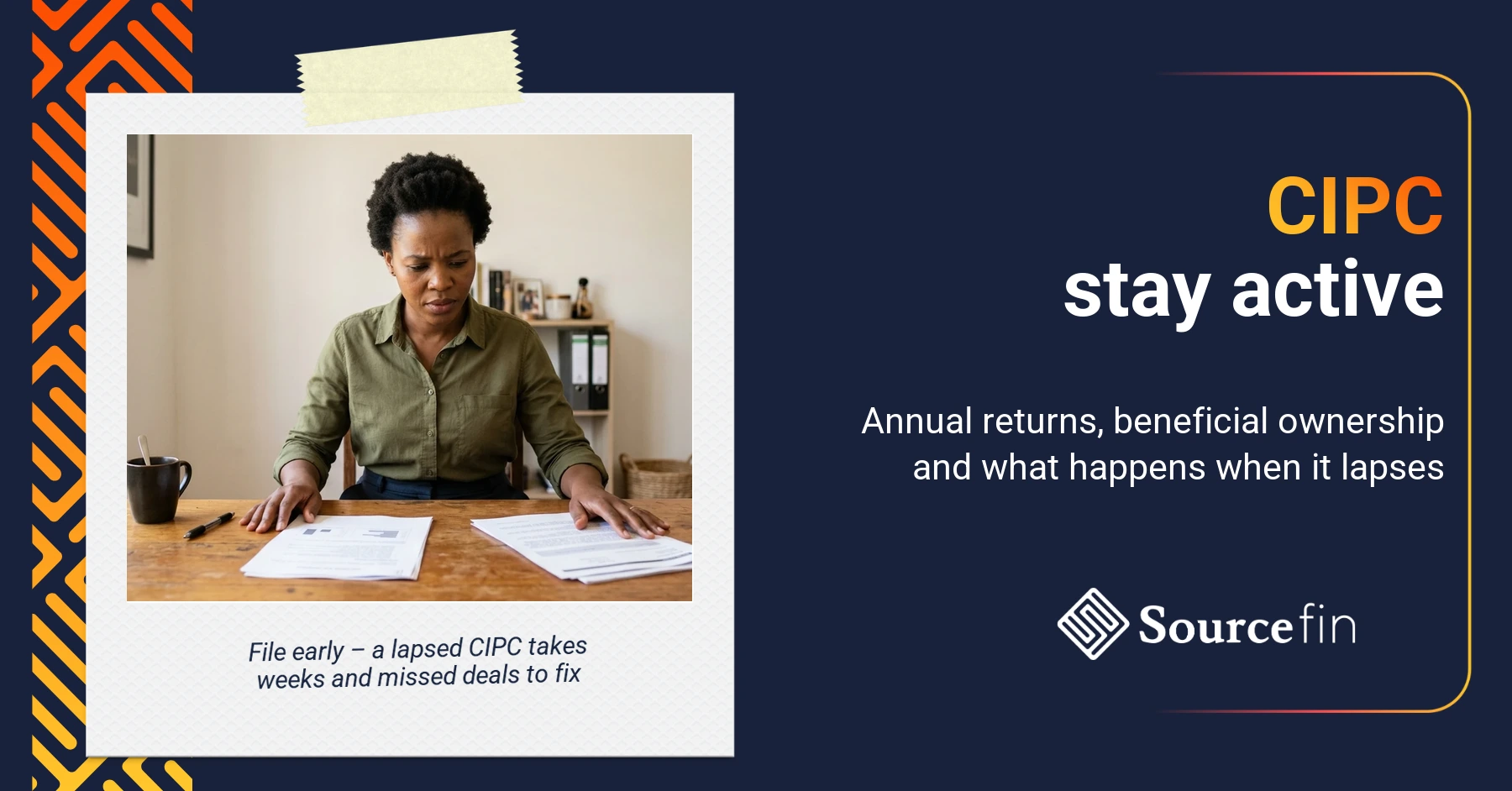

CIPC registration South Africa gives your company its legal identity – but registration alone is not enough. You must file annual returns every year and, since July 2024, a Beneficial Ownership Declaration before them. Miss either and your company moves toward deregistration, losing the right to hold a business bank account, bid for tenders, or access any form of funding.
Key Takeaways
- CIPC registration South Africa requires ongoing maintenance – not just once-off registration when you start trading.
- Annual returns must be filed within 30 business days of your company’s anniversary date every year.
- Since July 2024, a Beneficial Ownership Declaration must be submitted before your annual return can be filed.
- A deregistered company cannot hold a business bank account, bid for government tenders, or be approved for any form of funding.
- Reinstatement after deregistration is possible but takes weeks, costs more, and loses you opportunities in the meantime.
What CIPC Registration South Africa Actually Covers
The Companies and Intellectual Property Commission is the government body responsible for registering and maintaining all companies in South Africa under the Companies Act 71 of 2008. When you register a company – whether a private company (Pty) Ltd, a non-profit company, or a personal liability company – CIPC issues you a registration number that becomes the legal anchor for everything your business does.
That registration number appears on every contract, invoice, bank account, and tax submission your company ever produces. Without it, you are not a legal entity. But CIPC registration South Africa is not a once-off event – it’s an ongoing obligation that renews every year on your company’s anniversary date.
The two primary ongoing obligations are your annual return and, since July 2024, your Beneficial Ownership Declaration. Both must be filed on time, every year, or your company begins the slide toward deregistration. As covered in our guide to SMME compliance and funding access, these three compliance pillars – CIPC, SARS, and CSD – work together. A failure in any one of them can block your access to funding and tender opportunities.
Annual Returns: The Renewal Most Business Owners Overlook
Annual returns are CIPC’s mechanism for confirming that your company still exists and is actively trading. They must be filed within 30 business days of your company’s anniversary date – the date CIPC records as your registration anniversary, which is separate from your financial year-end.
The process is done entirely online through CIPC eServices at eservices.cipc.co.za. You log in, locate your company record, and submit the annual return with the applicable fee. Fees are tiered by annual turnover, so the cost for most SMMEs is modest. The risk of missing the deadline is not modest at all.
Miss one annual return and CIPC sends an arrears notice. Miss two consecutive annual returns and CIPC begins deregistration proceedings. Once that process starts, your company’s legal standing deteriorates – and with it, your ability to do almost anything that requires a formal business entity.
One common mistake worth flagging: your financial year-end and your CIPC anniversary date are two separate things. Many business owners conflate them and file late as a result. Check your CIPC eServices record to confirm your company’s exact anniversary date and set a reminder at least 45 days before it every year.

Beneficial Ownership Declarations: What Changed in July 2024
Since July 2024, CIPC requires all companies to file a Beneficial Ownership Declaration before their annual return can be submitted. This declaration discloses the natural persons who ultimately own or control the company – specifically anyone with a beneficial interest of 5% or more in the company’s shares or voting rights.
The requirement aligns South Africa with international anti-money laundering and anti-corruption standards. From CIPC’s perspective, it creates a transparent record of who actually benefits from every registered company in the country. From your perspective, the practical implication is clear: you cannot file your annual return until your Beneficial Ownership Declaration is on record.
If your company structure includes trusts, holding companies, or multiple individual shareholders, make sure all beneficial owners are correctly identified and submitted well before your anniversary date. And if your company structure changes during the year – a shareholder buys in, a director exits, a trust changes its beneficiaries – update your records promptly. Don’t wait for anniversary time.
What Happens When Your CIPC Status Lapses
A deregistered company ceases to be a legal entity. The consequences are immediate and wide-ranging.
Your business bank account cannot legally remain active under a deregistered company name. You cannot bid for government tenders – procurement officers must verify active CIPC status before processing any bid, and a deregistered status ends that process immediately. You cannot maintain an active profile on the Central Supplier Database, which cross-checks your CIPC status in real time. Read more in our guide to CSD registration in South Africa.
Funders – whether banks or alternative lenders – cannot advance money to a deregistered entity. Purchase order funding and invoice discounting providers both verify company status as part of their standard due diligence. Any contracts signed by a deregistered company also carry legal risk, which complicates any dispute resolution down the line.
Reinstatement is possible through CIPC’s formal restoration process, but it involves submitting an application, paying reinstatement fees, filing all outstanding annual returns, and waiting for CIPC to process everything – typically several weeks. During that period, your business is effectively in limbo. The cost, in time and missed opportunities, far outweighs the cost of staying compliant.
How to Check Your CIPC Status Right Now
You can verify your company’s CIPC status in a few minutes. Go to cipc.co.za and use the company search function. Your company record will show your current status (Active, Deregistered, In Liquidation, and so on), your anniversary date, your most recent annual return filing, and the directors currently on record.
If your status shows anything other than Active, or if your annual returns are in arrears, act immediately. Don’t wait until a tender deadline or a funding application is in front of you. A CIPC issue discovered two weeks before bid closing is almost always too late to resolve in time.
It’s also worth checking that your directors, registered office address, and banking details held by your bank all match what CIPC has on record. Discrepancies between your CIPC record and your SARS tax compliance profile can trigger verification failures when funders or procurement officers cross-check the two systems.
CIPC Registration South Africa and Your Funding Access
CIPC registration South Africa is a prerequisite for every form of business funding, not just government-linked sources. Commercial banks require active company registration before opening a business account. Alternative funders verify it as part of standard due diligence. Any funder advancing capital against a contract wants confirmation that the entity it’s funding actually exists in law.
For SMMEs pursuing government tender opportunities, CIPC compliance is checked at every stage – when your CSD profile is created, when your SARS TCS Pin is verified, and when a procurement officer processes your bid. A single lapse breaks the entire chain. All three pillars must be active and current for any government opportunity to proceed.
The good news: maintaining your CIPC registration South Africa is genuinely straightforward. File your annual return before your anniversary date. Keep your director records current. Submit your Beneficial Ownership Declaration before the annual return deadline. Those three actions, done consistently, mean your CIPC status will never be the reason an opportunity passes you by.
If you’re preparing for a funding application and want to confirm your compliance across CIPC, SARS, and the CSD before submitting, start your Sourcefin application – we work through the compliance picture with you before the deal goes anywhere.
Sources & References
Companies and Intellectual Property Commission (CIPC). Company Registration, Annual Returns and Beneficial Ownership. 2026. Retrieved from cipc.co.za
National Treasury, South Africa. Preferential Procurement Policy Framework and Supplier Compliance Requirements. 2026. Retrieved from treasury.gov.za
Frequently Asked Questions
How do I check my CIPC registration status in South Africa?
Go to cipc.co.za and use the company search function. Search by your company registration number or name to see your current status (Active, Deregistered, etc.), your anniversary date, most recent annual return filing, and directors on record. You can also log in to CIPC eServices at eservices.cipc.co.za to access your full company profile.
When must I file my CIPC annual returns?
CIPC annual returns must be filed within 30 business days of your company’s anniversary date — the date CIPC records as your registration anniversary, which is separate from your financial year-end. Miss one return and CIPC issues an arrears notice. Miss two consecutive returns and deregistration proceedings begin. Set a reminder at least 45 days before your anniversary date every year.
What is the CIPC Beneficial Ownership Declaration and when was it introduced?
The Beneficial Ownership Declaration is a mandatory filing introduced in July 2024 that discloses the natural persons who ultimately own or control a company — specifically anyone with a beneficial interest of 5% or more. It must be filed before your annual return can be submitted. The requirement aligns South Africa with international anti-money laundering and anti-corruption frameworks.
What happens if my company gets deregistered by CIPC?
A deregistered company loses its legal status entirely. Your business bank account cannot remain active, you cannot bid for government tenders, your CSD profile cannot be maintained, and no funder can advance money to the entity. Reinstatement is possible but requires a formal application to CIPC, payment of reinstatement fees, filing all outstanding annual returns, and waiting several weeks for processing.
How long does CIPC reinstatement take after deregistration?
CIPC reinstatement typically takes several weeks from submission of the restoration application. The process requires filing all outstanding annual returns, paying applicable reinstatement fees, and waiting for CIPC to process the application and restore Active status. The timeline can extend if documentation is incomplete. The cost in fees, time, and missed opportunities is substantially higher than maintaining compliance from the start.
Does CIPC registration affect my ability to get business funding?
Yes, directly. Every form of business funding — commercial bank accounts, purchase order funding, invoice discounting, and government-linked programmes — requires an Active CIPC registration. Funders verify company status as part of standard due diligence. A deregistered or lapsed CIPC registration halts any funding application immediately, regardless of how strong the underlying opportunity may be. For a wider view, see our invoice discounting pillar guide for South African SMMEs.
How does CIPC link to my CSD registration and SARS compliance status?
The Central Supplier Database cross-checks your CIPC status in real time every time a procurement officer verifies your supplier profile. If your CIPC registration has lapsed or your SARS tax compliance is non-compliant, the CSD flags your profile immediately. All three — CIPC, SARS, and CSD — must be active and current for any government tender or funded transaction to proceed.