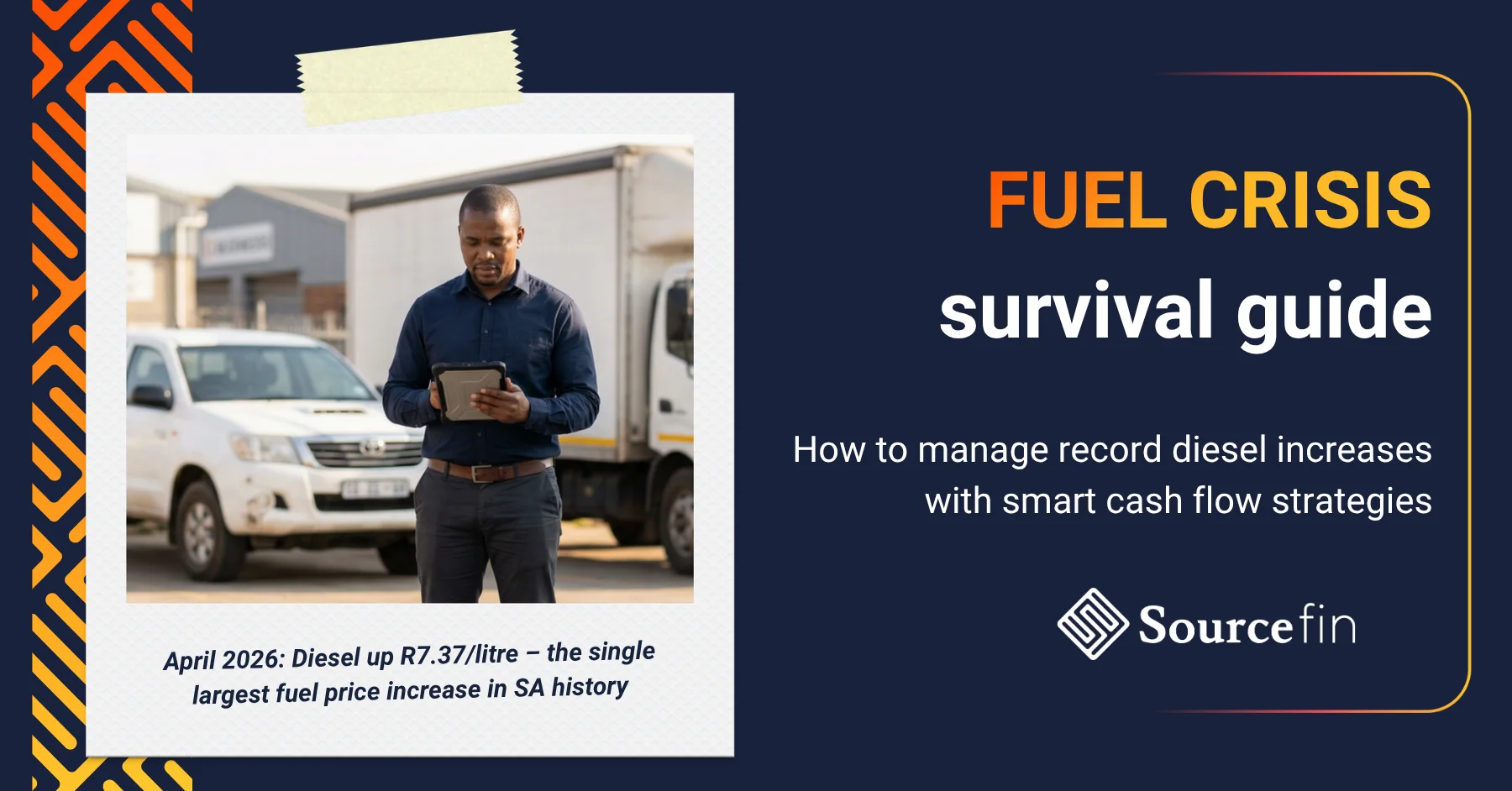

The fuel price increase South Africa experienced in April 2026 – R7.37 for diesel and R3.06 for petrol – creates unprecedented working capital pressure for businesses with fuel tenders, transport fleets, and supply chains. The crisis stems from the Strait of Hormuz closure disrupting 20% of global oil supply, pushing Brent Crude from $69 to $94 per barrel. Government introduced temporary R3/litre relief through May 5, but prices remain locked in through July. Businesses are managing cash flow strain through invoice discounting (paying for fuel earlier to beat price rises) and PO funding (addressing tender contract capital gaps from grid price escalation).
Understanding the fuel price increase South Africa is facing
If you filled up your diesel tank on April 1, 2026, you felt it immediately. Diesel jumped by R7.37 to R7.51 per litre – the single largest monthly fuel price increase in South Africa’s history. Petrol rose by R3.06 per litre. These aren’t small adjustments. For a business running even a modest fleet, the numbers add up fast.
The government stepped in with a temporary measure: a R3 per litre fuel levy reduction running from April 1 through May 5, 2026. Without this relief, the increases would have been even steeper. Finance Minister Enoch Godongwana and Mineral Resources Minister Gwede Mantashe announced the intervention as South Africans braced for what many called a fuel price “nightmare.”
But here’s the reality – even with the R3 cushion, businesses are facing serious pressure. The relief is temporary. The underlying drivers of the fuel price increase South Africa is experiencing aren’t going away quickly. And for businesses with fuel tenders, logistics operations, or supply chain dependencies, this isn’t just an inconvenience. It’s a cash flow crisis that demands strategic action.
Why fuel prices surged – and why they’re staying high
Three factors collided to create this crisis, and understanding them helps you plan for what’s ahead.
First, international oil prices skyrocketed. Brent Crude oil jumped from an average of $69.08 per barrel in February to $93.67 in March – a 38% surge in a single month. The driver? The ongoing conflict between the United States, Israel, and Iran. On March 4, 2026, Iran effectively closed the Strait of Hormuz, the narrow waterway through which roughly 20% of the world’s seaborne oil supply flows. Tanker traffic collapsed by over 90%. Oil prices spiked to $126 per barrel at their peak.
This isn’t a short-term disruption. Industry executives and analysts warn that if the Strait doesn’t reopen by mid-April, supply disruptions will worsen significantly. Even if the conflict ends tomorrow, oil prices are likely to remain elevated for months as countries restock depleted reserves. The International Energy Agency called this “the greatest global energy security challenge in history.”
Second, the rand weakened against the dollar. During the review period, the exchange rate slipped from R16.00 to R16.64 per USD. That depreciation alone contributed an additional 56 cents per litre to petrol and 78 cents per litre to diesel. When you import crude oil and refined products in dollars, currency movements matter.
Third, annual tax increases kicked in. The General Fuel Levy rose by 9 cents per litre, the Carbon Levy by 5 cents (petrol) and 6 cents (diesel), and the Road Accident Fund Levy by 7 cents. Together, these tax increases added another 21 cents per litre to pump prices.
Here’s what business owners need to know: government has confirmed there’s zero chance of fuel prices dropping before May, June, or July 2026 – no matter what happens geopolitically. Even if the Strait of Hormuz reopens, the government is breaking what would have been a R10 per litre diesel increase into bite-sized chunks spread over multiple months. You’re looking at sustained pressure for at least the next quarter.

The fuel tender cash flow trap
If you hold a fuel tender – whether for government, municipalities, or private sector clients – you’re facing a specific and acute problem that many people outside the industry don’t understand.
Most fuel tenders include escalation clauses linked to the grid price plus a percentage. That’s standard. When grid prices were stable, these clauses worked fine. But when the grid price jumps 25% to 38% in a single month, the mechanics of your contract just created a massive working capital gap.
Here’s why. Let’s say your contract requires you to deliver 30,000 litres of diesel per week. Before April, that cost you X. After the R7.37 increase, the same 30,000 litres now costs you 25% more in absolute terms. Your contract allows you to charge more – eventually. But you still need to deliver the fuel upfront. And you won’t get paid for 30 to 60 days.
The cash flow problem is immediate. You need 25% more capital today to deliver the same volume. If you’re doing meaningful volume, that 25% isn’t pocket change – it’s potentially hundreds of thousands or millions of rands you need to find, quickly, to keep your contract alive. Miss a delivery, and you’re in breach. Your entire tender is at risk.
This is where smart businesses are turning to tender funding and purchase order financing. PO funding addresses exactly this problem: it provides the upfront capital to fulfil your tender obligations when costs spike unexpectedly. You deliver the fuel, your client pays in 30–60 days, and you settle with your funder. The contract stays on track. Your business stays solvent.
Who’s feeling the pressure most
The fuel price increase isn’t hitting everyone equally. Some sectors are absorbing body blows right now.
Transport and logistics businesses are feeling the fuel price increase South Africa implemented most acutely. Diesel drives their entire operation. Every truck on the road, every delivery route, every distribution run just got significantly more expensive. A transport company moving goods from Gauteng to Durban now pays over R2,200 more per haul due to the 39.6% diesel price increase. That’s not a rounding error – it’s a material hit to margins that many businesses can’t absorb without raising prices or finding working capital solutions.
The taxi industry warned that fare increases are coming. With operating margins already tight, taxi operators simply can’t shoulder a R7+ per litre diesel increase without passing costs through to commuters. The South African National Taxi Council flagged potential job losses and financial strain across the sector.

Agriculture faces a triple threat. Diesel powers planting, harvesting, and irrigation equipment. Fertiliser costs are rising because roughly 30% of internationally traded fertilisers normally transit the Strait of Hormuz. And export logistics are under strain as transport costs surge. BDO South Africa’s Head of Agriculture noted that “South Africa’s agricultural sector is uniquely exposed to global shocks.” The result? Food prices are likely to climb as these costs work through the value chain.
Mining and construction operations that run heavy diesel-powered equipment are recalculating project costs. A mining operation consuming 300,000 litres per month faces massive cost escalations almost overnight. These aren’t businesses that can switch to petrol or pause operations – they need diesel, and they need it continuously.
Retail feels the impact indirectly but significantly. As distribution costs rise, suppliers pass those costs through. Grocery prices for essentials like bread, milk, and household goods tend to follow fuel price movements with a lag of a few weeks. Retailers have already warned of a “ripple effect” pushing prices up nationwide.

The common thread? These are all businesses where fuel isn’t discretionary. You can’t just use less diesel when you’re fulfilling a tender, planting crops on schedule, or running a transport route. The work has to get done. The only question is how you finance the increased cost without breaking your cash flow.
The inflation and interest rate knock-on
The fuel price increase South Africa is navigating isn’t just about the pump price. Fuel price increases have a way of spreading through the entire economy, and the effects compound.
The South African Reserve Bank has already warned that inflation risks are tilted to the upside. Higher fuel costs filter through to public transport fares, food prices, and the cost of virtually anything that needs to be moved. Economists expect inflation to climb toward 4.5% to 5% in the coming months. That matters because it limits the central bank’s ability to cut interest rates, which many businesses were hoping for to ease borrowing costs.
FNB warned that if the conflict drags on, South Africa could face not just higher inflation but potentially even interest rate hikes and lower economic growth. The longer fuel prices stay elevated, the more these secondary effects build. For businesses already managing tight margins, this creates a compounding pressure: higher operating costs, higher inflation eroding purchasing power, and potentially higher cost of capital if rates rise.
Some individuals already spend up to 40% of their income on transport. That leaves very little room for adjustment when fuel prices jump. Consumer spending power weakens, which flows back to businesses as reduced demand. It’s a cycle that’s hard to break without either fuel prices stabilising or incomes rising – and neither looks likely in the short term.
How businesses are adapting with smart funding
The businesses navigating this crisis successfully aren’t just hoping fuel prices drop. They’re taking strategic action on cash flow. Two funding solutions are proving particularly effective.
Invoice discounting lets you pay for fuel earlier and beat the price rises. Here’s how it works: you’ve completed work and issued an invoice, but your client won’t pay for 30, 60, or 90 days. Normally you’d wait. But during a fuel crisis, waiting means paying higher prices next month. Invoice discounting turns that unpaid invoice into immediate cash – typically 75% to 85% upfront, with the balance when your client pays. You use that cash to buy fuel now, at today’s prices, before the next increase hits.
For businesses with recurring fuel needs and regular invoicing cycles, this creates a buffer. You’re not scrambling each month to find cash for fuel at whatever the new price happens to be. You’re managing your working capital proactively, using money you’ve already earned but haven’t received yet.

Purchase order funding addresses a different but equally pressing need: the capital gap when you’ve won work but costs just spiked. This is the fuel tender scenario we discussed earlier, but it applies to any business where you need to deliver goods or services upfront and get paid later. PO funding provides the capital to fulfil the order, even when unexpected cost increases (like a 25% diesel price jump) change the economics mid-contract.
The combination is powerful. Invoice discounting helps you manage ongoing fuel purchases. PO funding helps you deliver on contracts when costs surge. Together, they create working capital flexibility that lets you focus on running your business rather than constantly chasing cash.
If your business is feeling the fuel price squeeze – whether you’re managing a tender, running a fleet, or simply trying to keep operations moving – it’s worth exploring these options. At Sourcefin, we specialise in exactly these kinds of working capital challenges. We’ve backed South African SMMEs with over R2.6 billion in funding because we understand that when your business has solid opportunities, capital shouldn’t be the bottleneck.
You can learn more about tender funding strategies or apply for funding directly. The fuel crisis is creating real pressure, but it doesn’t have to derail your business. Strategic funding can bridge the gap.
What to expect in the months ahead
The reality is that the fuel price increase South Africa experienced in April 2026 is unlikely to provide relief anytime soon. Government has confirmed that prices will remain elevated through at least May, June, and July 2026. Even if the Strait of Hormuz reopens and the geopolitical situation stabilises, the effects will linger. Oil-producing countries will need to restock reserves. Shipping costs will remain elevated. Currency pressures could persist.
Industry stakeholders and civil action groups have called for additional government intervention – potentially pausing fuel taxes or extending the R3 levy relief beyond May. But Treasury has made clear that cushioning fuel prices costs money the fiscus doesn’t readily have. The R3 relief already represents a R6 billion impact. Extending or expanding it would require difficult trade-offs elsewhere in the budget.
For businesses, the takeaway is simple: plan for sustained pressure. Budget conservatively. Look for working capital solutions that give you flexibility. Don’t assume prices will drop sharply in the next quarter, because all available evidence suggests they won’t.
But here’s the opportunity within the challenge. Businesses that move strategically now – securing working capital, optimising their fuel purchasing timing, and managing cash flow actively rather than reactively – will be better positioned not just to survive this crisis but to capture opportunities as competitors struggle.
This is the kind of moment where smart funding makes the difference between a business that weathers the storm and one that thrives through it. If you’re managing fuel tenders, running logistics operations, or simply dealing with the cash flow reality of higher diesel costs, you don’t have to navigate this alone. Reach out, explore your options, and let’s talk about how funding can keep your business moving forward.
Sources and references
Government announcements: Department of Mineral and Petroleum Resources (DMPR) fuel price adjustments (April 1, 2026), National Treasury fuel levy reduction statement (March 31, 2026)
Oil market data: Central Energy Fund daily fuel price calculations, Brent Crude price data (February-March 2026 review period), International Energy Agency (IEA) Strait of Hormuz crisis analysis
Industry impact: South African Petroleum Retailers Association (SAPRA) supply statements, BDO South Africa agricultural sector analysis, South African National Taxi Council (SANTACO) operator impact warnings, Solidarity Research Institute transport cost analysis
Economic analysis: South African Reserve Bank inflation risk assessment, First National Bank (FNB) economic outlook, Federal Reserve Bank research on Strait of Hormuz closure economic impact
Geopolitical context: Congressional Research Service Iran Conflict and Strait of Hormuz report, Bloomberg oil market analysis, Wikipedia 2026 Strait of Hormuz crisis documentation