
Transport business cash flow: profitable but broke?
Profit is not cash. Why transport SMMEs win the work, deliver it, and still run dry waiting 90 days for payment, and what to do about the gap.

On this page
- Key takeaways
- Why can profitable work still leave you broke?
- How do payment terms drain transport business cash flow?
- How does a future-focused funder differ from a bank?
- Is your margin hiding in the contract?
- What mistakes does desperation make?
- How do you build for ten years, not the next order?
- Where does Sourcefin fit in?
- Frequently asked questions
Transport business cash flow is the real threat, because profit and cash are not the same thing. A job can be profitable on paper yet leave you broke if you pay for diesel, drivers and maintenance up front and only get paid 30, 60 or 90 days later.
Key takeaways
- Profit and cash are different things, and transport SMMEs feel the gap harder than most because fuel, drivers and maintenance are paid long before the invoice is.
- Payment terms, not contract size, decide whether the business survives the month.
- A balanced client mix – some cash on delivery, some on 60 and 90-day terms – lets the fast payers fund the slow ones.
- Read the contract. A fuel price escalation clause may already entitle you to invoice more when diesel rises.
- Rent before you buy, insure against non-payment, and build your compliance before a funder asks for it.
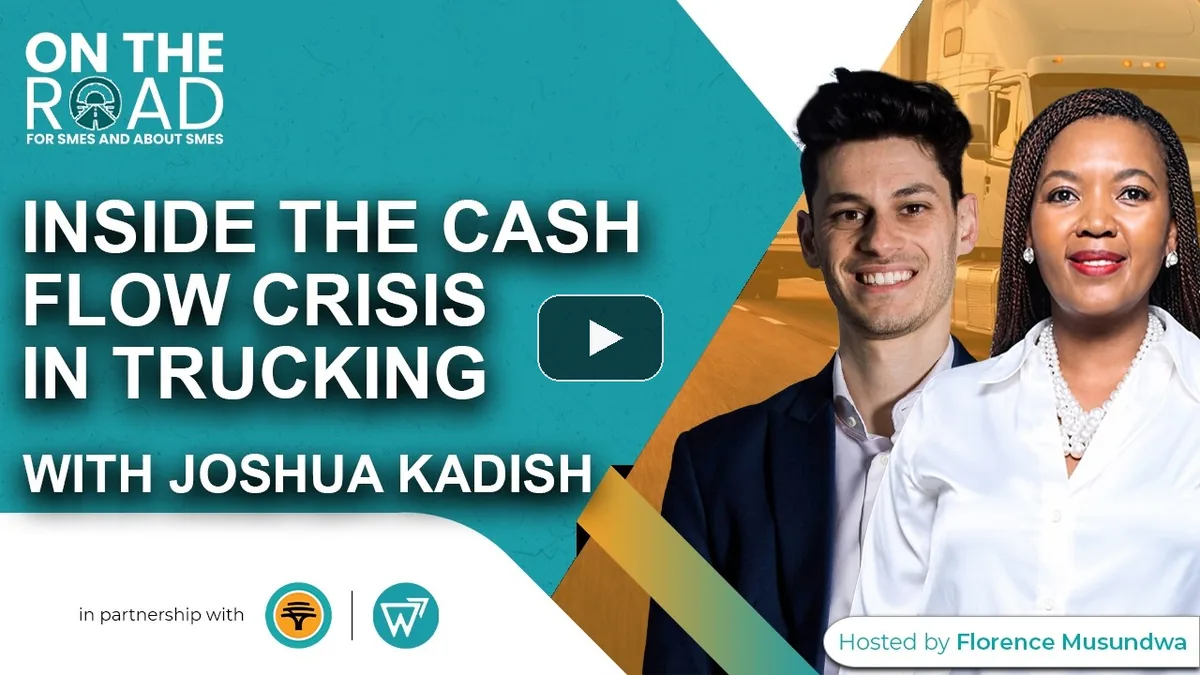
That gap between "profitable" and "paid" is where most transport SMMEs get into trouble. Sourcefin CEO Joshua Kadish unpacked it with Florence Musundwa on the On the Road podcast, and the practical lessons apply to almost every operator moving goods in South Africa. If you want the wider picture first, our guide to cash flow solutions for South African SMMEs covers the fundamentals this episode builds on.
Why can profitable work still leave you broke?
Ask most owners how a deal looks and they will tell you the margin: input cost, what they will make, what is left over. It is the right instinct, but only half the picture. As Joshua puts it, people look at revenue and profit, but they forget to look at cash – and without cash, you always run into a problem.
You win a contract, deliver, and invoice. On paper the job is profitable. But you have already paid for fuel, maintenance and drivers, and the client pays in 90 days. The profit is real. The cash to keep operating is not there yet. You could have 100% margin on a deal, but if the money only lands in 90 days, that margin does not help you today.

How do payment terms drain transport business cash flow?
Most public and private contracts pay on 30, 60, 90 or even 120-day terms. Government departments are meant to settle valid invoices within 30 days under National Treasury rules, but in practice transport SMMEs plan for longer. The longer the term, the longer your own money stays locked in work you have already delivered. That is why transport business cash flow lives or dies on payment timing, not on the size of the contract.
The move is to balance your client mix. A cash-on-delivery client may carry a lower margin, but the certainty of that cash can fund the 60 and 90-day clients where your margin is higher. Diversifying who you work with, and when they pay, keeps money in the business. Where the wait is unavoidable, invoice discounting for logistics businesses turns a delivered invoice into working capital now rather than in three months.
How does a future-focused funder differ from a bank?
Banks and traditional financiers serve a real purpose, and they do certain things very well. Their assessment is retrospective by design: it is built around affordability and security, which speak to what you have now and what you had in the past. Given the volume they carry, a single opportunity is hard to turn around quickly.
Transport SMMEs, though, are famous for arriving with an opportunity that needed capital last week. A future-focused funder asks a different question: if this opportunity succeeds and the invoice is paid, will you be able to repay? That is a different mandate, not a lesser one, and it is the gap Sourcefin was built to close.
Is your margin hiding in the contract?
The most expensive mistakes are rarely dramatic. They sit in the fine print of contracts people signed quickly because they wanted to start.
One client running logistics for a metro was steadily losing margin as diesel climbed. When Joshua sat down and read the award letter, purchase order and contract together, there it was: a fuel price escalation formula tied to the published grid price. The contract already allowed him to invoice more when diesel rose. He had been absorbing a cost his client was contractually meant to carry, simply because nobody had read the fine print.
The same discipline applies to the whole chain. If you are a subcontractor and the buyer pays on 90 days while your contract says 30, that mismatch is your problem in reality. Ask for sight of the terms above you before you commit your trucks. And do not gamble on the diesel price. Your expertise is logistics, not speculation. Lock your pricing to the grid, build the escalation into the contract, and get on with the job. Our guide to transport fleet fuel cost management goes further on the levers available once the clause is in place.
What mistakes does desperation make?
Under pressure, businesses make predictable errors. The biggest, in Joshua's view, is a lack of healthy scepticism, not a lack of ambition.
We South Africans love to own things. But a client wanting to buy a TLB for a two-year contract could rent the same machine month to month first, and test the contract for three months before committing capital and signing surety. Leasing is not the mistake we have been taught it is. Sometimes owning is right, sometimes renting is, and it is specific every time.
Protect the downside, too. You can run a fleet well for a year and lose it in a single month where the buyer does not pay. Credit guarantee or trade insurance lets you claim when a counterparty fails to pay for work you have delivered, and that is often the difference between a bad month and a lost business. Build your compliance early as well, because you cannot create two years of audited financials the day a funder asks for them.
How do you build for ten years, not the next order?
The thread through all of it is time horizon. Would you rather win ten orders in partnership, or one order at a time on your own? The operators who scale take on a funding or delivery partner and chase the bigger picture.
It matters even more in transport, because if all you own is trucks, you sit at the saturated bottom of the value chain where price is the only thing you compete on. Building an ecosystem – warehousing, distribution, freight forwarding – is more durable. And none of it works without a reputation for delivery. Relationships built on who you know are fragile, but relationships built on consistently delivering survive a change of sheriff.
Where does Sourcefin fit in?
Sourcefin is a future-focused funder and a partner, not a lender. Where a bank looks backwards at what you own, Sourcefin looks forwards at the opportunity, funding the purchase order so you can deliver, or advancing up to 75% on an unpaid invoice so you are not waiting 90 days for money you have already earned. Because the model is a partnership, the support goes beyond the funding: reading the contract, checking the chain, flagging the insurance you did not know existed. Sourcefin funds confirmed work from R250k to R100m+ across South Africa. If you have won the work, purchase order funding is the place to start, and invoice discounting is what closes the gap once you have delivered.
Won the work? Get the capital. Apply for funding and let's get your next order delivered.
Sources & references
- Joshua Kadish on the On the Road podcast with Florence Musundwa – the full episode this article draws on.
- Automobile Association of South Africa, fuel pricing – the published grid price transport contracts escalate against.
- National Treasury of South Africa – the 30-day payment rule for government invoices.
Frequently asked questions
Why is transport business cash flow a bigger threat than profit?
Transport business cash flow is the real threat because profit and cash are not the same thing. A job can be profitable on paper yet leave you broke if you pay for diesel, drivers and maintenance up front and only get paid 30, 60 or 90 days later.
What is the difference between profit and cash flow?
Profit is what remains after costs on a completed job. Cash flow is the actual money moving in and out of your account over time. A transport job can be profitable yet leave you short of cash if you pay for fuel and drivers long before your client settles the invoice.
How do 30, 60 and 90-day payment terms affect SMMEs?
Most public and private contracts pay on 30, 60 or 90-day terms. The longer the term, the longer your own money stays tied up in work you have already delivered. Managing that gap, through a mix of clients and the right funding, decides whether a transport SMME grows or stalls.
What is a fuel price escalation clause?
A fuel price escalation clause lets you adjust your invoice when the diesel price moves, usually linked to the official grid price. If your biggest cost is fuel and this clause is missing, a price spike quietly eats your margin. Read every contract to check whether the clause is there.
Should a transport business own or lease its equipment?
It depends on the contract and the risk. Leasing month to month lets you test a contract for a few months before committing capital and signing surety on a machine. Owning can suit stable, long-term work. The point is to decide deliberately, not default to owning because it feels safer.
Can Sourcefin fund my transport business if I am new?
Possibly. Sourcefin is a future-focused funder, not a lender, so we weigh the opportunity in front of you, not only your history. For invoice funding we advance up to 75% upfront, with the balance on payment. We fund confirmed work from R250k to R100m+ across South Africa.

Sourcefin is a South African alternative finance provider that offers purchase order funding and invoice discounting to SMMEs, enabling businesses to fulfil confirmed purchase orders or tenders and unlock cash flow without collateral. Unlike traditional lenders or banks, Sourcefin also provides end-to-end support including supplier sourcing, logistics, project management, and risk oversight.