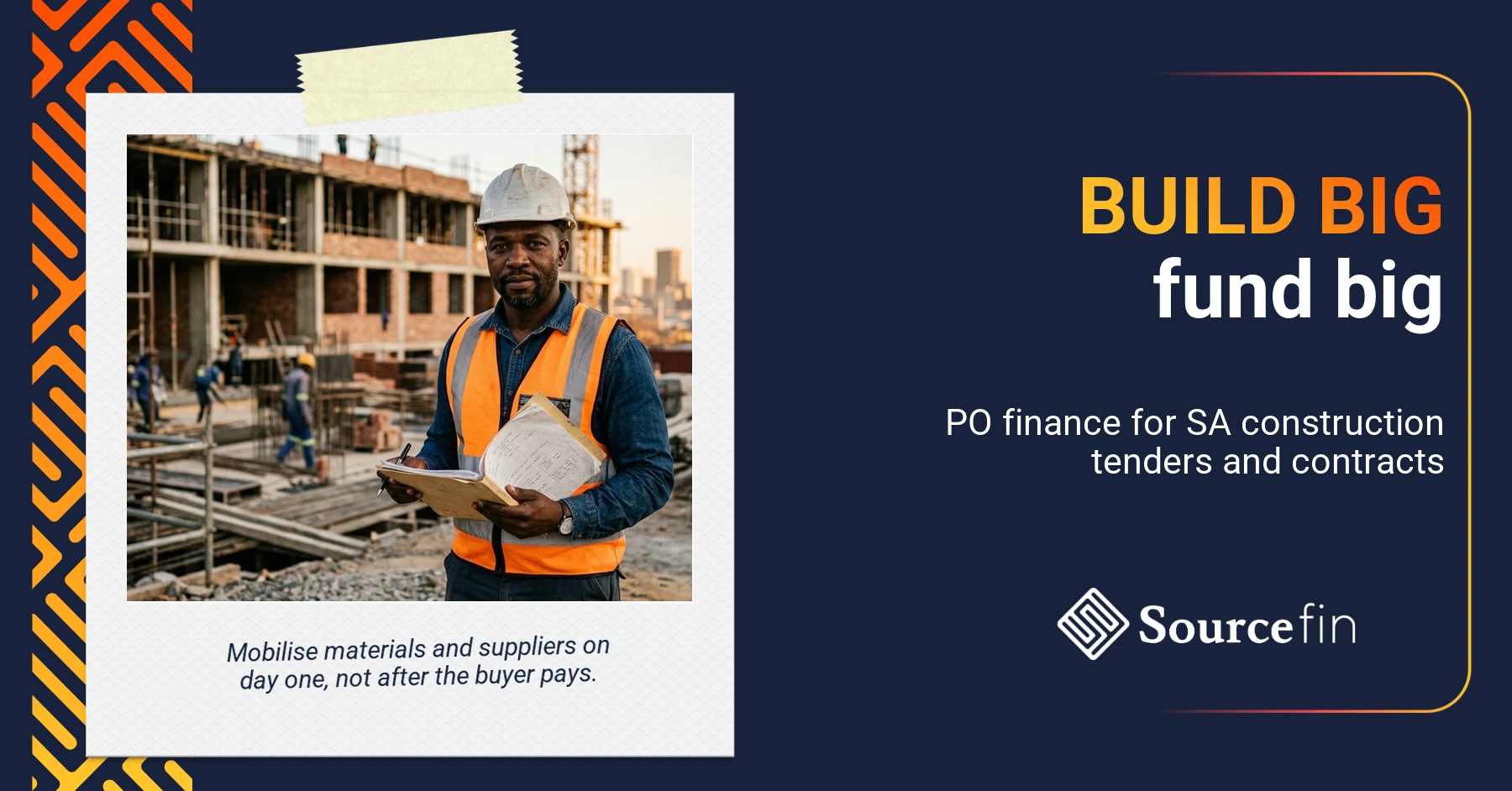

Purchase order finance construction South Africa is the funding model that lets contractors mobilise on awarded jobs without waiting for buyer payments. Whether the contract is government infrastructure, private development, or a sub-contract on a larger build, PO finance covers materials, suppliers, and execution costs upfront. The contractor delivers, the buyer pays, and the advance is recovered from that payment.
Key Takeaways
- Construction contracts often need significant capital on day one – materials, suppliers, plant hire – before any payment claim can be lodged.
- PO finance for construction covers the gap between awarded contract and first valuation or invoice payment.
- Sourcefin funds construction deals from R250,000 upwards, with significant exposure to government infrastructure work and SOE contracts.
- The buyer’s profile matters as much as the contractor’s – departments, SOEs, and reputable private developers are easier to fund against.
- Construction-specific risks (variations, retention, valuations) shape how the deal is structured.
- PO finance pairs well with other tools – overdraft, asset finance for plant – rather than replacing them.
Purchase Order Finance Construction South Africa: Where the Model Fits
South African construction is a working-capital-heavy industry. A new contract demands materials, sub-contractor commitments, and plant deployment from the first week. Payment claims, valuations, or PO-driven invoices typically lag delivery by weeks or months. The gap between mobilisation cost and first cash in is where most awarded SMME contractors hit pressure.
Purchase order finance construction South Africa fills that gap. The funder advances working capital against a confirmed contract or PO. Suppliers are paid directly. Materials reach site. Sub-contractors get mobilised. The work proceeds. The buyer pays per the contract terms, and the advance is recovered from that payment.
For broader context on how the funding model works across all sectors, the wider purchase order funding South Africa pillar guide covers the approach end to end. This article focuses on what makes construction different.
The Cash Flow Crunch in SA Construction
Construction cash cycles run longer than most other sectors. A typical contract might involve 30 to 60-day payment terms on valuations, retention sums held back until practical completion, and contingencies that take time to settle.
For an SMME contractor, that means significant capital is locked into the job long before any cash returns. Material suppliers usually want payment within 30 days. Sub-contractors invoice monthly. Plant hire is billed weekly. Payroll runs every two weeks. The contractor sits in the middle, paying out before getting paid.
Bank facilities help, but bank credit decisions take time and lean on overall financial profile rather than the specific contract. The PO funding vs bank loan South Africa guide walks through the difference in detail. For a contract-specific cash gap, PO finance is usually the more practical tool.
How PO Finance Works for Construction Contracts
For construction work, the PO finance flow looks like this. The contract is awarded. The contractor identifies the supplier set – typically materials suppliers, plant hire, and key sub-contractors. The funder reviews the contract, the buyer’s payment profile, and the supplier arrangements. A structured advance is built around the actual cost-to-deliver and the expected payment cycle.
Materials and supplier costs are paid directly from the funder. The contractor mobilises immediately. Work proceeds on the agreed programme. Valuations or PO-driven invoices are submitted to the buyer per the contract. The buyer pays. The advance is recovered from that payment, and the contractor retains the contract margin.
The structure differs from a traditional loan. There are no fixed monthly repayments running independently of the project. The deal is tied to the contract itself – its timeline, its payment cycle, and its delivery milestones.
Common Construction Scenarios for PO Finance

Sourcefin funds a range of construction contract types. Common scenarios include:
- Government infrastructure contracts. Roads, water, sanitation, and energy works. The SONA 2026 announcement of R156 billion for water infrastructure has opened up a meaningful pipeline of these. The government infrastructure tenders guide covers the 2026 opportunity set.
- Building works for departments and municipalities. Schools, clinics, government offices, municipal facilities. Awarded under standard procurement frameworks.
- SOE construction contracts. Eskom, Transnet, Rand Water, and similar. Typically larger contracts with contractually defined payment cycles.
- Sub-contracts on private development. Where the SMME is one tier below the principal contractor on a residential, commercial, or industrial build.
- Specialist sub-contracts. Mechanical and electrical, plumbing, HVAC, security, finishes. Often awarded by main contractors who themselves operate on staged payment.
Each scenario has its own payment-cycle pattern. The PO finance structure is adjusted accordingly.
What Construction SMMEs Need to Qualify
The standard PO funding requirements apply to construction. The purchase order funding requirements South Africa guide covers the full picture. For construction specifically, the funder looks at:
- The contract or PO. Signed letter of award, signed contract, or formal purchase order. The foundation of the deal.
- The bill of quantities or scope of work. What is being built or supplied, in what quantities, and over what programme.
- Supplier and sub-contractor commitments. Quotes for materials, plant, and key sub-contracts. The funder needs to see that the cost base is realistic.
- The contractor’s CIDB grading if relevant to the contract size and category.
- Standard compliance pack – CIPC, SARS, and recent business bank statements.
For government tenders specifically, the PO funding for government tenders guide adds the procurement-specific requirements (CSD, B-BBEE, SBD forms). The how to apply for PO funding walkthrough explains the application process.
Construction-Specific Risks Funders Look At
Construction contracts carry risks that funders specifically assess. Three sit at the front of the queue.
Variations and scope changes can shift the financial profile of a job mid-delivery. A funder wants to understand how variations are handled in the contract, who carries the cost, and how change orders flow through to payment.
Retention is the percentage of each payment held back by the buyer until practical completion or final certification. Standard retention can be 5 to 10% of contract value, released only at the end. For PO finance, retention affects how the advance is sized and recovered.
Programme risk – falling behind schedule – directly hits cash flow. A funder will look at whether the programme is realistic, whether the contractor has delivered comparable work before, and whether the supplier set is in place to actually meet the timeline.
None of these risks are deal-breakers. They are the realities of construction work that the funder factors into the deal structure. Honest disclosure of the risks specific to a job is far stronger than glossing over them in the application.
Comparing PO Finance to Other Construction Funding Routes
Construction SMMEs use a range of funding tools. PO finance is one of them.
Bank overdraft handles short-term, day-to-day fluctuations. Term loans handle long-horizon investment like premises or core equipment. Asset finance handles plant and vehicles specifically. PO finance handles the contract-specific working capital gap between mobilisation and buyer payment.
Most successful construction SMMEs use several of these in combination. The bank handles the everyday banking. Asset finance handles the truck or the excavator. PO finance handles the contract that needs R3 million in materials before the first valuation goes in. Each tool sits in its own lane.
For a comparison framework, the purchase order finance company South Africa guide covers what to look for when evaluating PO funders. The wider SMME funding alternatives overview covers the broader landscape.
The Bigger Picture for SA Construction SMMEs
South Africa’s infrastructure pipeline is substantial. Operation Vulindlela, the SONA 2026 water infrastructure commitment, and ongoing municipal and SOE programmes all point to sustained construction demand. The constraint for many SMME contractors is not winning the work – it is mobilising capital fast enough to execute.
The IFC’s recent SA SMME finance partnership work shows that even traditional lenders recognise the working capital constraint and are moving to widen access. Alternative funders – particularly purchase order finance construction South Africa providers – fill the gap that pure credit-based lending cannot reach for transaction-specific work.
To structure funding for a specific awarded construction contract, the Sourcefin funding application form is the starting point, and the Sourcefin purchase order funding service page sets out the full process.
Sources & References
- Construction Industry Development Board (CIDB) – South Africa
- National Treasury – Public Finance Management Act
- IFC and FirstRand Bank Partner to Widen Access to Finance for Small Businesses in South Africa
Frequently Asked Questions
Can I use purchase order finance for a construction contract in South Africa?
Yes, this is one of the most common use cases. Whether the work is government infrastructure, an SOE contract, a sub-contract on a private development, or a specialist trade package, PO finance covers the working capital needed to mobilise materials, suppliers, and sub-contractors before the buyer pays. The advance is recovered from the eventual contract payment.
What types of construction work qualify for PO finance?
Sourcefin funds a range of construction contract types: government infrastructure works (water, roads, energy, sanitation), building works for departments and municipalities, SOE construction contracts, sub-contracts on private commercial or residential developments, and specialist sub-contracts (mechanical, electrical, plumbing, finishes). The contract must be confirmed and the buyer financially sound.
How does retention affect PO finance for construction contracts?
Retention is the percentage of each payment held back by the buyer until practical completion or final certification. Standard retention sits at 5 to 10% of contract value. The funder factors retention into how the advance is sized and recovered, since the retention sum is released only at the end. It does not stop a deal from being funded – it shapes the deal structure.
What is the minimum contract size for construction PO finance?
Sourcefin funds construction deals from R250,000 upwards through to multi-million-rand contracts. Below that threshold, an overdraft facility or short-term working capital from a commercial bank is usually a better fit. The R250,000 minimum exists because the operational work involved in structuring a construction deal makes very small transactions unworkable for both sides.
Do I need a CIDB grading to apply for construction PO finance?
Not always. Many private construction contracts and smaller works do not require CIDB registration. For government infrastructure tenders and most public-sector building contracts, CIDB grading is required at the procurement stage, not at the funding stage. If your contract requires a specific grading and you have it, share the certificate with the funder. If not, that does not stop the application.
Does PO finance cover plant and equipment for the contract?
PO finance is typically used for materials, supplier payments, and sub-contractor mobilisation. Plant and equipment (excavators, vehicles, generators) are usually better financed through asset finance, where the equipment itself is collateral and the term matches the useful life of the kit. Many construction SMMEs use both: PO finance for the contract, asset finance for the equipment.
Can I use PO finance for a sub-contract on a larger build?
Yes. Sub-contracts on private or government developments are eligible. The funder will look at the principal contractor (your buyer) the same way they would look at a direct buyer: payment history, financial standing, and the strength of the contract terms. A reputable principal contractor on a well-funded project is a straightforward deal to structure.