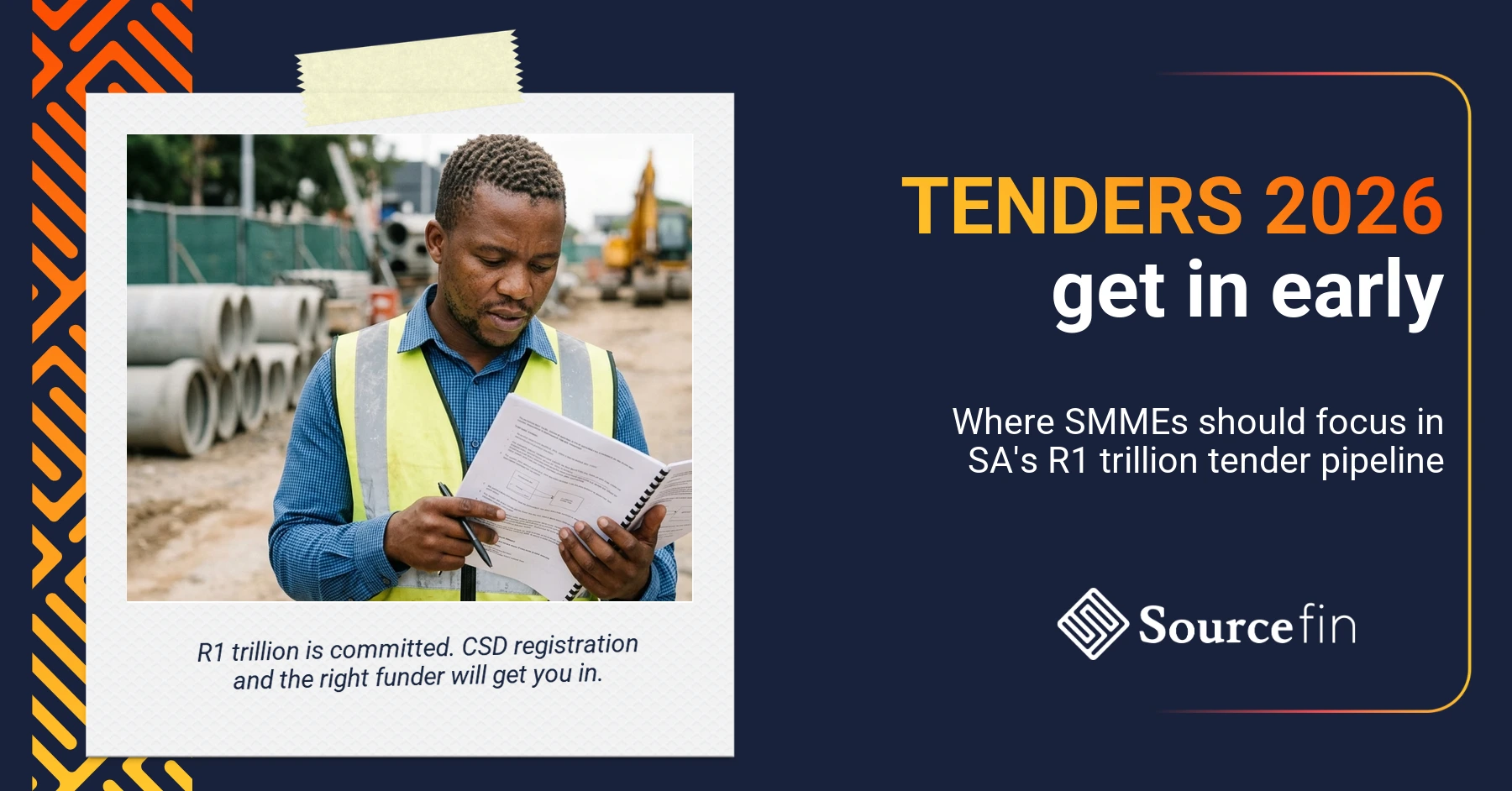

Government infrastructure tenders are the most significant opportunity for South African SMMEs in 2026. With R1 trillion committed to public infrastructure over the next three years, the pipeline is real, it is growing, and the sectors spending the most are precisely where SMME subcontracting and service delivery play a critical role.
Key Takeaways
- South Africa’s government has committed R1 trillion in public infrastructure spending over three years, with water, energy, transport, and digital infrastructure as priority sectors.
- R156 billion is specifically allocated to water and sanitation – the single largest opportunity area for SMMEs in construction, civil works, and infrastructure services.
- Operation Vulindlela Phase 2 is accelerating structural reforms across all four sectors, compressing delivery timelines and opening downstream SMME opportunities faster.
- Qualifying for government infrastructure tenders requires CSD registration, CIDB grading for construction work, B-BBEE compliance, and tax clearance – all of which take time to secure.
- The delivery gap is the most common reason SMMEs lose out: winning a tender without the capital to fund upfront materials and labour. Purchase order funding directly addresses this.
Government Infrastructure Tenders 2026: Where the R1 Trillion Is Going
President Ramaphosa’s SONA in February 2026 confirmed R1 trillion in public infrastructure investment over the next three years. This is committed budget, with delivery timelines and implementing agencies already named. National Treasury’s Budget Review sets out the spending in detail. (Source: The Small Business Site, 2026)
Government infrastructure tenders in 2026 break across four priority sectors. Water and sanitation carries R156 billion – the largest single allocation. A R54 billion metro incentive is built in to push urban municipalities to accelerate their own water projects. Energy infrastructure follows, covering Eskom rehabilitation, municipal grid upgrades, and procurement under the Renewable Energy Independent Power Producer Procurement Programme. Transport covers roads, rail rehabilitation, and port upgrades. Digital infrastructure – broadband and government connectivity – is the fourth and fastest-growing area.
For a detailed breakdown of the water opportunity, see: R156 billion for water infrastructure – how to win.
This spending flows through national departments, state-owned entities, metropolitan municipalities, and development finance institutions. That distribution matters for SMMEs – it means government infrastructure tenders are available across multiple procurement channels, not just a single central platform.
The Four Priority Sectors for SMME Tenders in 2026
Water and sanitation. The biggest opportunity area by volume. Contracts span civil construction, pipe installation, pump maintenance, water testing, and project management support. Many municipal projects are sub-R30 million in scale – well within reach for established SMMEs. The Operation Vulindlela Phase 2 reforms are specifically designed to accelerate water licensing and project approvals, so delivery pipelines in this sector are moving faster than in previous years.
Energy infrastructure. Eskom’s rehabilitation programme and municipal electricity grid upgrades create sustained demand for electrical contractors, civil works teams, and technical services SMMEs. The REIPPPP rounds carry formal SMME participation requirements – a set-aside mechanism that creates specific opportunities for qualifying businesses.
Transport. SANRAL and PRASA both have active contractor pipelines. Road rehabilitation, maintenance, and construction contracts at provincial level suit mid-tier SMMEs with CIDB grading and a proven delivery track record.
Digital infrastructure. Government’s broadband rollout and department-level IT modernisation are creating demand for connectivity services, hardware supply, and technical support. Entry requirements are often lighter than construction – no CIDB grading required – and individual contract values are manageable for smaller businesses.
What You Need to Qualify for Government Infrastructure Tenders
Before any tender document is completed, the compliance foundation has to be in place. For government infrastructure tenders, that means:
- CSD registration. The Central Supplier Database is the government’s supplier verification system. Without an active registration, you cannot be awarded any government contract. Registration is free and done online. Full details: CSD registration for suppliers.
- CIDB grading. For construction and civil works contracts, your Construction Industry Development Board grading determines which contract values you can bid on. Grading is based on financial capacity and track record – it takes time to build, so start now if you have not already.
- Tax clearance. An active SARS Tax Compliance Status pin is required for any government contract. It must be current at time of award, not just at time of bid submission.
- B-BBEE compliance. Most government tenders apply the 80/20 or 90/10 preference points system. A valid B-BBEE certificate adds points to your bid score – black-owned businesses at Level 1 or 2 are strongly positioned.
For a comprehensive guide to the full tender process, see Tendering in South Africa: Complete Guide.

The Cash Flow Gap: Why Winning a Tender Is Not Enough
Many capable SMMEs win government infrastructure tenders and then cannot deliver. The reason is almost always cash flow, not competence.
Government payment terms of 30 to 90 days are standard. On a R500,000 construction contract, you may need to purchase materials, pay labour, and cover site costs before the first invoice is even submitted – then wait up to 90 days for payment. That gap is where most SMME delivery failures happen. For a detailed breakdown of what this means in practice, read our guide on government tender payment terms.
The businesses that succeed in the government tender space are not necessarily the most technically capable. They are the ones with access to delivery capital. That is the real competitive advantage in the 2026 infrastructure pipeline.
Purchase Order Funding for Government Contract Delivery
Purchase order funding is designed specifically for this problem. When you hold a confirmed government contract, a funding partner advances the capital to buy materials, pay suppliers, and cover direct costs. When the government entity pays on completion, the funder recovers the advance and you retain your margin. For a wider view of purchase order funding for South African contractors, the pillar guide covers eligibility, timelines, and structure.
This is not traditional debt. There is no long-term liability building on your balance sheet. The funding is tied directly to the contract – it exists for the delivery cycle and closes when payment arrives. You are using your confirmed government work as the funding instrument.
At Sourcefin, we assess three things: the quality of the contract, your ability to deliver, and your character as a business owner. We do not require an extensive credit history. If the deal is solid, the funding follows. Find out how purchase order funding works, or apply directly and we will assess your situation.
The R1 trillion infrastructure pipeline is a genuine opportunity for South African SMMEs. The question is not whether the work is there – it is whether your business is positioned to take it and funded to deliver it. For the broader view on what this spending cycle means for SMME planning, read our pillar on the SA economic outlook and government opportunity for SMMEs.
Sources & References
The Small Business Site. “R1 trillion was announced. Most small businesses will see none of it. Here’s how to change that.” 2026. thesmallbusinesssite.co.za
National Treasury. 2026 Budget Review – Infrastructure and Investment. February 2026. treasury.gov.za
Frequently Asked Questions
What are the biggest government infrastructure tender opportunities for SMMEs in 2026?
The four priority sectors are water and sanitation (R156 billion allocated), energy infrastructure including Eskom rehabilitation and REIPPPP procurement, transport covering roads and rail rehabilitation, and digital infrastructure including broadband rollout. Water is the largest single opportunity area, with many municipal contracts sub-R30 million and well within reach of established SMMEs.
Do I need CIDB grading to bid for government infrastructure tenders?
CIDB grading is required for construction and civil works contracts. Your grading level determines which contract values you are eligible to bid on. It is based on your financial capacity and track record of delivery, so it takes time to build. Digital infrastructure and some service contracts do not require CIDB grading, making them accessible to a wider range of SMMEs.
How do I register for government tenders in South Africa?
The starting point is the Central Supplier Database (CSD), the government’s supplier verification system. Registration is free and done online at the National Treasury supplier portal. You will also need a valid SARS Tax Compliance Status pin, a B-BBEE certificate, and for construction work, CIDB grading. All of these must be active and current at the time your bid is evaluated.
What is the cash flow problem with government tenders and how can SMMEs solve it?
Government payment terms of 30 to 90 days mean SMMEs often need to fund materials, labour, and site costs upfront before receiving any payment. This delivery gap is the most common reason capable SMMEs fail to complete contracts they have won. Purchase order funding addresses this directly – a funder advances the delivery capital and recovers it when the government entity pays the invoice.
What is purchase order funding and how does it work for government contracts?
Purchase order funding is an asset-backed funding mechanism where a funder advances capital to cover the cost of delivering a confirmed contract. For government contracts, this means materials, labour, and direct costs are covered from day one of delivery. When the government entity pays the invoice on completion, the funder recovers the advance and you retain your margin. No long-term debt is created on your balance sheet.
Which departments and entities have the most infrastructure tenders for SMMEs in 2026?
The Department of Water and Sanitation and metropolitan municipalities carry the largest water infrastructure pipeline. SANRAL manages the roads contractor pipeline. PRASA has rail rehabilitation contracts. Eskom and municipal utilities manage energy infrastructure procurement. For digital infrastructure, the Department of Communications and Digital Technologies manages the broadband rollout programme.