
Purchase Order Funding for Women-Owned SMMEs: SA Smart Guide
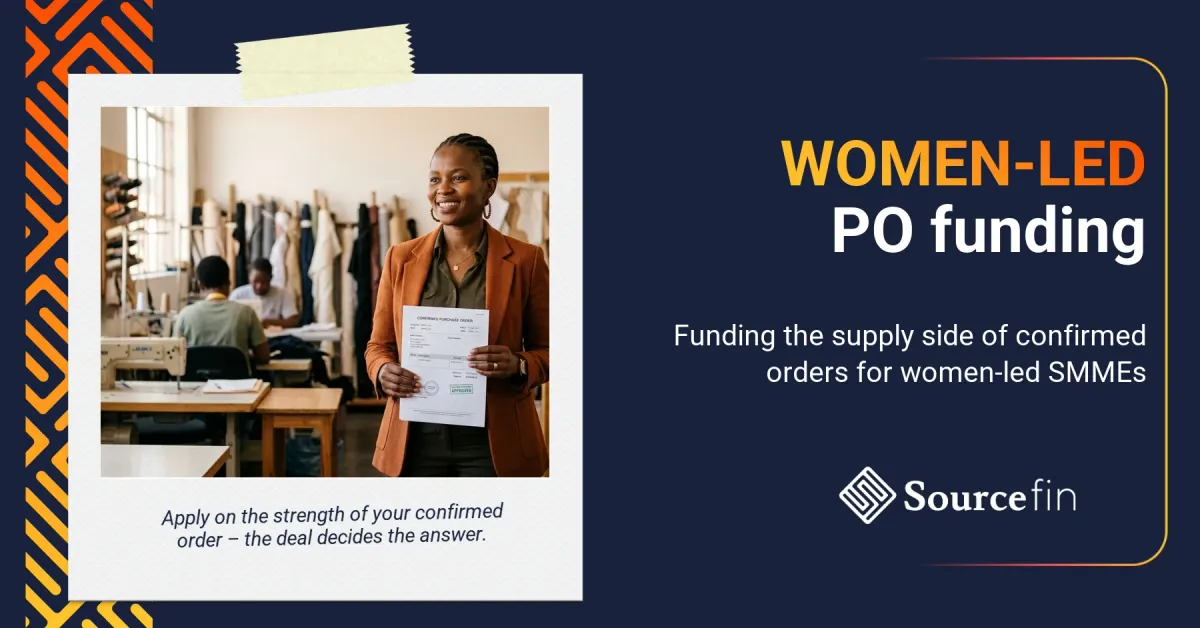
Purchase order funding for women-owned businesses in South Africa. How Sourcefin funds the supply side of confirmed orders for women-led SMMEs.
On this page
- Key Takeaways
- How purchase order funding for women-owned businesses works in practice
- Why women-owned status helps SMMEs win the work in the first place
- The four questions Sourcefin asks – the same for every SMME
- Sectors where Sourcefin funds women-owned SMMEs
- What documents Sourcefin needs for purchase order funding for women-owned businesses
- How to apply for purchase order funding for women-owned businesses
- Frequently asked questions
Purchase order funding for women-owned businesses in South Africa works on exactly the same deal-by-deal model Sourcefin applies to every SMME. Sourcefin assesses the confirmed order, the customer's payment credibility, the supplier path, and the operational capacity to deliver. Where those four are in place, the deal is fundable – regardless of ownership demographics. The result is a funding model that opens the door for women-led SMMEs to take on confirmed orders they could not previously fulfil from their own working capital.
Key Takeaways
- Purchase order funding for women-owned businesses is assessed on the same four practical questions as any other deal: confirmed order, credible customer, fundable supplier path, and operational capacity.
- Sourcefin's funding model is deal-based, not gender-based or credit-score-based – no preferential criteria are applied, and none are needed.
- Women-owned status frequently strengthens an SMME's ability to win the tender or corporate contract in the first place via B-BBEE preferential procurement – which Sourcefin then funds.
- Sourcefin has deployed more than R3 billion to South African SMMEs since 2020 across women-led, men-led, and joint-ownership businesses.
- Apply at the funding application page – the assessment is the same model regardless of who owns the business.
How purchase order funding for women-owned businesses works in practice
A women-owned SMME wins a confirmed purchase order. The supplier needs an upfront deposit. The customer pays on 30, 60, or 90-day terms. The cash flow gap between paying the supplier and being paid by the customer is the constraint. Purchase order funding closes that gap.
Sourcefin's specialists assess the deal on four practical questions: is the order confirmed and verifiable, is the customer credible, is there a clear supplier path, and does the SMME have the operational capacity to deliver? When those four line up, Sourcefin pays the supplier directly. The SMME produces or sources and delivers. The customer pays. Sourcefin is repaid from that payment. The SMME retains its margin and its own working capital stays free for payroll and overheads.
That assessment is identical for women-owned, men-owned, joint-ownership, and youth-owned businesses. The deal does the talking.

Why women-owned status helps SMMEs win the work in the first place
South Africa's Broad-Based Black Economic Empowerment (B-BBEE) framework gives buyers preferential procurement recognition for spending with women-owned and black-women-owned SMMEs. That recognition translates into procurement preference points on tenders and corporate enterprise development scorecards. The result: women-led SMMEs frequently sit in a strong position to win confirmed work, particularly in the public sector and within corporate supplier development programmes.
The strategic challenge is converting that opportunity into delivered orders. Winning the tender is one thing. Funding the production, the suppliers, and the delivery is another. This is where purchase order funding for women-owned businesses fits.
For the formal framework and current recognition criteria, the Department of Trade, Industry and Competition publishes the B-BBEE codes and recognition framework.
The four questions Sourcefin asks – the same for every SMME
Sourcefin's open-minded purchase order funding model assesses every deal on these four practical questions:
- Is the purchase order confirmed and verifiable with the issuing customer? Verified orders from credible buyers are the foundation of every funded deal.
- Is the customer credible and able to pay on the agreed terms? Government departments, large corporates, and established private-sector buyers typically present a clear credibility picture.
- Is there a clear supplier path Sourcefin can fund directly? Sourcefin pays suppliers rather than advancing cash to the business – clean supplier documentation and verifiable suppliers matter.
- Does the business have the operational capacity to deliver? Can the SMME produce or source and deliver to spec, on time? Capacity is assessed against the specific order.
When those four are in place, the deal is generally fundable. No preferential criteria are layered on top for women-owned businesses – and none are needed. The model is open-minded by design.
Sectors where Sourcefin funds women-owned SMMEs
Sourcefin has funded women-owned SMMEs across manufacturing, construction and civils, professional services, ICT and telecoms, security services, cleaning and facilities, logistics, agriculture, and the wider supplier base. The industries that fit purchase order funding best are those with project-based work – where a confirmed order or awarded contract sits between winning the work and getting paid.
For sector-specific eligibility detail, see Who Qualifies for Purchase Order Funding in South Africa. For the specific case of government tenders, see Purchase Order Funding for Government Tenders.
What documents Sourcefin needs for purchase order funding for women-owned businesses
The core documents Sourcefin needs are the same regardless of ownership demographics:
- Business registration documents (CIPC)
- Proof of business address and bank account
- The confirmed purchase order or contract
- Supplier quotation(s)
- ID for the company directors
Where the SMME also wants to demonstrate B-BBEE status to the customer (separately to the funding application), a current B-BBEE certificate or affidavit is the supporting document. That is for the customer's procurement file, not for Sourcefin's funding assessment.
How to apply for purchase order funding for women-owned businesses
The application is direct:
- Open the funding application page and complete the online form.
- Have the confirmed purchase order, supplier quotations, and basic business documents ready to upload.
- Sourcefin's deal team will be in touch to discuss the order and walk through the assessment.
For broader context on the SA SMME funding landscape, the Department of Small Business Development publishes SA small-business policy and reporting, and the IFC SME Finance Forum publishes the global MSME Finance Gap database covering emerging markets.
For South African women-led SMMEs holding confirmed orders and ready to deliver, purchase order funding for women-owned businesses is the model designed for that exact moment – on the same deal-based terms as every other Sourcefin-funded SMME.
Sources & References
- Department of Trade, Industry and Competition – South African B-BBEE codes and recognition framework.
- Department of Small Business Development – SA small-business policy and reporting.
- IFC SME Finance Forum – Global MSME Finance Gap database, World Bank Group.
Frequently asked questions
Is purchase order funding for women-owned businesses different to standard PO funding?
No. Sourcefin's purchase order funding model is gender-neutral by design. The same four practical questions apply to every deal: is the order confirmed and verifiable, is the customer credible, is there a clear supplier path, and does the SMME have the capacity to deliver. Women-owned businesses access the same product on the same terms as any other SMME.
Does Sourcefin offer preferential terms for women-owned SMMEs?
No. The funding model is open-minded by design rather than preferential. Sourcefin assesses the specific deal on its merits, not on the demographics of the owner. The advantage women-owned SMMEs typically hold is on the procurement side – B-BBEE recognition can help win the tender or contract in the first place, which Sourcefin then funds.
Can a startup women-owned business access purchase order funding?
Yes. Sourcefin funds startups and first-time PO holders regularly. Trading history is not the gating question – the four-question deal assessment is. Where the order is confirmed, the customer is credible, the supplier path is fundable, and the SMME has the operational capacity to deliver, startups qualify on the same basis as established businesses.
Do I need a B-BBEE certificate to apply for PO funding?
Not for the Sourcefin funding application itself. B-BBEE documentation is what the customer's procurement team needs to award the order to a women-owned supplier in the first place. Once you hold a confirmed order, Sourcefin's funding assessment focuses on the four practical questions above, not on the B-BBEE status of the business.
What documents do I need to apply for purchase order funding for women-owned businesses?
Business registration documents (CIPC), proof of business address and bank account, the confirmed purchase order or contract, supplier quotation(s), and ID for the company directors. Where you also want to demonstrate B-BBEE status separately to your customer, a current B-BBEE certificate or affidavit is the supporting document.
Which sectors does Sourcefin fund for women-owned SMMEs?
Sourcefin has funded women-owned SMMEs across manufacturing, construction and civils, professional services, ICT and telecoms, security services, cleaning and facilities, logistics, agriculture, and many other sectors. The industries that benefit most are those with project-based work – where a confirmed order sits between winning the work and getting paid.

Sourcefin is a South African alternative finance provider that offers purchase order funding and invoice discounting to SMMEs, enabling businesses to fulfil confirmed purchase orders or tenders and unlock cash flow without collateral. Unlike traditional lenders or banks, Sourcefin also provides end-to-end support including supplier sourcing, logistics, project management, and risk oversight.