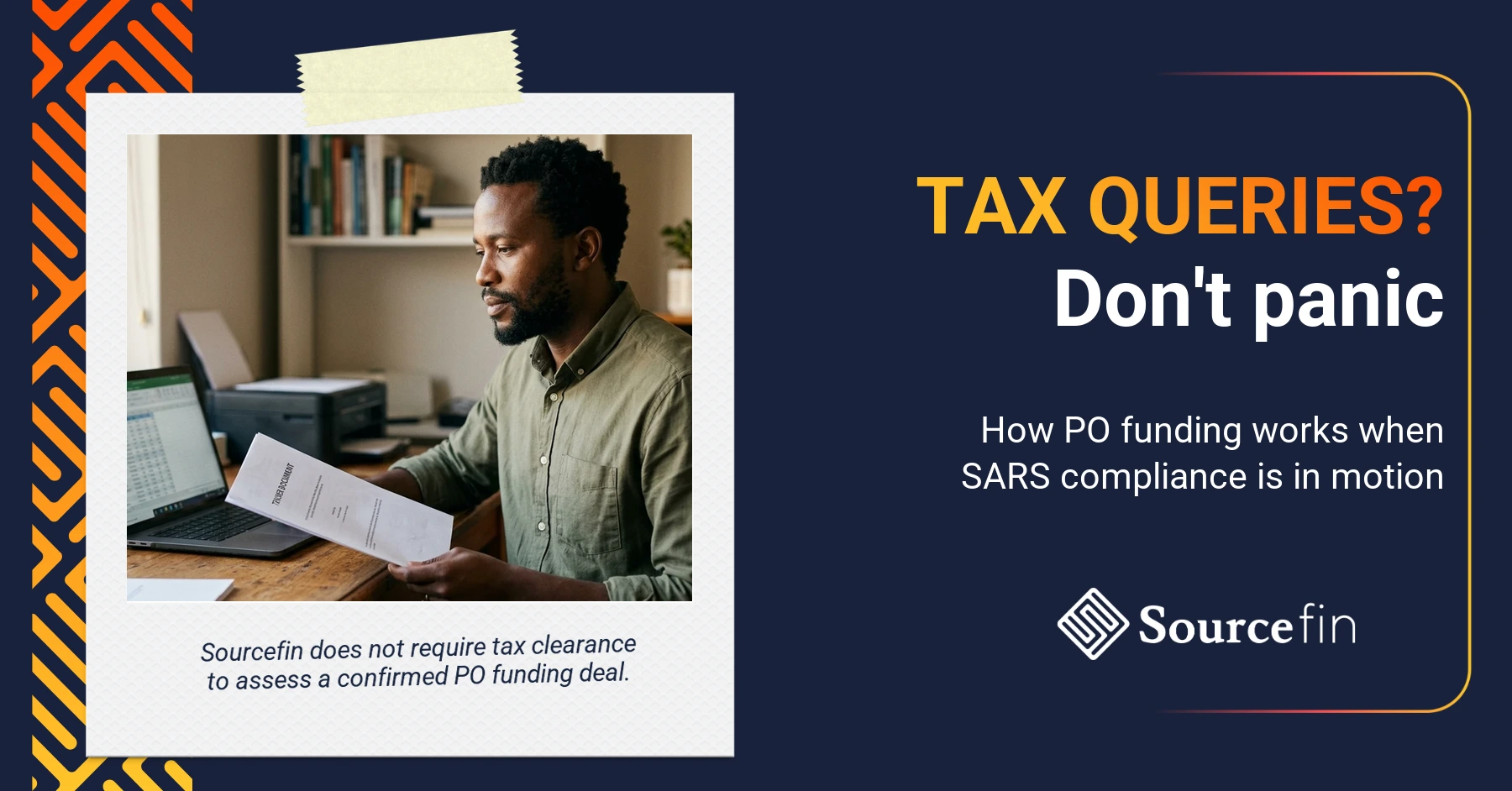

Purchase order funding without tax clearance is a regular reality for South African SMMEs working through SARS arrears, an active compromise arrangement, or a procurement process that has not yet asked for compliance status. The honest answer: Sourcefin does not require a tax clearance certificate to assess or fund a confirmed PO funding deal. Tax clearance is typically a customer-side procurement requirement, not a Sourcefin funding requirement. The two are distinct, and SMMEs benefit from treating them as separate workstreams.
Key Takeaways
- Sourcefin’s PO funding model does not require a SARS tax clearance certificate as a precondition for assessing a deal.
- Tax clearance is typically requested by the customer’s procurement process (especially organs of state), not by Sourcefin.
- SMMEs working through SARS arrears or compromise arrangements can still have a confirmed PO funding deal assessed and funded.
- Tax compliance with SARS remains the SMME’s separate responsibility – this article does not advise on SARS disputes.
- Apply at the funding application page with the confirmed PO and supplier quotation in hand.
The two-track reality of tax clearance and PO funding
South African SMMEs often conflate two separate workstreams when thinking about tax clearance and purchase order funding:
- Track 1 – the customer’s procurement process. Many customers, particularly organs of state under PFMA prescripts and some large corporates, require a current Tax Compliance Status (TCS) PIN from SARS as part of their procurement onboarding. This is between the SMME and the customer.
- Track 2 – Sourcefin’s funding assessment. Sourcefin assesses the confirmed PO funding deal on the four practical questions: PO confirmed, customer credible, supplier path fundable, capacity to deliver. Tax clearance is not one of those four. It is not a Sourcefin funding requirement.
Treating these as two distinct workstreams clarifies what is actually blocking a deal. Where the constraint is Track 1, the path forward involves SARS. Where the constraint is funding the supply side, Sourcefin can assess the deal in parallel.
Why Sourcefin does not require tax clearance to assess a deal
The structural reason is the deal-based assessment model. Sourcefin’s open-minded funding model is built around the specific deal, not a generic compliance gate. Tax clearance does not directly answer any of the four practical questions Sourcefin asks:
- Is the purchase order confirmed and verifiable? Tax clearance does not affect this.
- Is the customer credible? Tax clearance is about the SMME’s compliance, not the customer’s credibility.
- Is the supplier path fundable? Tax clearance does not change the supplier path.
- Does the SMME have capacity to deliver? Tax clearance does not bear on operational capacity to deliver the specific order.
Where the customer has already required a TCS PIN for procurement onboarding, the SMME presumably has one in hand by the time the PO is issued. Where the customer has not asked, Sourcefin does not impose an additional gate.

When tax clearance is genuinely the blocker
Where the customer’s procurement process requires a current TCS PIN and the SMME does not have one, the constraint sits with the customer, not Sourcefin. The path forward typically involves:
- Checking current compliance status with SARS directly. The SARS eFiling portal allows registered representatives to request a TCS PIN. Where the status is non-compliant, the underlying issue (outstanding returns, arrears, registration gaps) needs to be addressed at source.
- Engaging SARS on arrears. SARS publishes guidance on payment arrangements, compromise applications, and dispute resolution. Where arrears exist, an active and documented engagement with SARS is often part of getting compliant.
- Using a registered tax practitioner. For SMMEs without internal tax expertise, a registered tax practitioner can assess the position and work through the options. This article does not substitute for that advice.
For tender-specific tax clearance context, see Tax Clearance Certificate for Tenders.
What about SARS arrears or active compromise arrangements?
SMMEs working through SARS arrears or an active compromise arrangement sometimes assume this disqualifies them from PO funding. It does not. Sourcefin’s assessment is on the deal in front of the SMME, not on the SMME’s SARS history. Where the customer’s procurement process accepts the SMME’s current compliance position (or does not require tax clearance at all – many private-sector corporate customers do not), the PO is fundable on the same four-question basis as any other deal.
This is one of the structural differences between Sourcefin’s deal-based PO funding and traditional bank lending. Banks are built for stability and conservative balance-sheet assessment. Sourcefin is built for speed and deal-level assessment. Both models have their place – they are built for different purposes.
Setting expectations: typical PO funding deal sizes
Alongside the tax-clearance question, first-time applicants often want to know what deal sizes Sourcefin typically funds. In practice, most Sourcefin-funded deals – across purchase order funding and invoice discounting – start at around R250,000. Deals below that level are sometimes funded where the deal structure is particularly clean and the customer is highly credible, but below R200,000 is rare. The reason is operational: the assessment, supplier engagement, and fulfilment support per deal is meaningfully heavier than a traditional unsecured lender’s process. Smaller deals can be done where the effort-to-deal-size economics work for both sides.
For SMMEs sitting with a confirmed PO above R250,000 and a tax-clearance constraint, the deal can usually be assessed by Sourcefin while SARS work runs in parallel. For smaller orders, other tools may fit better. For more on what governs deal viability across different deal sizes, see Purchase Order Funding Minimum Amount.
Documents Sourcefin actually needs for the application
The core PO funding documents required for the Sourcefin application are practical and focused on the deal:
- CIPC business registration documents
- Proof of business address and bank account
- The confirmed purchase order or contract
- Supplier quotation(s)
- ID for the company directors
Tax clearance is not on the core list. Where the customer has supplied a copy as part of the procurement documentation, including it in the application pack is helpful context but it is not what Sourcefin is gating against. For the full eligibility view, see Purchase Order Funding Requirements in South Africa.
Common scenarios where SMMEs ask about tax clearance
- “I have just won a private-sector PO and the customer did not ask for tax clearance.” Sourcefin can assess the deal. Whether to also pursue current SARS compliance is a separate question for the SMME’s broader business hygiene.
- “I won an organ-of-state tender and the customer requires a TCS PIN, but I am working through SARS arrears.” The Sourcefin assessment can run in parallel with the SARS engagement. Some SMMEs sequence the SARS work first; others apply for PO funding while SARS work is in motion.
- “My TCS PIN expired and I cannot get it renewed in time.” The renewal is between the SMME and SARS. Sourcefin can engage on the deal but the SMME still needs the TCS PIN to satisfy the customer’s procurement process.
The pattern across all three scenarios is the same: Sourcefin assesses the deal; the SMME handles SARS compliance separately.
The bottom line on purchase order funding without tax clearance
For South African SMMEs working through tax clearance constraints, the practical message is straightforward: Sourcefin’s deal-based assessment is not gated by SARS compliance. The customer’s procurement process may be, and that is the constraint to engage with separately. To assess a specific confirmed PO, apply at the funding application page. For the full PO funding product, see Purchase Order Funding. For broader product context, A quick guide to purchase order funding covers the basics.
For SARS compliance guidance, the South African Revenue Service publishes Tax Compliance Status guidance, the National Treasury publishes PFMA prescripts governing organs of state procurement, and the Department of Small Business Development publishes SA small-business policy.
Sources & References
- South African Revenue Service – Tax Compliance Status guidance and SMME tax obligations.
- National Treasury – PFMA prescripts and organs of state procurement.
- Department of Small Business Development – SA small-business policy and reporting.
Frequently Asked Questions
Does Sourcefin require a tax clearance certificate for purchase order funding?
No. Sourcefin’s deal-based assessment is not gated by SARS tax clearance. The four practical questions Sourcefin asks – PO confirmed, customer credible, supplier path fundable, and capacity to deliver – do not include tax clearance. Tax clearance is typically requested by the customer’s procurement process, not by Sourcefin as the funder.
Can I get PO funding while I am dealing with SARS arrears?
Yes, the Sourcefin assessment is on the deal in front of the SMME, not on SARS history. Where the customer’s procurement process accepts your current compliance position, or does not require tax clearance, the PO is fundable on the same four-question basis as any other deal. SARS compliance remains the SMME’s separate workstream to manage with SARS directly.
What if the customer requires tax clearance and I do not have one?
That constraint sits with the customer’s procurement process, not with Sourcefin. The path forward is to engage SARS directly to address the underlying compliance issue – outstanding returns, arrears, or registration gaps – and obtain a current Tax Compliance Status PIN. A registered tax practitioner can assist where internal tax expertise is limited. Sourcefin can assess the deal in parallel while that work is in motion.
Do private-sector customers typically require tax clearance?
It varies. Many corporate customers do require a current TCS PIN as part of their supplier onboarding, but the requirement is not as universal as for organs of state under PFMA prescripts. Check the specific customer’s procurement requirements. Where tax clearance is not required by the customer, it is not required at all for the deal to proceed – Sourcefin does not add it as a separate gate.
Is Sourcefin’s PO funding the same as a loan against my business?
No. Sourcefin’s PO funding is a deal-based transaction, not a loan. Sourcefin pays the supplier directly for the goods or services needed to fulfil a specific confirmed order. The customer pays the SMME on the agreed terms after delivery, and Sourcefin is repaid from that payment. The structure does not put the SMME’s balance sheet at risk in the way a traditional business loan does.
Where can I get help with SARS tax clearance issues?
Engage SARS directly through the eFiling portal, or work with a registered tax practitioner. SARS publishes guidance on Tax Compliance Status, payment arrangements, and compromise applications. This article does not substitute for tax advice – a qualified practitioner is the right place to assess your specific position and work through the available options.
What deal size does Sourcefin typically fund?
In practice, most Sourcefin-funded deals – across purchase order funding and invoice discounting – start at around R250,000. Deals below that level are sometimes funded where the structure is particularly clean and the customer is highly credible, but below R200,000 is rare. The reason is operational: the assessment and fulfilment effort per deal is heavier than a traditional unsecured lender’s process. Smaller orders may be better served by other tools.