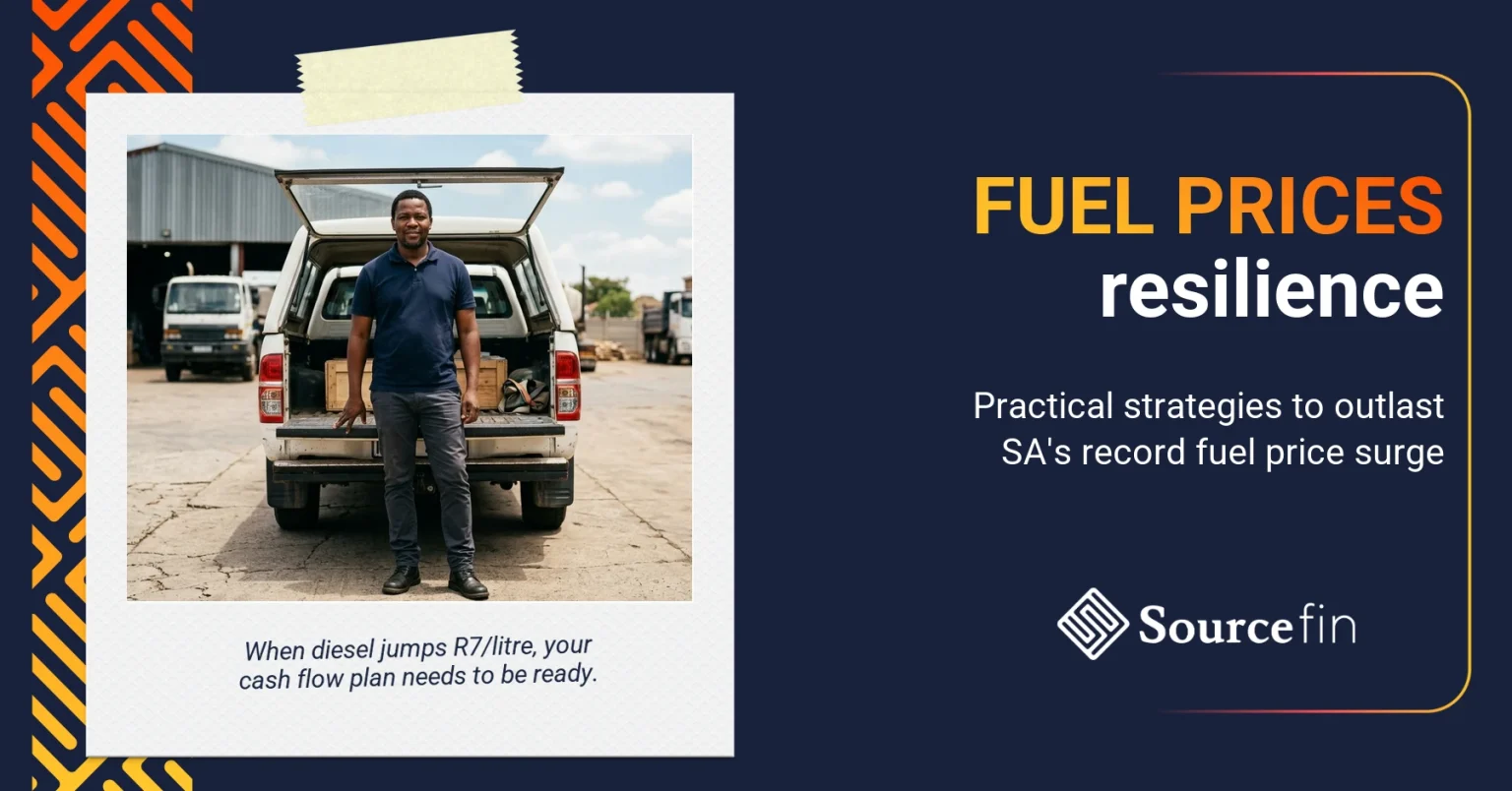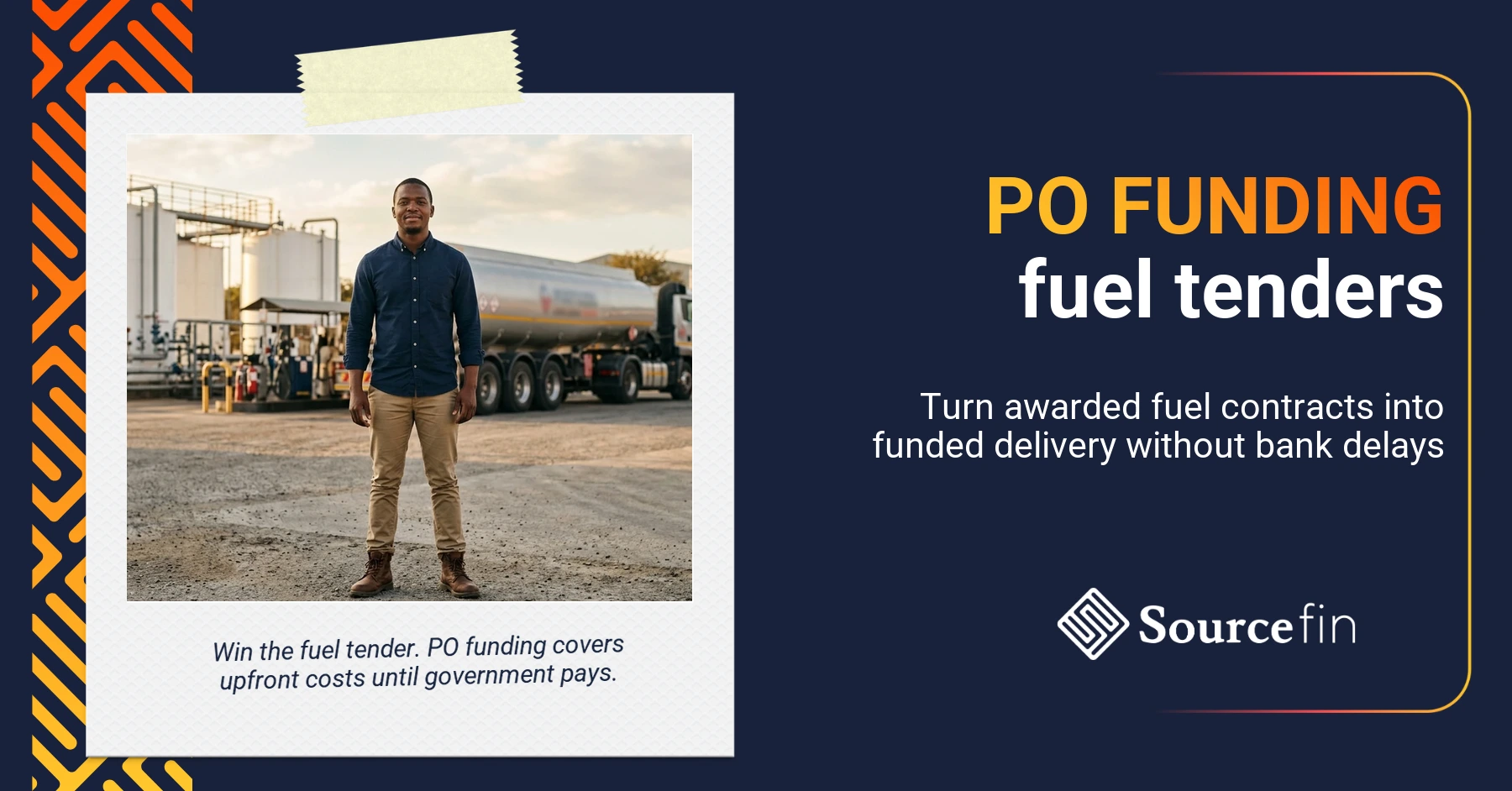

Purchase order funding fuel tenders South Africa provides upfront execution capital when government awards you a fuel supply contract but you lack resources to purchase diesel inventory before delivery. Alternative funders evaluate the contract itself – providing 48 to 72 hour funding approvals based on government’s ability to pay rather than your credit history. During April 2026’s R7+ diesel price increases, PO funding bridges the gap between winning fixed-price tenders and executing delivery at volatile procurement costs.
You submitted your fuel tender bid in February when diesel was R18 per litre. Your pricing reflected R18 procurement costs plus reasonable margin. March brought the contract award – government selected your bid, issued the purchase order, and confirmed delivery schedule. This should be celebration. Except March also brought geopolitical crisis in the Middle East, Strait of Hormuz disruption, and April diesel prices jumping to R26 per litre.
Now you’re holding a R500,000 government fuel contract priced at February’s R18 diesel costs, but you need to purchase inventory at April’s R26 pricing to execute delivery. The math doesn’t work. Your margin evaporated. Worse, you don’t have R300,000 to purchase the inventory even if you wanted to execute at a loss just to honour the contract and maintain government relationships.
Purchase order funding fuel tenders South Africa addresses both problems simultaneously. It provides execution capital you lack whilst giving you strategic timing options that help manage the diesel price volatility destroying your tender economics. Understanding how PO funding works differently from bank loans and when it makes strategic sense separates businesses that execute awarded tenders successfully from those that win contracts but can’t deliver.
The Fuel Tender Execution Gap
Fuel tenders create a predictable cash flow timing problem even during stable diesel pricing. You bid on contracts weeks or months before execution. Government evaluates submissions, awards contracts, and issues purchase orders. You purchase diesel inventory, arrange delivery logistics, and execute the contract. Government receives delivery, processes invoices through their payment systems, and eventually pays you 30 to 60 days after delivery completion.
From your perspective: purchase inventory today (R300,000 cash outlay), deliver fuel next week, invoice government, wait 45 days for payment. You’ve funded government’s fuel needs for 45+ days using your working capital. If you have R300,000 sitting available, this works. Most emerging SMMEs pursuing government fuel tenders don’t have that capital readily available. That’s precisely the gap that purchase order funding fuel tenders South Africa is designed to fill.
April 2026’s diesel crisis amplified this challenge exponentially. Businesses that submitted February tenders based on R18 diesel pricing faced April procurement costs 44% higher. Even businesses with execution capital available questioned whether to honour fixed-price contracts at massive losses or attempt renegotiation that might damage government relationships and future tender prospects.
Purchase order funding solves the capital availability problem. It doesn’t solve the pricing problem – if your tender pricing is unsustainable given current diesel costs, funding won’t magically restore margin. But it does give you execution options and timing flexibility that pure bank loan approaches don’t provide.
How Purchase Order Funding Fuel Tenders South Africa Works
The mechanics differ fundamentally from bank lending. When you win a government fuel tender and receive the purchase order, you submit that PO to alternative funders along with supplier quotations showing diesel procurement costs and delivery logistics expenses. The funder evaluates the contract viability – is the tender pricing sufficient to cover procurement costs, delivery expenses, and repayment after government pays?
If viable, the funder advances capital to execute the contract. Some funders provide 100% of procurement costs. Others advance 80% to 90% depending on margin structure. You use funded capital to purchase diesel inventory from fuel suppliers, arrange transport to government delivery points, and complete the contracted supply. Government receives delivery, you submit invoices, and government processes payment through their standard 30 to 60 day cycles.
When government pays the R500,000 invoice, repayment flows to the funder who deducts their advance plus fees, then releases any remaining balance to you. Your profit comes from the margin between tender pricing and actual execution costs including funding fees. The key insight: funding fees become a cost component in your tender economics, not a separate financing burden you manage independently.
Approval timelines run 48 to 72 hours for qualifying contracts, dramatically faster than traditional bank loan processes requiring weeks of credit assessment, collateral evaluation, and committee approvals. Speed matters when diesel prices move R7 per litre in a month – the difference between submitting for funding Monday and receiving capital Wednesday versus waiting three weeks for bank approval could represent another R2 per litre diesel increase.
PO Funding vs Bank Loans vs Invoice Discounting
Understanding when each funding type makes sense prevents applying the wrong tool to your specific situation. Bank loans assess your creditworthiness, require collateral or guarantees, and provide general-purpose capital you deploy however you choose. You repay from business cash flow regardless of whether specific contracts succeed. This works when you have established credit history, available collateral, and diversified revenue that can service debt even if individual contracts underperform.
Purchase order funding assesses contract viability rather than your credit history. The government contract itself provides security. Repayment comes from contract proceeds, not general business cash flow. This works when you have strong contracts but limited track record, insufficient collateral, or need contract-specific capital that doesn’t burden overall business debt capacity.
Invoice discounting accelerates payment on work already completed. You’ve executed the tender using your own capital, delivered fuel to government, and issued invoices. Invoice discounting converts those unpaid invoices into immediate working capital rather than waiting 30 to 60 days for government payment. This works when you have execution capital available but need faster cash conversion to maintain operations or pursue additional contracts whilst waiting for payment.
For fuel tenders specifically: use PO funding when you lack execution capital upfront. Use invoice discounting when you’ve funded execution yourself but need to accelerate the payment cycle. Use bank loans when you need general working capital not tied to specific contracts and have the creditworthiness and collateral banks require.
What Fuel Tender Contracts Qualify
Not every awarded tender qualifies for purchase order funding. Funders evaluate contracts against specific criteria that determine viability and risk. The issuing entity matters significantly. National government departments, provincial administrations, municipalities, and state-owned enterprises generally qualify because their payment reliability is strong despite occasional processing delays. Established private corporates with strong creditworthiness also qualify. Smaller private entities or new companies without payment history face more scrutiny.
Contract pricing must support execution costs plus funding fees whilst leaving sustainable margin. If your tender pricing is R500,000 but diesel procurement costs R480,000 and logistics add R30,000, the R510,000 total execution cost exceeds contract value before funding fees. This doesn’t qualify – the economics don’t work regardless of funding availability. Funders need margin buffer that accommodates their fees whilst leaving you profitable enough to make contract execution worthwhile.
Delivery timelines typically can’t exceed 60 to 90 days. Funders advance capital based on expectation that government payment arrives within standard cycles. Multi-year contracts or phased deliveries extending beyond quarterly windows create repayment timing uncertainty that most PO funders avoid. You can potentially structure longer contracts as sequential PO funding tranches, but the initial contract structure needs reasonable completion timelines.
Fuel tenders specifically work well for PO funding because diesel procurement from established suppliers is straightforward, delivery logistics are manageable, and government fuel needs are genuine operational requirements rather than discretionary purchases that might get cancelled. The combination of strong buyer creditworthiness, clear procurement path, and essential product category makes purchase order funding fuel tenders South Africa one of the more accessible entry points for emerging SMME suppliers.
The Execution Partnership Model
Sourcefin’s approach to purchase order funding fuel tenders South Africa goes beyond transactional capital provision. We structure funding as execution partnerships where our success depends on your successful delivery. This alignment creates value beyond the capital itself.
Supplier negotiation support matters during volatile diesel markets. When prices spike R7 per litre in a month, fuel suppliers become selective about extending credit or holding inventory for pending contracts. Having a funder involved who can guarantee supplier payment immediately often secures better pricing, priority allocation, and delivery reliability that standalone SMMEs struggle to access.
Logistics coordination becomes critical when government delivery schedules are tight and diesel availability faces supply constraints like April 2026’s panic buying period. Partnership models that provide operational support alongside capital increase successful completion rates. Your business gets the contract delivered. Government receives their fuel supply. The funder gets repaid. Everyone benefits from execution success.
This contrasts with pure capital providers who advance funds then step back. If execution challenges emerge – supplier delays, logistics bottlenecks, government delivery point access issues – you’re managing solo. Partnership models maintain engagement through delivery completion because the funder’s repayment depends on successful execution just as much as your profit does.
Diesel Price Volatility and Contract Timing
April 2026’s fuel crisis highlighted timing risks in fixed-price tender pricing. Businesses that submitted bids in February faced dramatically different execution economics by April. Fuel cost increases cascade through every aspect of contract execution – procurement costs jump, transport costs increase, and margins compress or disappear entirely.
Purchase order funding creates strategic timing options that help manage this volatility. When you know diesel prices are forecast to increase but you’ve won a tender at current pricing, PO funding lets you purchase inventory immediately rather than waiting until delivery dates approach. You lock in procurement costs at today’s pricing using funded capital, store inventory if necessary, and execute delivery at locked-in costs regardless of where diesel prices move by delivery date.
This assumes your tender includes pricing sufficient to absorb funding fees plus any storage or inventory carrying costs. The calculation: does locking in current diesel pricing through early procurement funded by PO funding cost less than risking higher diesel prices at delivery time? When forecasts show R5+ per litre increases coming and your funding fees represent R1 to R2 per litre equivalent cost, early procurement makes economic sense.
The inverse also applies. When diesel prices are forecast to moderate or government levy relief might extend, delaying procurement whilst using PO funding for execution capital gives you flexibility to purchase at potentially better pricing closer to delivery dates. The funding provides execution certainty whilst preserving tactical procurement timing options.
Calculating Sustainable Tender Pricing
The April 2026 fuel crisis taught businesses a critical lesson: tender pricing must incorporate volatility buffers and funding cost assumptions, not just current procurement costs plus target margin. Sophisticated tender pricing for fuel contracts now includes diesel price movement scenarios, funding fee structures, and contingency margins that protect against the kind of R7+ spikes that destroyed February tender economics.
Start with current diesel wholesale pricing as baseline. Add realistic volatility buffer based on recent price movement patterns – if diesel moved R7 in one month, your pricing should assume potential R3 to R5 movement during contract execution period. Include logistics costs with similar volatility buffers given freight surcharges typically implement within 2 to 4 weeks of diesel increases. See our article on how fuel price increases affect South African businesses for a fuller picture of the flow-on costs.
Factor purchase order funding fees as an execution cost component if you know you’ll need funding. Government tenders allow businesses to include legitimate financing costs in pricing. Better to price contracts assuming a funding requirement and end up not needing it than to price without funding costs and discover execution requires funding that erodes all profit.
Build minimum acceptable margin thresholds that remain viable even after funding fees and volatility buffers. If your target is 15% gross margin on fuel tenders, structure pricing to preserve 15% after funding costs and anticipated diesel movement. This might mean higher tender pricing that reduces win rates, but winning unprofitable contracts doesn’t build sustainable business.
Strategic PO Funding Application
Purchase order funding fuel tenders South Africa works best as part of an integrated tender strategy rather than emergency scrambling after contract awards. Businesses successfully executing government fuel tenders during volatile periods establish PO funding relationships before bidding, understanding their funding capacity and fee structures whilst preparing tender submissions. This lets you price realistically knowing what funding will cost and how it affects your tender economics.
When diesel prices spike unexpectedly after contract awards, having pre-established PO funding relationships means quick activation rather than starting approval processes from scratch during crisis. The difference between 48-hour funding and a 2-week first-time approval could determine whether you execute the contract profitably or scramble to renegotiate with government.
At Sourcefin, we’ve backed South African SMMEs with over R2.6 billion in funding because we understand that winning government tenders creates opportunity, but executing them successfully requires working capital that moves as fast as diesel prices. Purchase order funding isn’t just capital – it’s execution certainty that lets you pursue tenders confidently knowing funding won’t constrain delivery when government awards your bid.
Sources & References
- Tender Funding Options for South African SMMEs | Sourcefin
- Purchase Order Funding for Tenders | SME South Africa
- Procurement Finance | National Empowerment Fund
- Government Tender Opportunities | eTenders Portal
Frequently Asked Questions
How quickly can I get purchase order funding for an awarded fuel tender?
Alternative funders typically provide approval decisions within 48 to 72 hours for qualifying government fuel tenders, dramatically faster than traditional bank loan processes requiring weeks of credit assessment. Speed matters during diesel price volatility — the difference between receiving capital Wednesday versus waiting three weeks for bank approval could represent another R2 to R5 per litre diesel increase. To maximise speed, submit complete documentation including the awarded purchase order, government contract details, supplier quotations for diesel procurement, and delivery logistics information when applying.
What’s the difference between purchase order funding and invoice discounting?
Purchase order funding provides upfront capital to execute awarded contracts before you’ve completed delivery — you need money to purchase diesel inventory and fulfil the tender. Invoice discounting accelerates payment on work already completed — you’ve executed the tender using your own capital, delivered fuel, and issued invoices to government. Use PO funding when you lack execution capital upfront. Use invoice discounting when you’ve funded execution yourself but need to accelerate the 30 to 60 day government payment cycle. Some businesses use both sequentially: PO funding for execution, then invoice discounting to accelerate payment after delivery.
Do I need collateral or strong credit history for PO funding?
No. Purchase order funding evaluates the government contract itself rather than your credit history or collateral availability. Alternative funders assess whether the tender pricing covers procurement costs, delivery expenses, funding fees, and leaves sustainable margin, plus whether the government entity issuing the contract has strong payment reliability. Your track record matters less than the contract’s viability and the client’s creditworthiness. This makes PO funding accessible for emerging SMMEs pursuing government tenders who lack the established credit history or collateral that traditional banks require.
What government fuel tenders qualify for purchase order funding?
Qualifying contracts typically come from national government departments, provincial administrations, municipalities, and state-owned enterprises because their payment reliability is strong. Contract pricing must cover diesel procurement costs, logistics expenses, funding fees, and leave sustainable profit margin. Delivery timelines generally can’t exceed 60 to 90 days as funders advance capital expecting government payment within standard cycles. Fuel tenders work particularly well because diesel procurement is straightforward, delivery logistics are manageable, and government fuel needs are genuine operational requirements unlikely to be cancelled.
How do I price fuel tenders to account for diesel volatility and funding costs?
Start with current diesel wholesale pricing, then add a realistic volatility buffer based on recent price movements — if diesel moved R7 in one month, assume potential R3 to R5 movement during contract execution. Include logistics costs with similar buffers. Factor purchase order funding fees as a legitimate execution cost component in your tender pricing — government allows businesses to include financing costs. Build minimum acceptable margin thresholds that remain viable after funding fees and volatility buffers. Better to price contracts assuming a funding requirement and preserve 15% margin than win contracts with unsustainable economics.
Can PO funding help if diesel prices spike after I win a tender?
Yes, strategically. When diesel prices increase between tender submission and delivery dates, PO funding creates timing options. If you know prices are forecast to rise further, use PO funding to purchase inventory immediately at current pricing rather than waiting until delivery dates, locking in procurement costs before additional increases. If prices might moderate, PO funding provides execution capital whilst preserving tactical procurement timing flexibility. However, PO funding doesn’t restore margin if your tender pricing is fundamentally unsustainable given current diesel costs — it provides execution options and capital, not a pricing rescue for contracts bid at unviable economics.
Should I establish PO funding relationships before submitting tenders?
Absolutely. Businesses that successfully execute government fuel tenders establish PO funding relationships before bidding, understanding funding capacity and fee structures whilst preparing tender submissions. This lets you price tenders realistically knowing what funding will cost and how it affects your economics, building funding fees into tender pricing rather than discovering them after contract awards. Pre-established relationships mean 48-hour activation when you win contracts versus starting approval processes from scratch during a crisis. When diesel prices spike unexpectedly after awards, having funding relationships ready determines whether you execute profitably or scramble to renegotiate.