
FATF Grey List South Africa: Real Impact for SMMEs
SA's FATF grey list exit in October 2025 reduces transaction costs, improves international banking, and signals a better investment environment for SMMEs.
On this page
FATF grey list South Africa exit, confirmed on 24 October 2025, is one of the most significant structural improvements to the country's business environment in years. This article explains what the grey list is, how it was affecting South African businesses operationally, and what the removal means for SMMEs navigating the 2026 environment.
Key Takeaways
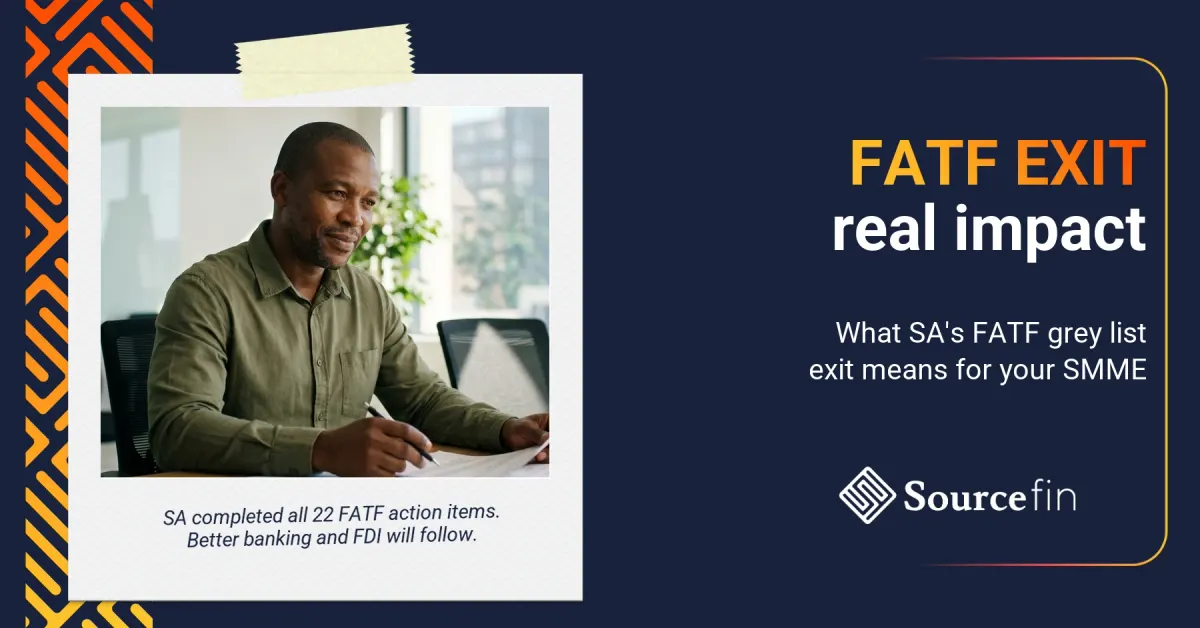
- South Africa was formally removed from the FATF grey list on 24 October 2025, after successfully completing all 22 required action items in its Financial Action Task Force action plan.
- Grey list status increased transaction costs for international banking, raised compliance scrutiny on South African financial institutions, and signalled elevated risk to foreign investors – all of which are now reversing.
- The EU removed South Africa from its High-Risk Third Country Jurisdictions list in January 2026, a direct downstream consequence of the FATF exit.
- For SMMEs, the most immediate practical benefits are lower international transaction friction, easier correspondent banking, and an improved foreign direct investment environment.
- Effects filter through gradually – improved FDI inflows, easier trade finance, and lower sovereign risk premiums are medium-term outcomes that build over 12–36 months.
What Is the FATF Grey List and Why Did It Matter?
The Financial Action Task Force is an intergovernmental body that sets global standards for anti-money laundering (AML) and counter-terrorism financing (CTF). Countries that fail to meet those standards are placed on the "Jurisdictions under Increased Monitoring" list – commonly called the grey list.
South Africa was added to the grey list in October 2023, following a mutual evaluation that found significant deficiencies in the country's AML and CTF frameworks. The practical consequences were immediate. International correspondent banks – the large institutions that process cross-border payments – began applying additional due diligence to transactions involving South African banks. That added friction, cost, and delay to international payments, trade finance, and foreign currency transactions. (Source: KPMG, 2025)
For South African SMMEs dealing with international suppliers or clients, grey list status meant slower payments, higher compliance costs, and in some cases, banking relationships that became harder to maintain. For the broader economy, it signalled to foreign investors that South Africa's financial system carried elevated governance risk – a deterrent to the foreign direct investment the country needs.
FATF Grey List South Africa: What the Exit Required
Exiting the FATF grey list is not automatic. It requires a country to demonstrate that it has substantively addressed the deficiencies identified in its mutual evaluation. South Africa was given 22 specific action items to complete.
By June 2025, South Africa had substantially addressed all 22 items. This included legislative reforms to the Financial Intelligence Centre Act, stronger enforcement actions against money laundering and terrorism financing, improved asset recovery frameworks, and enhanced supervision of financial institutions. A follow-up on-site assessment by FATF evaluators in July 2025 confirmed the sustainability of those reforms. The formal removal was announced at the FATF Plenary in Paris on 24 October 2025. (Source: National Treasury, 2025)
This is relevant context for SMMEs because it illustrates the depth of the institutional reform. The exit was not a diplomatic gesture – it required concrete, verifiable changes to South Africa's financial governance architecture. That foundation matters for long-term business confidence.
What the Exit Means Practically for SA Businesses
The grey list exit does not immediately reduce your overdraft rate or put cash in your account. But it sets in motion a sequence of practical improvements that SMMEs will feel over the next 12–36 months.
Easier international banking. Correspondent banks have already begun reversing the additional due diligence measures they applied to South African transactions. International wire transfers, trade finance instruments, and foreign currency accounts become less complicated and less expensive as those measures are lifted.
EU High-Risk list removal. The European Union removed South Africa from its list of High-Risk Third Country Jurisdictions in January 2026 – a direct consequence of the FATF exit. This reduces compliance barriers for South African businesses dealing with European counterparties, opening up export relationships and international supply chain opportunities that were previously more complex to manage.
Improved FDI environment. Foreign direct investment flows toward markets where capital is safe and governance is credible. The FATF grey list was a deterrent. Its removal – alongside the S&P sovereign credit rating upgrade in November 2025 – is contributing to a measurably improved investment environment. For SMMEs, inbound FDI creates downstream opportunities: multinational supply chains, localisation requirements, and procurement from local SMME suppliers. (Source: Glacier Insights, 2025)
Lower sovereign risk premium over time. As South Africa's risk profile improves in global capital markets, government borrowing costs fall. That creates more fiscal room for productive spending and contributes to the conditions for lower interest rates over the medium term.

How South African SMMEs Can Benefit in 2026
The FATF grey list South Africa exit is a structural improvement, not an immediate windfall. But there are practical steps SMMEs can take now to position for the benefits.
International trade relationships. If your business has been deterred from pursuing international clients or suppliers by the friction of cross-border banking, the operating environment has measurably improved. Pursue those relationships now, before your competitors do.
Positioning for FDI-driven opportunities. As multinational companies increase their South African operations in response to the improved investment environment, they will need local suppliers – services, materials, and specialist skills. SMMEs that are properly registered, B-BBEE compliant, and financially credible will be best placed to win those supply chain positions. Our guide on scaling your South African SMME covers how to position your business for larger opportunities.
Access to funding as conditions improve. As South Africa's risk profile normalises in international capital markets, funding partners operating in the South African market – including development finance institutions and alternative funders – gain better access to international capital. That eventually translates into more funding capacity for SMMEs. At Sourcefin, we assess your deal on its merits: the quality of your invoice or purchase order, your ability to deliver, and your track record. Invoice discounting and purchase order funding are available now – you do not need to wait for macro conditions to improve to access working capital for confirmed work. For a wider walk-through of the South African invoice discounting market, see our pillar guide.
For the full picture of what these structural improvements mean for SMME strategy in 2026, read our pillar on the improving SA economic outlook for SMMEs in 2026. For SMMEs looking to understand their full range of funding options in a changing environment, our SMME funding alternatives guide covers the current landscape in detail.
Sources & References
National Treasury. "South Africa Exits the FATF Greylist on 24 October 2025." Media Statement, October 2025. treasury.gov.za
KPMG. "South Africa: Removal from Financial Action Task Force grey list." Tax News Flash, November 2025. kpmg.com
Glacier Insights. "What being removed from the FATF grey list means for South Africa." 2025. glacierinsights.co.za
Frequently asked questions
What is the FATF grey list and why was South Africa on it?
The FATF grey list identifies countries with deficiencies in their anti-money laundering and counter-terrorism financing frameworks. South Africa was placed on the list in October 2023 following a mutual evaluation that found significant gaps in its financial crime governance. Being on the list increased transaction costs, added compliance scrutiny to international banking, and signalled elevated risk to foreign investors.
When did South Africa exit the FATF grey list?
South Africa was formally removed from the FATF grey list on 24 October 2025, following the FATF Plenary meetings in Paris. The exit came after South Africa successfully completed all 22 action items in its FATF action plan. A follow-up on-site assessment in July 2025 confirmed the sustainability of the reforms implemented.
What did South Africa have to do to exit the FATF grey list?
South Africa was required to complete 22 specific action items covering anti-money laundering legislation, counter-terrorism financing frameworks, asset recovery, and enhanced supervision of financial institutions. The key reforms included strengthening the Financial Intelligence Centre Act and demonstrating improved enforcement through prosecutions and asset recoveries. By June 2025, all 22 items had been substantially addressed.
How does the FATF grey list exit affect South African SMMEs?
The most immediate effects are reduced friction in international banking, lower transaction costs for cross-border payments, and an improved foreign direct investment environment. The EU also removed South Africa from its High-Risk Third Country Jurisdictions list in January 2026, reducing compliance barriers for trade with European counterparties. Medium-term benefits include improving FDI inflows and lower sovereign risk premiums that contribute to conditions for lower interest rates.
What is the EU High-Risk list and why does South Africa's removal matter?
The European Union's High-Risk Third Country Jurisdictions list identifies countries with strategic deficiencies in their anti-money laundering frameworks. Being on the list creates additional compliance obligations for European financial institutions and businesses dealing with South African counterparties. South Africa's removal in January 2026 reduces those compliance barriers, making it easier for South African SMMEs to establish and maintain trade relationships with European buyers and suppliers.
How long will it take for SMMEs to feel the benefits of the FATF exit?
Some benefits are already in effect – correspondent banks began reversing additional due diligence measures immediately after the October 2025 announcement. The EU High-Risk list removal in January 2026 is also already reducing compliance friction. Broader benefits – improved FDI inflows, lower sovereign risk premiums, and the downstream funding environment improvements – will build progressively over 12 to 36 months as international capital markets adjust to South Africa's improved risk profile.

Sourcefin is a South African alternative finance provider that offers purchase order funding and invoice discounting to SMMEs, enabling businesses to fulfil confirmed purchase orders or tenders and unlock cash flow without collateral. Unlike traditional lenders or banks, Sourcefin also provides end-to-end support including supplier sourcing, logistics, project management, and risk oversight.