

CIDB Grading South Africa: Practical SMME Contractor Guide
CIDB grading South Africa for SMME contractors: practical guide to grades 1 to 9, fees, tender value ceilings, and how to move up the grading ladder.
On this page
- Key Takeaways
- CIDB grading South Africa: where it sits in the registration journey
- What CIDB grading South Africa actually does
- The full CIDB grading South Africa ladder
- How to register for CIDB grading South Africa
- How to actually move up the CIDB grading South Africa ladder
- The CIDB grading South Africa link to funding
- Common CIDB grading South Africa traps for new contractors
- In this series: more on registering a business in South Africa
- When the CIDB grading is in place, Sourcefin is next
- Frequently asked questions
CIDB grading South Africa is the gating mechanism for every construction SMME that wants to bid on public works tenders. Grades run from 1 to 9, with each grade capping the maximum tender value you can pursue. Grade 1 is a R450 entry point with no track record required. Grades 2 to 9 require completed projects registered with CIDB plus a financial capability assessment. Your grade is the single biggest determinant of which tenders are even open to you.
Key Takeaways
- The Construction Industry Development Board (CIDB) was established under the CIDB Act 38 of 2000 to regulate construction in South Africa. CIDB grading determines the maximum tender value a contractor can bid for on public works.
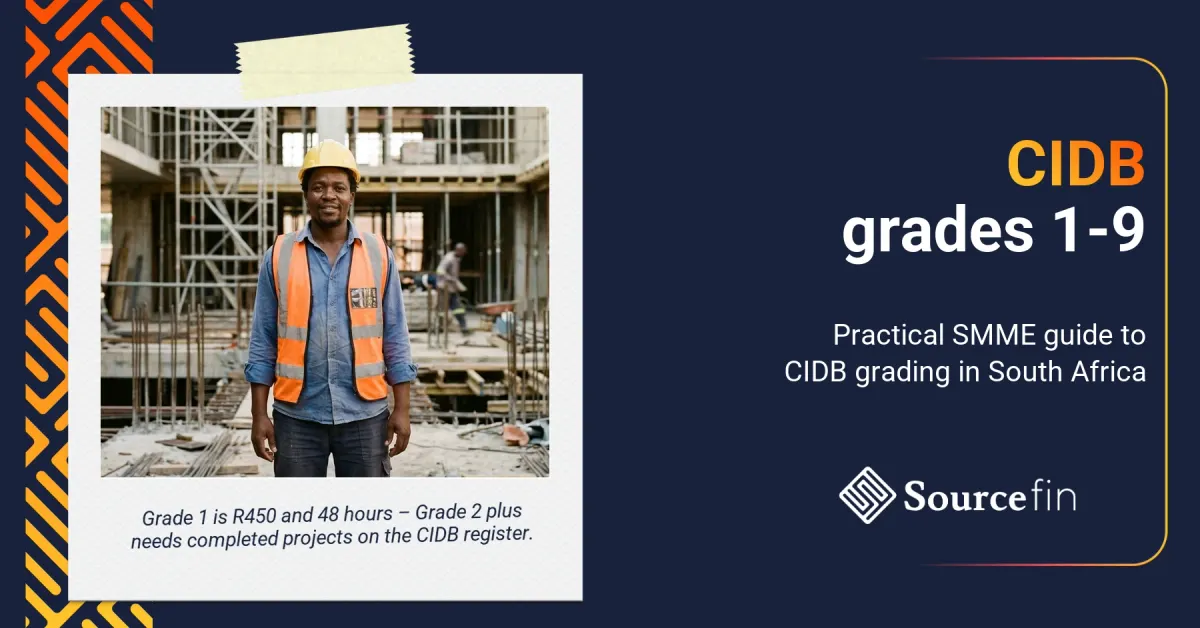
- Grade 1 registration costs R450, activates within 48 hours, requires no track record, and is valid for 3 years – it is the natural entry point for newly registered construction SMMEs.
- Grades 2 to 9 require completed projects registered on the CIDB Register of Projects plus a financial capability assessment. Without a project track record, you cannot upgrade.
- Tender value ceilings rise from Grade 1 (R500,000) to Grade 9 (no upper limit). Most newly registered construction SMMEs operate at Grade 1 or 2 for the first 2 to 3 years.
- CIDB grading South Africa is layered on top of CIPC registration and CSD registration – all three must be in place before bidding on government construction tenders.
- The fastest route from Grade 1 to Grade 2 is winning, completing, and registering one private or government project at the Grade 1 ceiling, then applying for upgrade with the project record and updated financials.
CIDB grading South Africa: where it sits in the registration journey
This cluster pairs with Sourcefin's full guide on when to register a business in South Africa. For construction SMMEs, the sequence is: CIPC company registration first, SARS automatic registration second, CSD registration third, CIDB registration and grading fourth. CIDB is not a substitute for any of those – it is layered on top. You cannot register with CIDB unless your underlying company is registered with CIPC.
Lerato Mathodlana addressed the broader compliance ladder for South African SMMEs on The Great Enabler podcast. The order in which you tackle these registrations is consequential – starting CIDB before CIPC is impossible, and starting CIDB before you have a real project pipeline can be a wasted investment.
What CIDB grading South Africa actually does
CIDB grading is a contractor capability rating issued by the Construction Industry Development Board. Each grade certifies that the contractor has the demonstrated track record and financial capability to deliver projects up to a specified maximum value. Government departments, parastatals, and many large private buyers use CIDB grades as a hard filter in procurement – a Grade 3 contractor cannot bid on a Grade 6 tender, regardless of the merits of the bid.
The grading is based on two dual criteria:
- Construction works track record. Projects completed in the last five years in the field or class of works the contractor is applying for. The CIDB looks at scope, value, and successful delivery.
- Financial capability. Available capital and working capital that the CIDB presumes you would need to start and execute a new project at the maximum value of the grade.
The two criteria are weighted together. A contractor with strong track record but weak capital can be capped at a lower grade. A contractor with strong capital but no track record cannot move past Grade 1.
The full CIDB grading South Africa ladder
Maximum tender value ceilings as set by the CIDB:
- Grade 1: R500,000 maximum tender value. R450 registration fee. No track record required. Activated within 48 hours. Valid 3 years.
- Grade 2: R1 million. Requires completed Grade 1 projects on the CIDB Register and basic financial capability.
- Grade 3: R3 million. Stronger project track record and capital base required.
- Grade 4: R6 million. Multiple completed projects at Grade 3 value and financial capability assessment required.
- Grade 5: R10 million. Substantial project portfolio and proven working capital.
- Grade 6: R20 million. Established contractor with multi-project track record.
- Grade 7: R60 million. Major construction contractor.
- Grade 8: R200 million. Top-tier contractor.
- Grade 9: No upper limit. Largest projects, including major infrastructure.

How to register for CIDB grading South Africa
The CIDB registration process for a newly registered construction SMME:
- Confirm prerequisites. Your company must be registered with CIPC (with current annual returns and beneficial ownership filing) and have a SARS tax number. Most contractors also register on CSD before applying to CIDB.
- Choose your class of works. CIDB grading is class-specific. You register for general building (GB), civil engineering (CE), or specialist classes. You can register for multiple classes but each requires its own track record.
- Apply for Grade 1. Submit the online application via the CIDB Contractor Portal. R450 fee. Activation within 48 hours of complete submission.
- Start bidding on Grade 1 tenders. Government infrastructure programmes, municipal repairs and maintenance, and small private projects up to R500,000 in value.
- Register completed projects on the CIDB Register of Projects. Without registered projects, you cannot upgrade.
- Apply for grade upgrade. Once you have the project record and financial capability for the next grade, submit an upgrade application.
How to actually move up the CIDB grading South Africa ladder
The track record requirement is the bottleneck for most construction SMMEs. The CIDB looks at projects completed in the last five years in the relevant class of works. Practical strategies for building that record:
- Win Grade 1 tenders aggressively. Public works at municipal level, repair and maintenance, township upgrades – these are typically Grade 1-2 in value.
- Register every completed project on the CIDB Register of Projects. If it is not on the register, it does not count for upgrades.
- Take joint venture (JV) positions on larger projects. Partnering with a higher-graded contractor on a single larger project can count toward your own track record, depending on the JV structure.
- Prioritise variety in class of works. If you want to upgrade in general building, complete general building projects – completing road repairs (CE class) does not move your GB grade.
- Strengthen your capital base. CIDB assessment looks at working capital, retained earnings, and access to facilities. Clean accounts and demonstrable working capital matter as much as project count.
The CIDB grading South Africa link to funding
Grade 1 contractors often hit a capital wall. The tender value is small enough to be winnable, but the upfront cash flow demands – materials, labour, plant – can exceed the working capital available before the first payment certificate clears. This is where Sourcefin's products fit:
- Purchase order funding covers the gap between winning the project and being able to pay suppliers for materials.
- Invoice discounting covers the gap between submitting a payment certificate and the government department paying it (often 30 to 90 days).
For broader cash flow context, Sourcefin's invoice discounting guide for South African construction SMMEs covers the construction-specific cash flow patterns and funding solutions.
Common CIDB grading South Africa traps for new contractors
- Bidding above your grade. Tenders with a CIDB grade requirement higher than yours will reject your bid at the compliance stage. No exceptions.
- Letting CIDB registration lapse. Grades have validity periods – Grade 1 is 3 years. Letting it lapse means re-applying from scratch.
- Not registering completed projects. A project not on the CIDB Register of Projects effectively does not exist for upgrade purposes.
- Mixing classes of works. Upgrading in GB does not lift your CE grade and vice versa. Track each class separately.
- Ignoring CSD updates. CIDB grading shows up on CSD profiles. If your CSD is not synced with the latest CIDB status, government buyers may filter you out.
In this series: more on registering a business in South Africa
- Should you register a business in South Africa? Honest SMME guide – the pillar that precedes every construction SMME's CIPC registration.
- Sole proprietor vs Pty Ltd in South Africa – the structural decision before CIPC.
- Pty Ltd compliance cost South Africa: honest year-one budget – the ongoing cost of being a registered contractor.
- CSD registration guide for South African suppliers – the prerequisite for any government tender, construction or otherwise.
When the CIDB grading is in place, Sourcefin is next
Construction tenders are exactly the use case Sourcefin was built for. Banks are built for stability – they cannot fund the working capital demands of a Grade 1 to Grade 4 contractor with project-by-project cash flow swings. Sourcefin is built for speed. R3 billion deployed to South African SMMEs, 1,000+ businesses funded, 100% delivery rate. When your CIDB grade is current and a project is in hand, the next step is the Sourcefin funding application.
Sources & References
CIDB. Requirements For Grading – Register of Contractors. cidb.org.za
CIDB. Construction Industry Development Board. cidb.org.za
National Treasury. Central Supplier Database. csd.gov.za
The Great Enabler Podcast. Lerato Mathodlana on registering a business in South Africa. 2026. youtube.com
Frequently asked questions
What is CIDB grading South Africa and why does it matter?
CIDB grading is a contractor capability rating issued by the Construction Industry Development Board. Each grade (1 to 9) caps the maximum tender value the contractor can bid for on public works. Government departments use the grade as a hard procurement filter – your CIDB grade determines which construction tenders you can even apply for.
How much does CIDB Grade 1 registration cost in South Africa?
Grade 1 registration costs R450, activates within 48 hours of complete submission, and requires no track record of completed projects. It is the natural entry point for any newly registered construction SMME. Grade 1 is valid for 3 years and allows you to bid on tenders up to R500,000 in value.
What is the maximum tender value at each CIDB grade in South Africa?
Grade 1: R500,000. Grade 2: R1 million. Grade 3: R3 million. Grade 4: R6 million. Grade 5: R10 million. Grade 6: R20 million. Grade 7: R60 million. Grade 8: R200 million. Grade 9: no upper limit. Bidding above your grade means automatic rejection at the compliance stage of the tender process.
How do I upgrade my CIDB grade in South Africa?
Two requirements. First, completed projects registered on the CIDB Register of Projects in the relevant class of works (general building, civil engineering, etc.) over the last five years. Second, financial capability – working capital and capital base sufficient for the next grade's tender values. Submit an upgrade application with both track record and updated financials.
Do I need CIPC registration before applying for CIDB grading?
Yes. CIDB grading is layered on top of CIPC registration. Your construction business must be a registered Pty Ltd with current annual returns and beneficial ownership filing – or a sole proprietor with a SARS tax number. Most government contractors also register on the CSD (Central Supplier Database) before applying to CIDB.
How long does CIDB Grade 1 registration last in South Africa?
Grade 1 CIDB registration is valid for 3 years. After that, you must renew or apply for a grade upgrade. Letting your grade lapse means re-applying from scratch and potentially losing the ability to bid on live tenders during the gap. Most contractors apply for upgrade or renewal before the 3-year expiry to avoid the gap.

Sourcefin is a South African alternative finance provider that offers purchase order funding and invoice discounting to SMMEs, enabling businesses to fulfil confirmed purchase orders or tenders and unlock cash flow without collateral. Unlike traditional lenders or banks, Sourcefin also provides end-to-end support including supplier sourcing, logistics, project management, and risk oversight.