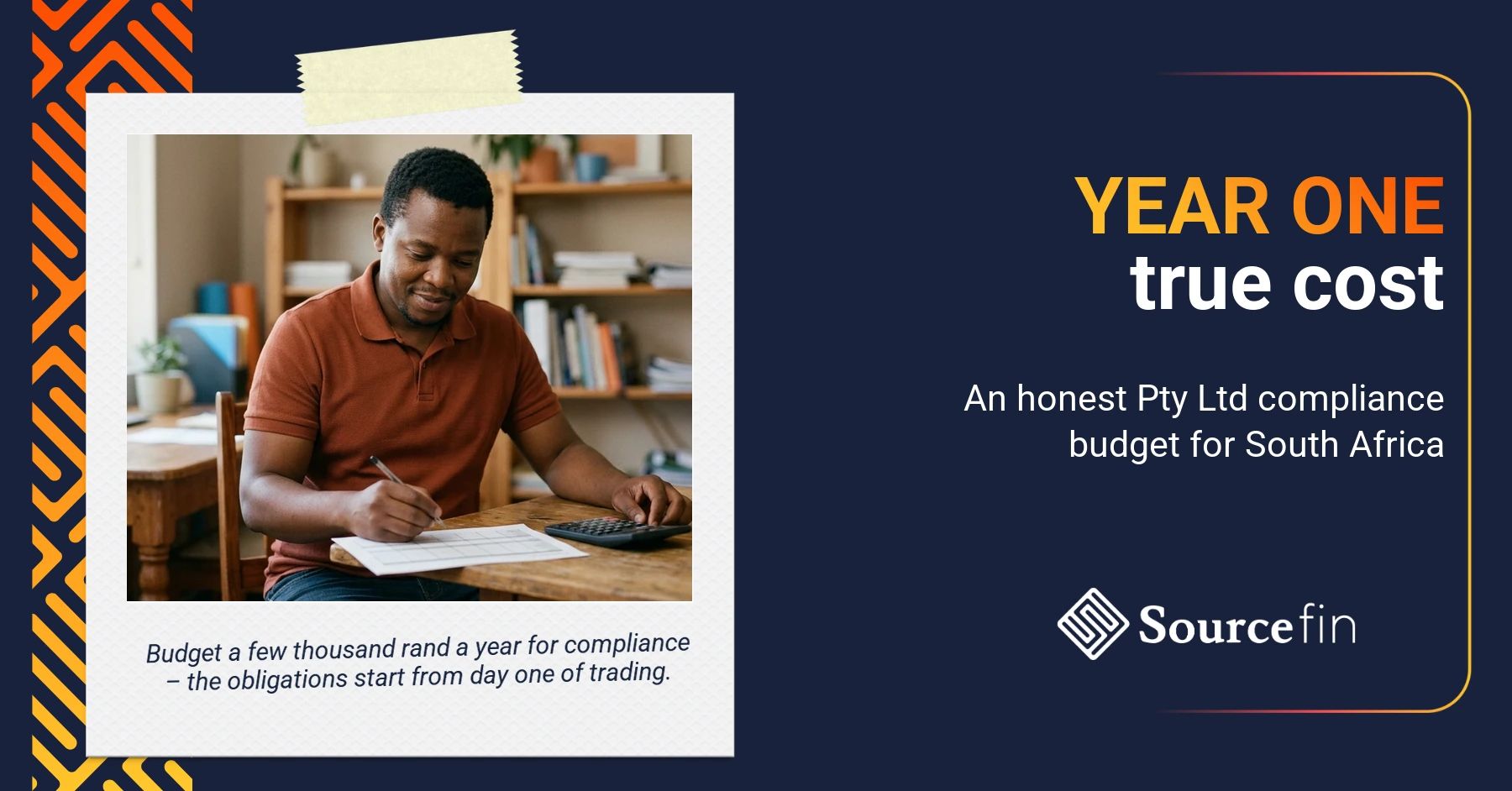

Pty Ltd compliance cost South Africa is the honest number most “just register” advice quietly skips. CIPC registration is genuinely cheap (R175), but year-one running costs reach a few thousand rand once you add annual returns, beneficial ownership filings, provisional tax preparation, and bookkeeping support. Budget the real number before you register – not after.
Key Takeaways
- CIPC registration itself is cheap: R125 to register a private company, R50 per name reservation, total about R175.
- Year-one compliance running costs for a South African Pty Ltd typically reach a few thousand rand once bookkeeping, provisional tax preparation, and annual return fees are included.
- CIPC annual return fees start at R100 for turnover up to R1 million and scale with turnover. Beneficial ownership filing is free but carries a R1 million penalty for non-compliance.
- SARS provisional tax must be filed twice yearly. VAT registration becomes compulsory at R2.3 million per twelve months (raised from R1 million on 1 April 2026), voluntary at R120,000.
- The single biggest variable in Pty Ltd compliance cost South Africa is bookkeeping – DIY with software (cheapest), monthly bookkeeper (mid-range), or full-service accountant (highest).
- SEDFA provides free non-financial support for founders who cannot afford private compliance help.
Pty Ltd compliance cost South Africa: the one-page summary
This cluster pairs with Sourcefin’s full guide on when to register a business in South Africa. The pillar is the decision framework. This article is the honest budget that should sit alongside that decision. Most founders only learn the real Pty Ltd compliance cost South Africa after they have already registered – the goal here is to put the number in front of you before the certificate of incorporation arrives.
Lerato Mathodlana addressed exactly this on The Great Enabler podcast: “You maintain the business by going and filing your beneficial ownership… and you’re also going to pay 100 bucks to CIPC to say I have intentions to trade in the coming year. That’s all an annual return is. It’s the renewal of your status.” Cheap in isolation. The cumulative annual cost is where founders are caught off guard.
The Pty Ltd compliance cost South Africa breakdown – every line item
Year-one compliance running costs for a typical South African Pty Ltd break down into eight categories. Here they are in the order they hit your bank account.
1. CIPC registration (once-off)
R125 to register a private company, plus R50 per name reservation (up to three names in order of preference). Most founders pay about R175 in total. If you skip name reservation and accept your CIPC registration number as your company name, you pay R125 only.
2. CIPC annual return (every year)
R100 for companies with turnover up to R1 million. The fee scales with turnover – higher revenue brackets pay more, and dormant companies still owe the R100 base fee. The annual return is due within 30 business days of your company’s registration anniversary. Miss it for two consecutive years and CIPC begins the deregistration process.
3. Beneficial ownership filing (free, with R1 million penalty for non-compliance)
The filing itself costs nothing through the CIPC e-Services portal. Newly incorporated companies must file within 10 business days of incorporation. From 1 July 2024 CIPC enforces beneficial ownership alongside annual returns. Penalties reach R1 million or 10% of turnover. See Sourcefin’s deep-dive on beneficial ownership filing CIPC for the full procedure.
4. SARS provisional tax preparation (twice yearly)
The IRP6 provisional return is free to submit but requires accurate profit projections. If you have a bookkeeper, this is typically built into their monthly retainer. If you DIY, plan to spend several hours each cycle on the calculation and submission. Penalties for under-estimation can be material – this is the single biggest case for paying a professional rather than doing it yourself.
5. Annual income tax return (ITR14)
Filed annually with SARS. Free to submit but requires audited or independently reviewed financial statements depending on company size. Smaller companies (below the public interest score threshold) can submit independently reviewed statements; larger companies must be audited. The cost is the financial statement preparation, not the return itself.
6. VAT registration and submission (if turnover triggers it)
VAT registration is free at SARS. Compulsory once turnover passes R2.3 million per twelve months (raised from R1 million on 1 April 2026). Voluntary registration is available from R120,000 turnover. Once registered, VAT returns are typically due bi-monthly. The administrative load of VAT is one of the biggest reasons founders use a bookkeeper.
7. Bookkeeping or accounting
This is the largest variable cost in your year-one Pty Ltd compliance budget. Three common approaches:
- DIY with software. Cloud accounting platforms (Xero, Sage, QuickBooks) cost a few hundred rand a month. Best for founders comfortable with bookkeeping and willing to invest the time. Lowest direct cost, highest time cost.
- Monthly bookkeeper retainer. A bookkeeper handles day-to-day records, VAT, and provisional tax preparation. Costs vary by region, transaction volume, and provider – plan to budget for monthly fees as the largest line in your compliance budget.
- Full-service accountant. An accountant takes responsibility for bookkeeping, tax, financial statements, and CIPC compliance. The highest-cost option but the lowest founder time investment.
The honest guidance: most newly registered Pty Ltds start with cloud software and move to a bookkeeper once monthly transactions exceed about 50 or VAT registration kicks in. Sourcefin’s financial confidence guide for South African SMMEs covers the bookkeeping discipline in more detail.
8. Business bank account fees
Pay-as-you-use accounts are typically R0 to a small monthly fee with per-transaction charges. Fully managed business banker packages can run several hundred rand per month. For most newly registered SMMEs, the pay-as-you-use account is the right starting point.

The three Pty Ltd compliance budget scenarios
Pty Ltd compliance cost South Africa varies dramatically by founder approach. Here are three honest scenarios for a first-year registered Pty Ltd with turnover under R2.3 million (so no VAT yet).
Bootstrap (DIY, cloud software, no accountant)
Year-one cost lives almost entirely in software subscriptions, the CIPC annual return, and your own time. Best for founders with finance backgrounds, technical operators, or anyone trading at low volume. The single biggest risk is provisional tax under-estimation – SARS penalties for getting it wrong can outweigh the saving from skipping the professional.
Mid-tier (bookkeeper retainer + software)
You pay a bookkeeper a monthly fee to handle day-to-day records, VAT preparation if applicable, and provisional tax. You handle invoicing and basic data entry. Suits most growing SMMEs – the bookkeeper effectively becomes your finance back office at a fraction of the cost of a full-time hire.
Scaling (full accountant + audit-ready statements)
Suitable once turnover passes about R5 million or once funder requirements demand audited or independently reviewed statements. A registered accountant handles compliance end-to-end, prepares financial statements, and signs off on tax. The highest cost tier, but the bare minimum for any SMME serious about institutional funding.
Hidden Pty Ltd compliance cost South Africa: the things that catch founders out
Beyond the line-by-line budget, four hidden costs catch most newly registered Pty Ltds in the first year:
- SARS penalties. Late provisional tax, late income tax, or material under-estimation can add up quickly. The defence is a bookkeeper or careful DIY discipline.
- CIPC late filing fees. Annual returns filed after the 30-business-day window incur penalties that accumulate daily. Calendar your anniversary date.
- Beneficial ownership update filings. Free to file but mandatory whenever ownership or directorship changes. Forgetting to re-file is a common compliance gap.
- Personal sureties. Many lenders ask directors to sign personal sureties on funding facilities. This is a hidden compliance and risk cost – the limited liability protection of a Pty Ltd is undermined by the personal guarantee.
If cost is the friction point, the Small Enterprise Development and Finance Agency (SEDFA) – the 2024 merger of SEDA and SEFA – provides free non-financial support to South African SMME founders, including help navigating CIPC and SARS registration.
When the Pty Ltd compliance cost South Africa is too high to absorb
If the year-one compliance budget genuinely exceeds what the business can carry, the right answer is to delay registration – not to register and then under-deliver on compliance, which creates penalty exposure. Sourcefin’s pillar on when to register a business in South Africa covers the “when to wait” scenarios in detail. Trade informally as a sole proprietor while you validate the business, then register the Pty Ltd when the revenue can support the compliance overhead.
In this series: more on registering a business in South Africa
- Sole proprietor vs Pty Ltd in South Africa: which to pick – the structural decision that drives this budget.
- Beneficial ownership filing CIPC: complete SMME guide – the R1 million penalty risk every newly registered Pty Ltd must avoid.
- Choosing a company name in South Africa that doesn’t box you in – the CIPC naming decision that pairs with this budget.
When the compliance is paid for, Sourcefin is next
Clean compliance is the gateway to formal funding. Once your Pty Ltd is registered, your annual returns are current, and your beneficial ownership filing is up to date, the next step is matching the right funding product to the right cash flow gap. Purchase order funding covers the gap between winning a contract and being able to fulfil it. Invoice discounting covers the gap between delivering and being paid. When the order arrives, the next step is the Sourcefin funding application. Over R3 billion deployed, 1,000+ SMMEs funded, 100% delivery rate.
Sources & References
CIPC. Company Forms and Fees. 2026. cipc.co.za
CIPC. Annual Returns Portal. cipc.co.za
SARS. Corporate Income Tax. 2026. sars.gov.za
SARS. Companies, Trusts and Small Business Corporations. 2026. sars.gov.za
Cliffe Dekker Hofmeyr. VAT threshold increased – Should SMEs remain registered? March 2026. cliffedekkerhofmeyr.com
SEDFA. Small Enterprise Development and Finance Agency. sedfa.org.za
The Great Enabler Podcast. Lerato Mathodlana on registering a business in South Africa. 2026. youtube.com
Frequently Asked Questions
What is the total Pty Ltd compliance cost South Africa for year one?
For a typical Pty Ltd with turnover under R2.3 million, year-one Pty Ltd compliance cost South Africa usually lands at a few thousand rand once bookkeeping, the CIPC annual return (from R100), and provisional tax preparation are included. Bootstrap founders using cloud software can keep it lower; founders using a full accountant pay more.
How much does CIPC company registration cost in 2026?
CIPC charges R125 to register a private company directly, and R50 per name reservation if you want to reserve a name first. Total is about R175 with a reserved name. If you skip name reservation, your registration number becomes your company name and you pay R125 only. Beneficial ownership filing is free.
What does a CIPC annual return cost in South Africa?
CIPC annual returns start at R100 for private companies with turnover up to R1 million and scale with turnover. Dormant companies still owe the R100 base fee. The return is due within 30 business days of your company’s registration anniversary date. Missing two consecutive returns triggers the CIPC deregistration process.
Do I need a bookkeeper for my newly registered Pty Ltd in South Africa?
Not legally, but practically yes for most founders. SARS provisional tax (twice yearly), annual income tax returns, and VAT compliance (once turnover passes R2.3 million) all reward professional discipline. Most newly registered Pty Ltds start with cloud accounting software and move to a bookkeeper once monthly transaction volume or VAT registration justifies the cost.
When does VAT registration become compulsory for a Pty Ltd in South Africa?
VAT registration is compulsory once your Pty Ltd’s turnover passes R2.3 million per twelve months. This threshold was raised from R1 million on 1 April 2026. Voluntary registration is available once turnover passes R120,000 per twelve months. Below R120,000, voluntary registration is not allowed.
Can I delay registering a Pty Ltd if the compliance cost is too high?
Yes, and it is often the smarter call. If your business cannot yet absorb the year-one Pty Ltd compliance cost South Africa, trade informally as a sole proprietor while you validate the model. Register the Pty Ltd once revenue can support the obligations. SEDFA also provides free non-financial support for founders who cannot afford private compliance help.