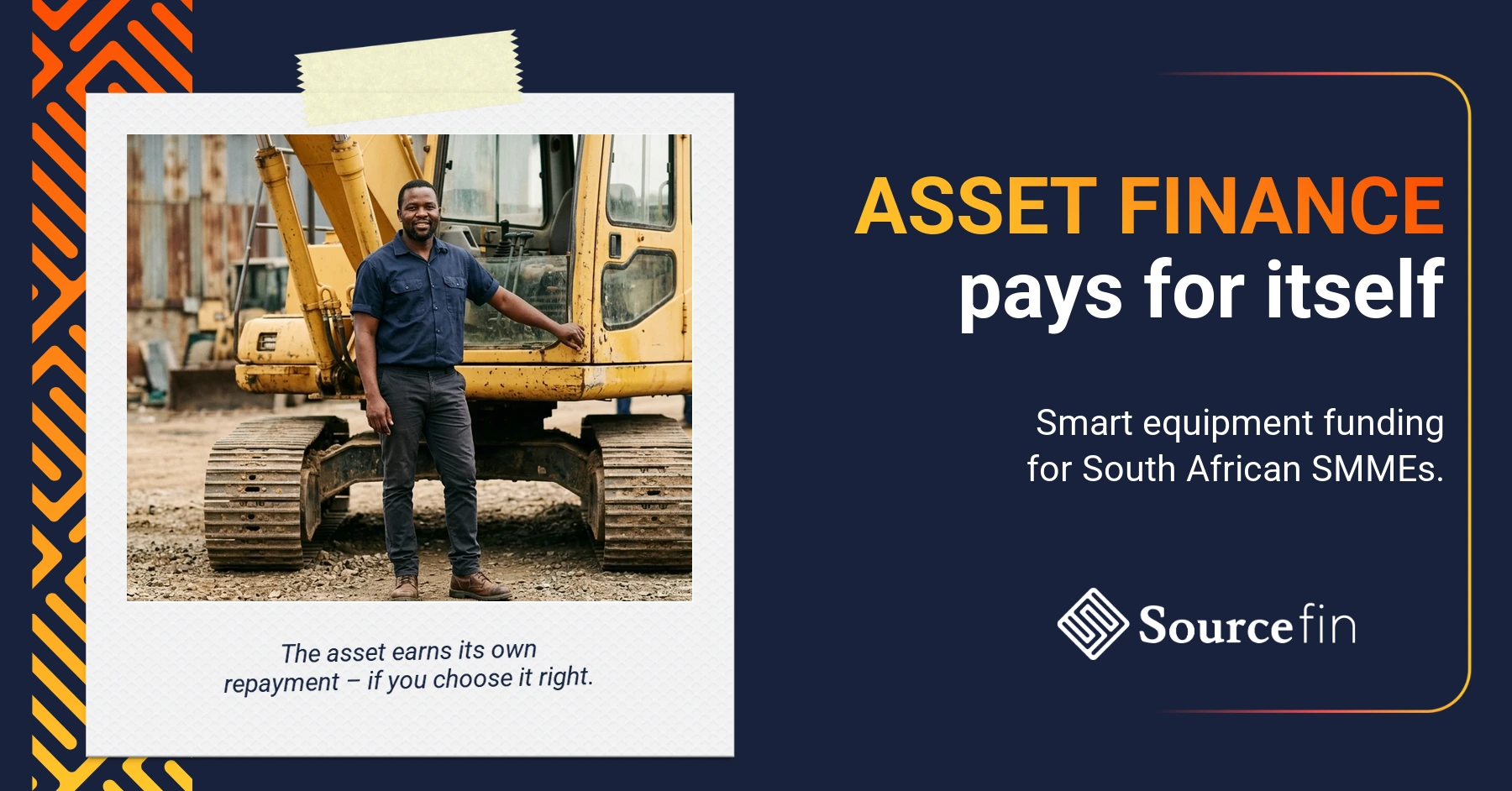

Asset finance South Africa SMME owners use to fund equipment, vehicles, and machinery works differently from a standard business loan. The funder buys the asset on your behalf, you use it to generate revenue, and repay in fixed instalments over time. The asset itself is the security – no property required.
Key Takeaways
- Asset finance is structured around a specific asset – the asset is what secures the facility, not your property.
- Common assets include trucks, bakkies, excavators, manufacturing machinery, and specialised tools.
- Funders assess the asset’s commercial value and its direct link to revenue – not just your credit history.
- The key discipline: only finance an asset that directly drives revenue. An asset that sits idle becomes a liability.
- Asset finance is a long-term commitment – repayment terms run over years, aligned to the useful life of the asset.
What Is Asset Finance for South African SMMEs?
Asset finance is a funding structure that allows South African SMMEs to acquire equipment, vehicles, or machinery without paying the full cost upfront. Instead of applying for a general business loan and using that money to buy an asset, the funder purchases the asset directly. You then use the asset in your business and repay the funder in fixed instalments over an agreed term. At the end of the term, the asset is yours.
The defining feature of asset finance is that the asset itself acts as the security. This is significant for SMMEs, because it means you don’t need to put up your home or property as collateral. The funder’s security is the thing you’re buying – and the commercial value that asset holds.
Common assets financed this way include:
- Trucks, bakkies, and light commercial vehicles
- Excavators, graders, and construction plant
- Manufacturing and production machinery
- Engineering and specialised tools
- Technology and processing equipment
If your business operates in construction, logistics, manufacturing, or engineering, asset finance is likely part of the funding landscape you’ll encounter. For a broader view of what funding options are available to South African SMMEs, the SMME funding options guide covers the full picture.
How Asset Finance Works
The process follows a clear sequence, and understanding each step helps you approach it with the right preparation.
Step 1: Identify the asset you need. Be specific. Asset finance is structured around a particular piece of equipment – the funder needs to know exactly what they’re buying. A quote or specification sheet from the supplier is the starting point.
Step 2: Apply and present your case. You’ll provide business documentation, information about the asset, and evidence of the revenue it will support. This might be a signed contract, a purchase order, or a clear explanation of how the asset contributes to your operations.
Step 3: The funder buys the asset. Once approved, the funder purchases the asset from the supplier directly. You don’t handle the funds – the asset arrives at your business ready for use.
Step 4: You use the asset and repay in instalments. Repayments are fixed – monthly or quarterly – and structured over the agreed term. The term is designed to align with the useful life of the asset and the revenue it generates. A truck that earns income on every delivery should be able to carry its own repayment.
Step 5: At the end of the term, the asset is yours. Once you’ve completed the repayment schedule, ownership transfers to you. Some agreements include a refinancing or balloon payment option at the end, depending on the structure you negotiate.
What Asset Finance Funders Actually Assess
Asset finance is forward-looking. Funders aren’t only asking “how has this business performed in the past?” – they’re asking “does this asset have real commercial value, and will it generate the revenue needed to carry its own repayment?”
The core questions funders work through:
- Does the asset have commercial value? Can it be resold if the deal goes wrong? Specialised equipment with a thin resale market carries more risk for funders than standard commercial vehicles or widely used machinery.
- Does the asset directly generate revenue? A truck that makes deliveries on a confirmed contract is fundable. Equipment that might one day be useful is not the same conversation.
- Is the contract or revenue stream real and durable? Funders want to see that the work the asset will support is genuine. A signed contract, a purchase order, or a demonstrable track record of demand all help make your case.
- Can the business service the repayments? Your financials still matter. The funder needs confidence that your business can meet fixed monthly or quarterly obligations – especially in slower months.

Asset finance decisions are asset-specific – which is why coming prepared with documentation is worth the effort. The stronger the link between the asset and a real revenue stream, the more straightforward the assessment becomes.
Asset Finance South Africa SMME: When It Works and When It Doesn’t
Asset finance is a powerful tool when used for the right purpose. It becomes a burden when used for the wrong one.
When asset finance works well:
- The asset directly drives revenue – every delivery, every job, every production run contributes to your ability to repay.
- The repayment term matches the useful life of the asset – you’re not still paying off equipment that’s worn out or obsolete.
- The contract or work the asset supports is confirmed and durable, not speculative.
- Your margins can carry fixed repayments, even in a quieter month.
When asset finance becomes a problem:
- The asset is non-essential – a nice upgrade rather than a revenue driver.
- The work it supports is uncertain or dependent on winning contracts that aren’t yet confirmed.
- Your margins are too thin to absorb a fixed monthly commitment over years.
- You’re buying the asset because finance is available, not because the business case is clear.
The long-term nature of asset finance is worth taking seriously. You’re committing to repayments over years – not months. A truck that earns well in year one but sits idle in year two will still require payment in year two. Make sure the revenue case is durable before you sign.
Asset Finance vs Other SMME Funding Options
Asset finance sits alongside other funding tools, but it solves a specific problem. Understanding how it compares helps you match the right facility to the right need.
Asset finance vs working capital finance: These solve different problems. Working capital finance covers day-to-day cash flow gaps – wages, stock, operating costs – between money going out and money coming in. Asset finance is for acquiring a specific piece of equipment. If you need both, they can run alongside each other. Learn more about working capital finance for South African SMMEs.
Asset finance vs purchase order funding: PO funding is short-term and deal-specific – it funds a confirmed purchase order so you can fulfil it, then closes once the deal is paid. Asset finance is long-term and asset-specific – it runs for years, tied to the life of the equipment. Both are forward-looking, but they operate on very different timelines. Read more about purchase order funding in South Africa.
Asset finance in the broader alternative funding landscape: South African SMMEs have more options than most business owners realise. Asset finance is one piece of a larger picture that includes invoice-based facilities, supply chain finance, and more. The alternative business funding guide maps out the landscape.
Getting Started with Asset Finance
If asset finance looks like the right fit for your business, here’s what to prepare before approaching a funder:
- Asset quote or specification: A formal quote from the supplier, with the asset clearly described and priced.
- Revenue evidence: A signed contract, purchase order, or documentation showing the work the asset will support.
- Business documents: Company registration, financial statements or management accounts, and CIPC documents.
- Bank statements: Typically three to six months, showing your business’s cash flow position.
Asset finance is facilitated by specialist asset finance providers, banks, and development finance institutions in South Africa. Sourcefin specialises in purchase order funding and invoice discounting – two of the most useful tools for SMMEs that are winning work and managing debtors. If those are the funding gaps you’re facing, PO funding or invoice discounting may be the right conversation. You can start your application here. For wider context, our South African invoice discounting pillar covers the model end to end for SMMEs.
For asset finance specifically, we’d recommend speaking to a specialist asset finance provider or your bank’s business division alongside exploring the broader funding landscape.
Sources & References
- Small Enterprise Development Agency (SEDA) – SMME Support and Funding Resources
- Industrial Development Corporation (IDC) – Equipment Finance
Frequently Asked Questions
What is asset finance and how does it work for South African SMMEs?
Asset finance is a funding structure where the funder purchases a specific piece of equipment, vehicle, or machinery on your behalf. You use the asset in your business and repay the funder in fixed monthly or quarterly instalments over an agreed term. The asset itself is the security – no property collateral is required. At the end of the term, the asset belongs to you.
What types of assets can be financed through asset finance in South Africa?
Asset finance is commonly used for commercial vehicles such as trucks and bakkies, construction plant and equipment, manufacturing and production machinery, engineering tools, and business technology. The common thread is that the asset must have clear commercial value and directly contribute to the business’s ability to generate revenue.
Do I need a deposit to access asset finance?
Some asset finance agreements require a deposit – often called a residual or balloon payment structure – while others do not. Requirements vary between funders and depend on the asset type, its value, and the business’s financial profile. It’s worth asking each funder about deposit requirements upfront when comparing options.
How is asset finance different from a business loan?
With a business loan, you borrow funds and use them as you choose – then repay the loan. With asset finance, the funder buys a specific asset on your behalf and that asset is the security. You don’t receive cash. Because the asset secures the facility, you typically don’t need to offer property as additional collateral, which is a meaningful difference for many SMMEs.
What happens at the end of an asset finance agreement?
Once you’ve completed all repayments, ownership of the asset transfers to you. Some agreements include a final balloon payment or a nominal residual payment to finalise ownership. In other structures, you may have the option to refinance the asset or upgrade to newer equipment. The end-of-term terms should be clarified with your funder before you sign.
Can a new business access asset finance in South Africa?
It can be more difficult for new businesses, as most funders want to see trading history and some evidence of financial stability. That said, a strong asset with clear commercial value and a confirmed contract or revenue stream can improve your position. Some specialist providers and development finance institutions – such as the IDC – offer facilities designed for earlier-stage businesses.