
Funding Companies South Africa: Smart Guide for SMMEs
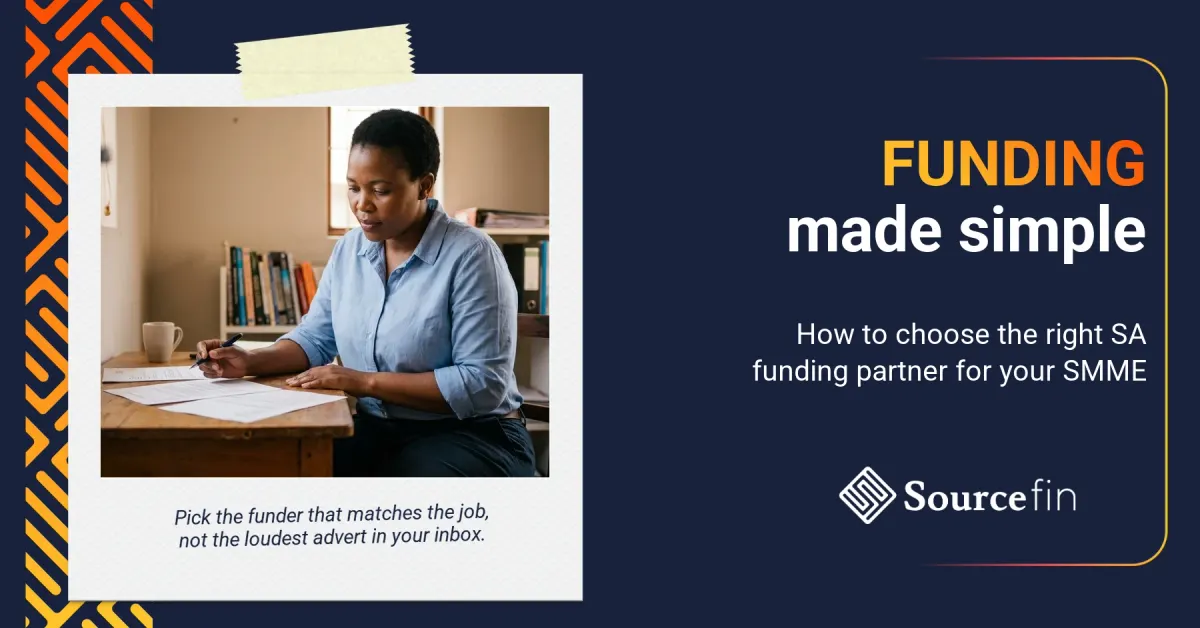
A practical SMME guide to funding companies in South Africa – what each type funds, how to evaluate them and the red flags to avoid before you sign anything.
On this page
- Key Takeaways
- The five main types of funding companies in South Africa
- How to evaluate funding companies South Africa wide
- What to look for in a good funding partner
- Red flags when choosing a funding company
- Public-sector funding companies South African SMMEs should know
- Where Sourcefin fits in the funding companies South Africa landscape
- How to use TenderCentral and AffiliateHub alongside funding
- About the source data
- Frequently asked questions
Funding companies South Africa wide do very different jobs, and the smart move is matching the funder to the deal in front of you. Banks fund stability. Development finance institutions back development goals. Private alternative funders back opportunity-led work. Fintech lenders move quickly on small deals. Specialist providers cover niche cash flow needs. This practical SMME guide breaks down the five main categories, how to evaluate them and the red flags to avoid before you sign anything.
Key Takeaways
- South African SMMEs can choose from five broad categories of funding companies, each built for a different job.
- Banks are built for stability. Private alternative funders, fintech lenders and specialists fill different gaps in the market.
- Public-sector pathways like SEFDA, NEF and the IDC are real options worth checking alongside private funders.
- Evaluate funders on speed, cost transparency, security requirements and how they treat clients when payments run late.
- Watch for upfront application fees, vague timelines and unregistered providers – these are the most common red flags.
- Sourcefin is an opportunity-led private alternative funder, focused on purchase order funding and invoice discounting tied to confirmed work.
The five main types of funding companies in South Africa
South Africa has a deeper funding market than most SMME owners realise. The challenge is not whether finance exists, it is knowing which type fits the deal you are trying to deliver. Funding companies South Africa wide split into five clear categories, and you will meet most of them at some point.
1. Traditional banks
Banks are built for stability. They take deposits from the public, so their mandate is conservative by design. They tend to fund SMMEs through term loans, overdrafts and asset finance, and they look at credit history, financial statements and collateral. If your business has a long trading record, audited financials and security to offer, banks are an essential part of the picture. They serve a different mandate to alternative funders, and that is a strength of the system, not a weakness.
2. Development finance institutions
Development finance institutions are public-sector funders with a development mandate. The main ones South African SMMEs should know are SEFA (now consolidated into SEFDA), the National Empowerment Fund and the Industrial Development Corporation. They offer loans, equity, blended finance and sector-specific incentive support, often at concessionary rates. Application processes can be more involved, and the focus is usually on jobs, transformation and economic impact, not just financial return.
3. Private alternative funders
This is the category Sourcefin sits in. Private alternative funders fund deal-linked working capital – purchase order funding, invoice discounting, asset finance and tender finance. The focus is the opportunity, not just the past. If you have won a contract or issued an invoice to a creditworthy client, an alternative funder can back that specific deal. This category suits SMMEs that move faster than a bank credit committee but still need real money behind real work.
4. Fintech lenders
Fintech lenders use data-driven, automated decisioning to fund smaller, shorter-term deals. They typically connect to your bank account or accounting software, run analytics and offer a working capital facility within days. Deal sizes are usually smaller, and pricing reflects the speed and the unsecured nature of the lending. They suit SMMEs that need quick top-up cash and have predictable monthly turnover.
5. Specialist providers
The fifth category covers niche use cases. Invoice factoring providers buy your invoices outright and chase collection themselves. Merchant cash advance providers fund against future card sales, mostly for retail and hospitality. Supply-chain finance providers sit between buyers and suppliers, paying suppliers early on the buyer's instruction. Each has a specific job and is worth understanding so you do not pay for a feature you do not need.

How to evaluate funding companies South Africa wide
Once you know the categories, the next step is comparing specific funders. Most SMME owners we work with weigh up the same six things.
Speed of decision. Ask how long a real first decision takes for a deal your size. Banks can take weeks. Alternative funders should give you a term sheet in days. Fintechs often answer in hours. Match the speed to your deal timeline.
Cost transparency. A good funder explains fees in writing before you sign anything. You should see how the price is built up, what triggers extra costs and what happens if a payment is late. If a quote is hard to read, that is a sign.
Security and personal guarantees. Different categories require different security. Banks usually want collateral. Alternative funders often link security to the deal itself – the invoice, the purchase order, the end buyer. Make sure the security request matches the deal size.
Sector experience. Funders that already work in your sector will understand your payment terms, compliance burden and seasonality. A funder that has never funded a tender will struggle to fund yours.
Support beyond capital. The best funders help you deliver, not just pay you out. Access to suppliers, supply-chain support and a real person on WhatsApp are practical signs of a partner.
Payment behaviour. Talk to other SMMEs the funder has worked with. How did the funder behave when something went wrong? That tells you more than any sales deck.
What to look for in a good funding partner
Evaluation criteria are useful, but the right funder feels different from a transactional lender from your first conversation. There are a few practical signs we tell SMME owners to look out for.
Open-minded assessment. A good funder asks about the deal, the end buyer and your delivery plan, not just your credit score. The question they should be answering is, "If this opportunity succeeds, can you pay us back?" That is a very different question to, "Do you have a perfect history?" Read more on this approach in our piece on the forgotten SMME.
Deal-linked structure. Funding linked to a specific contract or invoice usually means smaller security demands and faster decisions. The funder is taking a view on the work itself, not asking you to put your house on the line for a project you have already won.
Transparent fees. A good funding partner is happy to walk you line by line through pricing. There is no shame in fees, only in hidden ones. If your funder cannot explain a charge in plain English, you have the wrong funder.
Recovery support. Tenders and corporate clients sometimes pay late. A real partner has a process for that – they help you chase payment, restructure and stay in business. They do not disappear the moment the schedule slips. This is one of the biggest differences between a transactional lender and a long-term SMME funding partner.
Aligned incentives. The strongest model is one where the funder only wins if you deliver. Profit-share PO funding and percentage-based invoice discounting both work this way. The funder is not just hoping you pay back – they are actively invested in helping you deliver.

Red flags when choosing a funding company
South African SMMEs lose real money every year to funders that look legitimate but are not. The good news is that the warning signs are usually obvious if you know what to look for.
Upfront application fees. A reputable funder does not charge you to apply. Origination fees can exist once a deal is approved and signed, but anyone asking for cash before they have looked at your file is not a funder you want to work with.
Opaque pricing. If a funder will not put fees in writing, walk away. The same goes for "all-in" rates that hide multiple charges, or quotes that change between conversations. Pricing is allowed to be commercial, but it must be clear.
Personal guarantees on small deals. A blanket personal guarantee from every director on a small invoice deal is a sign of a funder reaching too far. Security should match the size and shape of the deal.
No regulatory registration. Check whether the funder is registered with the relevant authority for the product they are offering. Credit providers operating in regulated parts of the market should be on the National Credit Regulator's register. Refusing to share registration details is a serious warning sign.
Vague approval timelines. "We will get back to you" is not a process. A funder should be able to tell you, on day one, what their realistic turnaround is for your deal size.
High-pressure tactics. A funder that pushes you to sign before you understand the terms is not a partner. The deal will still be there tomorrow, and a real funder knows that. For more on rejection patterns and how to avoid them, see our guide on SMME funding questions.
Public-sector funding companies South African SMMEs should know
Before you sign with any private funder, it is worth checking the public-sector pathways. They will not always be the right fit, but they are real options that get overlooked.
SEFDA – Small Enterprise Development and Finance Agency. SEFDA is the consolidated agency formed by combining SEFA, SEDA and the Co-operative Banks Development Agency. It offers small business loans, business support and incubation, and is one of the largest single funders of micro and small businesses in South Africa.
NEF – National Empowerment Fund. The NEF provides debt, equity and quasi-equity finance to support black economic empowerment, with a focus on growth-stage businesses. Deal sizes can range from start-up tickets to multi-million-rand growth investments.
IDC – Industrial Development Corporation. The IDC backs larger industrial and infrastructure projects, often in manufacturing, agro-processing, renewable energy and mining services. It is not a typical first stop for a small invoice or PO deal, but for larger industrial growth plays, it is a serious option.
The dtic incentive schemes. The Department of Trade, Industry and Competition runs sector-specific incentive programmes. These are not loans, they are grants and rebates against qualifying expenditure. They can sit alongside private funding rather than replacing it.
For a wider view of what is possible, our overview of alternative business funding and our guide to how to get business funding are good starting points.
Where Sourcefin fits in the funding companies South Africa landscape
Of the funding companies South Africa SMMEs can choose from, Sourcefin sits clearly in the private alternative funder category, opportunity-led by design. We work alongside the banking system, not against it. Banks are built for stability. Sourcefin is built for speed and for deals that are tied to confirmed work.
Our core products are purchase order funding and invoice discounting. PO funding backs SMMEs that have won a tender or purchase order but need capital to deliver. Invoice discounting turns issued invoices into cash, so SMMEs do not have to wait 30, 60 or 90 days for the end buyer to pay.
The model is simple. Funding is linked to the deal, not to a long credit history. We assess three things. Can we trust you? Can the work be delivered? Will the end buyer pay? If the answers are yes, we are interested.
The numbers reflect the model. Sourcefin has deployed more than R3 billion across more than 2,000 SMMEs since 2020, with a strong delivery track record on government and SOE tenders. We are 80% public-sector, 20% private-sector, with strategic partnerships across the Gauteng Enterprise Propeller, the City of Johannesburg, the Northern Cape and a R150 million investment from Futuregrowth Asset Management.
Sourcefin is not the right funder for every SMME. If you need a 25-year mortgage on a building, a bank is your partner. If you need an unsecured retail overdraft, a fintech may be the answer. If you have won real work and need capital tied to that work, that is exactly the gap we fill. Ready to test the fit? Start with a funding application.
How to use TenderCentral and AffiliateHub alongside funding
Funding only matters if you are winning the right work in the first place. South African SMMEs that build a steady pipeline tend to be the ones that find the right funder.
TenderCentral is Sourcefin's free government tender discovery platform. It pulls together municipal, provincial and national tenders and lets you filter by sector and region, so you can see the opportunities that match your business before they close. Pairing tender visibility with deal-linked funding is one of the simplest ways to grow a tender-led SMME without taking on debt against your home.
If you advise SMMEs for a living – consultants, accountants, business coaches, industry body leaders – AffiliateHub is the partner channel. Introduce SMMEs to Sourcefin, track referrals in real time and earn commission on successful deals. It is a structured way to add real funding access to the support you already give your network. For SMMEs hunting alternative funding routes or innovative SMME financing, the combination of TenderCentral and a funding partner is a strong starting position.
About the source data
The funding categories and evaluation criteria in this guide draw on publicly available material from Statistics South Africa, the National Small Business Chamber, the Department of Trade, Industry and Competition and FinFind's SMME funding gap research. Where qualitative language is used – "many", "most", "commonly" – it reflects observed patterns in the South African market rather than fabricated statistics. Specific deal sizes and milestones for Sourcefin are drawn from internal records up to March 2026. For client perspective, see our Sourcefin reviews.
Sources & References
- Statistics South Africa – SMME and economic data
- National Small Business Chamber – SMME advocacy and funder directory
- Department of Trade, Industry and Competition (dtic) – SMME policy and incentive schemes
- FinFind – SMME funding gap research
- Small Enterprise Finance Agency (now SEFDA) – public-sector SMME finance
- National Empowerment Fund – equity and quasi-equity funding
Frequently asked questions
What types of funding companies operate in South Africa?
South African SMMEs can choose from five broad categories of funding companies. Traditional banks provide collateral-based term lending. Development finance institutions like SEFDA, NEF and the IDC offer public-sector and blended finance. Private alternative funders fund deal-linked working capital. Fintech lenders use data-driven decisioning for smaller deals. Specialist providers cover niche needs like merchant cash advances, factoring and supply-chain finance.
Are alternative funding companies safer than banks?
Banks and alternative funders serve different purposes, so safety is not the right word. Banks are built for stability and follow conservative mandates that protect depositors. Alternative funding companies are built for speed and can fund opportunities banks are not designed to handle. Both are legitimate. The right choice depends on what your SMME needs to deliver and how quickly the cash needs to be available.
What should I check before applying to a funding company?
Check whether the funder is properly registered in South Africa. Confirm fees are clearly explained in writing, not buried. Ask how long approval realistically takes for a deal your size. Find out what security or personal guarantees they require. Look at how they handle late payments. Ask for client references in your sector. Avoid any funder asking for an upfront application fee.
Are there government-backed funding companies for SMMEs?
Yes. SEFDA is the consolidated Small Enterprise Development and Finance Agency and supports small business finance and development. The National Empowerment Fund (NEF) provides equity and quasi-equity for empowerment-led businesses. The Industrial Development Corporation (IDC) backs larger industrial and infrastructure projects. The dtic offers various sector-based incentive schemes. These public-sector pathways are worth exploring alongside private funding companies.
How does Sourcefin compare to other funding companies?
Sourcefin is an opportunity-led private alternative funder. Where many funders focus on credit history and collateral, Sourcefin assesses the deal in front of you – the purchase order, the invoice, the end buyer. Funding is linked to confirmed work through purchase order funding and invoice discounting. The model suits SMMEs delivering tenders or supplying clients on long payment terms who need cash flow tied to that specific opportunity.
Where can I find a list of funding companies in South Africa?
Start with neutral, well-respected industry bodies. The National Small Business Chamber (NSBC) directory covers SMME-aligned funders. The dtic publishes incentive scheme partners and accredited finance pathways. FinFind has done extensive work mapping the SMME funding gap and the funder landscape. These three sources will give you a balanced picture before you start comparing specific funding companies.

Sourcefin is a South African alternative finance provider that offers purchase order funding and invoice discounting to SMMEs, enabling businesses to fulfil confirmed purchase orders or tenders and unlock cash flow without collateral. Unlike traditional lenders or banks, Sourcefin also provides end-to-end support including supplier sourcing, logistics, project management, and risk oversight.