
Invoice Discounting for Retentions: The Honest Answer
Invoice discounting for retentions in South Africa. The honest answer on construction retentions, and which related receivables are actually fundable.
On this page
- Key Takeaways
- Understanding what retention actually is on a construction contract
- Why invoice discounting for retentions is structurally difficult
- Invoice discounting for retentions vs progress claims: what can be funded
- Invoice discounting for retentions at defects liability release
- What contractor SMMEs do with the invoice discounting for retentions question
- Edge cases worth flagging
- Documents for the related receivables (the part that does fit)
- Where Sourcefin lands
- Frequently asked questions
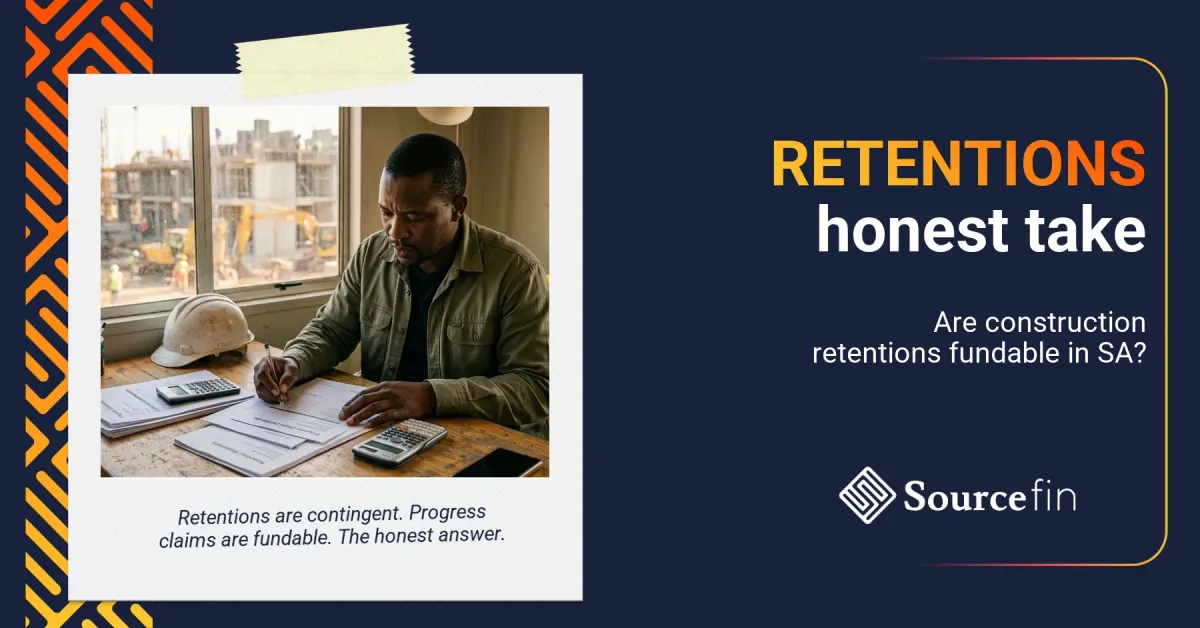
Invoice discounting for retentions in South Africa is one of the most common questions construction-sector SMMEs ask, and the honest answer is nuanced. Retentions – the 5 to 10% the customer holds back from each progress claim until the defects liability period ends – are typically not fundable on a standard invoice discounting structure. Retentions are contingent: the customer's obligation to pay only crystallises once the defects liability period closes and any remedial work is complete. Progress claims for work already certified and not subject to retention can be discounted on standard terms. This article walks through where the line sits and what actually works for contractor SMMEs.
Key Takeaways
- Invoice discounting for retentions is structurally difficult because retentions are contingent receivables, not unconditional invoices.
- The non-retained portion of a progress claim – the cash payable now after retention is deducted – is a clean invoice discounting case.
- Retention release at the end of the defects liability period is typically not discountable in advance because the customer's obligation has not yet crystallised.
- For contractor SMMEs, the practical path is to discount the certified, payable progress claims and plan working capital around the retention release date separately.
- Sourcefin's invoice discounting funds uncontested, already-delivered receivables – retentions sit on the wrong side of that test in most cases.
Understanding what retention actually is on a construction contract
South African construction and civil contracts (JBCC, NEC, FIDIC) typically include a retention mechanism. The basic structure:
- For each progress claim certified during the construction period, the customer pays out the certified amount less a retention percentage (commonly 5 to 10%).
- The retained amount accumulates on the customer's side. The contractor sees it on the payment certificate but does not receive the cash.
- At practical completion, half of the accumulated retention is typically released, with the remaining half held through the defects liability period (often 12 months).
- At the end of the defects liability period, subject to defects being repaired and a certificate of final completion being issued, the remaining retention is released.
The contractor's right to the retention is conditional on the work passing the defects liability test. That conditionality is exactly what makes retention difficult to fund on a standard invoice discounting structure.

Why invoice discounting for retentions is structurally difficult
Sourcefin's invoice discounting funds receivables that meet four tests:
- The invoice is valid and verifiable with the customer
- The customer is credit-credible
- The work has been delivered and the invoice is uncontested
- The SMME has operational capacity to retain the customer relationship
Retentions fail the third test in most cases. The work has been done, but the customer's obligation to pay the retention is contingent on:
- The defects liability period running to completion
- Any latent defects identified during that period being properly remedied
- The certificate of final completion being issued by the engineer or principal agent
Until those conditions are met, the customer is not obligated to pay the retention. From an invoice discounting standpoint, that is a contingent claim, not an unconditional receivable.
Invoice discounting for retentions vs progress claims: what can be funded
The non-retained portion of a certified progress claim is a clean invoice discounting case. Specifically:
- The progress claim has been certified by the engineer or principal agent
- The customer has accepted the certified amount
- The retention deduction has been applied and the payable amount is now an unconditional invoice on the customer
- The customer is on a standard payment term (often 30 days from certification under JBCC, longer on government contracts)
This is the practical path for contractor SMMEs. The certified-and-payable portion is what invoice discounting funds. See invoice discounting for construction SMMEs in South Africa for the broader construction-sector context.
Invoice discounting for retentions at defects liability release
Once the defects liability period has run and the certificate of final completion has been issued, the retention release becomes an unconditional receivable in form. At that point:
- The final retention release certificate has been issued
- The customer's obligation to pay is no longer contingent
- The invoice for the retention release amount can be raised and processed
- The receivable now meets the invoice discounting tests
In other words, retention release after final completion can be discounted as a normal invoice discounting deal. What does not work is discounting the retention before final completion, while the contingency is still active.
What contractor SMMEs do with the invoice discounting for retentions question
Contractor SMMEs that understand the structural reality of retentions tend to plan working capital differently:
- Discount the certified, payable progress claims on standard invoice discounting. This is the working-capital backbone for live projects.
- Plan retention release separately. The retention release date is typically known in advance from the contract – the contractor can plan capital deployment around it without trying to fund it early.
- Use bonds or guarantees where applicable. Some customers accept a retention bond from a bank in lieu of cash retention, which releases the cash earlier. This is a bank product, not an invoice discounting product.
- Once the retention release certificate is in hand, discount the release invoice if the customer's payment term is meaningful.
This is the honest, practical answer. It is not the same as a flat "no" – it is a structural reality that splits retentions into two phases (contingent during defects liability, unconditional after final completion).
Edge cases worth flagging
- Disputed retentions. If the customer is contesting the retention release after final completion (alleging defects, claiming damages), the receivable is no longer uncontested. Invoice discounting cannot move until the dispute is resolved.
- Bond-backed retentions. Where a bank retention bond replaces the cash retention, the contractor receives the full progress payment up front. The bond is a bank product and sits outside invoice discounting entirely.
- Long-tail retentions. Some industrial and civil contracts run defects liability periods of 24 to 36 months. The structural answer is the same – the longer the contingency, the less appropriate it is to try to discount in advance.
- Government and parastatal retentions. Public-sector retention release sometimes runs longer than the contract specifies because of administrative delay. Once the release certificate is issued and the invoice raised, the standard invoice discounting test applies.
Documents for the related receivables (the part that does fit)
For the portion of a contractor SMME's book that does fit invoice discounting – the certified, payable progress claims – the standard pack from invoice discounting documents required in South Africa applies. Useful additional construction-specific items:
- The signed progress payment certificate
- The contract excerpt covering the payment-term clause
- The customer purchase order or contract reference
- The valuation breakdown supporting the progress claim
For broader eligibility see invoice discounting requirements in South Africa.
Where Sourcefin lands
Sourcefin has deployed R3 billion-plus in working capital to South African SMMEs since 2020, funded 1,000+ SMMEs including a large cohort of construction contractor SMMEs, and maintained a 100% delivery rate on funded deals. The discipline on what is and is not fundable comes from the same four-question framework that runs across every Sourcefin deal. On retentions, that discipline produces the nuanced answer above – not because the product is restrictive, but because contingent receivables are a different financial instrument than unconditional invoices.
For broader context, Stats SA publishes SA construction-sector economic statistics, the Department of Small Business Development publishes SA small-business policy, and the IFC SME Finance Forum publishes the global MSME Finance Gap database covering emerging markets.
If your construction SMME is sitting on certified progress claims and the cash cycle is tight, invoice discounting for retentions is not the right tool for the retention portion – but invoice discounting on the certified, payable progress claims is. Start at the funding application page or read more about how invoice discounting works at Sourcefin.
Sources & References
- Statistics South Africa – Official SA construction-sector economic statistics.
- Department of Small Business Development – SA small-business policy and reporting.
- IFC SME Finance Forum – Global MSME Finance Gap database, World Bank Group.
Frequently asked questions
Can a construction SMME get invoice discounting for retentions in South Africa?
Not typically, on a standard invoice discounting structure. Retentions are contingent receivables – the customer's obligation to pay only crystallises once the defects liability period closes and any remedial work is complete. Until that contingency clears, the receivable does not meet the invoice discounting tests. The non-retained portion of a certified progress claim, by contrast, is a clean invoice discounting case.
What is the difference between a retention and a progress claim for invoice discounting?
A progress claim is the certified amount payable for work completed during the construction period. The non-retained portion of that progress claim is an unconditional invoice once the customer accepts the certificate – this is fundable. The retention is the 5 to 10% held back, contingent on the defects liability period running successfully. That contingency is what makes retention difficult to fund in advance.
Can retention release at the end of defects liability be discounted?
Yes, once the certificate of final completion has been issued and the retention release invoice has been raised. At that point the receivable is no longer contingent – the customer's obligation to pay is unconditional. Sourcefin's deal team can assess the release invoice on standard terms. What does not work is discounting the retention before final completion.
Does a retention bond solve the cash flow problem on retentions?
A retention bond from a bank can replace the cash retention so the contractor receives the full progress payment up front. The bond is a bank-issued product and sits outside invoice discounting. Where the customer accepts a bond in lieu of cash retention, it directly solves the working-capital impact. Not all customers accept bonds, so the option depends on contract terms.
What if a customer disputes the retention release after final completion?
If the customer is contesting the retention release – alleging unresolved defects, claiming damages, or running a counter-claim – the receivable is no longer uncontested. Invoice discounting cannot move until the dispute is resolved and the customer formally accepts the release invoice. The fix is to work through the dispute first, then apply once the receivable is clean.
What is the practical working capital strategy for contractor SMMEs with retention exposure?
Discount the certified, payable progress claims on standard invoice discounting to fund the live cash cycle. Plan retention release separately around the contract's known release dates. Where applicable, negotiate retention bonds with the customer to remove the cash hold. Once the retention release invoice is raised post-completion, that specific invoice can be discounted on standard terms.

Sourcefin is a South African alternative finance provider that offers purchase order funding and invoice discounting to SMMEs, enabling businesses to fulfil confirmed purchase orders or tenders and unlock cash flow without collateral. Unlike traditional lenders or banks, Sourcefin also provides end-to-end support including supplier sourcing, logistics, project management, and risk oversight.