
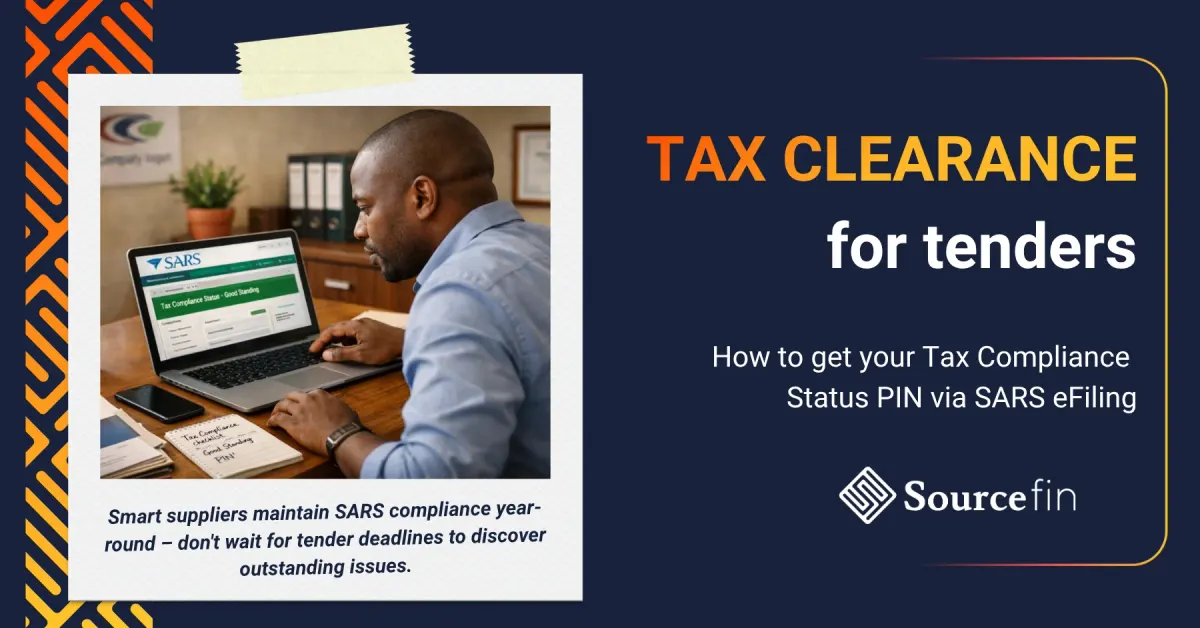
Tax Clearance Certificate Tenders: Essential Guide for SA
SARS now uses Tax Compliance Status PINs instead of physical certificates. Apply via eFiling for Good Standing status – PINs verify compliance in real-time.
On this page
- What Tax Clearance Certificate for Tenders Proves
- How the TCS PIN System Works
- Why Real-Time Verification Changes Everything
- What You Need Before Applying
- The eFiling Application Process
- Common Mistakes That Block Compliance
- What Documents to Submit with Your Tender
- Building Complete Tender Readiness
- Sources & References
- Frequently asked questions
A tax clearance certificate for tenders in South Africa is now issued as a Tax Compliance Status (TCS) PIN through SARS eFiling. Apply for "Good Standing" status (not "Tender" – that option was removed in 2023), receive your PIN immediately via SMS if compliant, and share it with procurement offices who verify your compliance in real-time. Tax clearance certificate for tenders remains valid for 12 months and proves you have no outstanding tax obligations with SARS.
Every government tender submission requires proof that your tax affairs are in order with SARS. Missing this document, or submitting an expired one, leads to automatic disqualification regardless of how competitive your pricing is or how well you meet technical requirements.
The challenge is that the system changed in 2019. Many businesses still ask for a "Tax Clearance Certificate" – the old physical document SARS used to issue. That's not how it works anymore. South Africa now uses a Tax Compliance Status PIN that third parties verify online through eFiling. The name changed, the process changed, and not understanding the difference causes problems.
If you've been avoiding tenders because tax clearance seems complicated, or if you've submitted applications only to discover compliance issues at deadline, this changes. Understanding how the tax clearance certificate for tenders actually works in 2026 removes the confusion.
What Tax Clearance Certificate for Tenders Proves
When you obtain a tax clearance certificate for tenders, you're proving to SARS and to procurement offices that your tax affairs meet specific compliance standards. This isn't just about having paid your taxes. SARS evaluates multiple criteria before granting compliant status.
You must have all tax returns submitted – not just paid, but filed. Even nil returns that show zero income or activity need to be lodged with SARS. A missing return from three years ago, forgotten because you had no activity that year, will block your compliance status today.
Outstanding debt disqualifies you unless you've arranged a payment plan with SARS or obtained suspension of payment. Small businesses sometimes accumulate penalties without realising it – an administrative penalty for a late VAT return, interest on underpaid provisional tax, or assessment differences from previous years. These must be cleared or formally arranged before SARS grants compliance.
Registration requirements matter too. You must be registered for all tax products you're liable for. If your turnover crossed the R1 million VAT threshold two years ago but you never registered for VAT, you're non-compliant even if you've paid all your income tax correctly. SARS checks that your registrations align with your actual business activity.
Your registered particulars need to be current. Outdated contact details, old addresses, or incorrect bank details flag as non-compliant. This catches businesses who moved offices or changed banking arrangements but never updated SARS. The My Compliance Profile on eFiling shows exactly what's preventing compliance, which saves you from guessing.
How the TCS PIN System Works
The Tax Compliance Status system replaced physical Tax Clearance Certificates in 2019. Instead of receiving a printed document, you get a unique PIN that third parties use to verify your compliance status online.
You apply through SARS eFiling by logging in and selecting the "Tax Status" menu option. The application type you want is "Good Standing" – this is the standard option for proving compliance to third parties including tender procurement offices. The old "Tender" option was removed in April 2023, so if you're following outdated instructions that mention selecting "Tender", that's why you can't find it.
When you submit your Good Standing request, SARS evaluates your compliance against all their criteria immediately. If everything is in order, your PIN is issued instantly and sent to your registered mobile number via SMS. You can also view the PIN on your eFiling dashboard and print a formal TCS result letter that includes the PIN.
The PIN is a 10-digit number unique to that specific request. Each time you apply for Good Standing, you receive a new PIN. This matters because you can have multiple active PINs simultaneously, which is useful when dealing with different organisations at the same time.
Third parties – procurement offices, banks, suppliers, government departments – use your PIN to check your status through their own eFiling accounts. They enter your tax reference number and the PIN, and SARS shows them your current compliance status at that exact moment. This is dynamic verification, not a static snapshot. Your status reflects your actual compliance position when they check it, not when the PIN was issued.
Why Real-Time Verification Changes Everything
Physical Tax Clearance Certificates stated your compliance status on a specific date. If you were compliant on 15 March when SARS issued the certificate, the document said you were compliant on 15 March. Even if you became non-compliant on 20 March, the certificate still said 15 March. Procurement offices had to accept it at face value.
The TCS PIN system works differently. When a procurement office verifies your PIN on 15 April, SARS checks your compliance status on 15 April – not when you got the PIN, not when you submitted your tender, but at the moment of verification. If you were compliant when you applied for the PIN but missed a VAT payment before tender evaluation, the verification shows non-compliant.
This dynamic checking protects procurement offices from businesses gaming the system, but it creates risk for businesses who don't maintain continuous compliance. You can submit a tender with a valid PIN, thinking everything is sorted, then fail compliance verification during evaluation because something changed between submission and assessment.
Smart approach: apply for your tax clearance certificate for tenders well before the deadline, then monitor your My Compliance Profile on eFiling weekly through the tender period. SARS shows you exactly what's compliant and what isn't, colour-coded green for compliant and red for issues. Catching problems early means you can fix them before they block your tender.
What You Need Before Applying
Before you can get a tax clearance certificate for tenders, certain prerequisites must be in place. You can't apply via eFiling if you're not registered on the system. Registration requires your tax reference number, identity document, and contact details. First-time eFiling users go through a verification process that can take a few days, so don't leave this until tender deadline week.
All your tax products must be properly registered with SARS. This means income tax (if you're a company, trust, or individual earning above the threshold), PAYE (if you have employees), VAT (if your turnover exceeds R1 million), and any other taxes applicable to your business. Unregistered tax products show as non-compliant even if you don't owe any money.
Outstanding returns must be filed. Check your eFiling account for any returns showing as overdue. This includes annual income tax returns, provisional tax returns, PAYE submissions, and VAT returns. Even if you've since filed them, administrative penalties may still be outstanding and need attention.
Tax debt must be cleared or arranged. Log into eFiling and check your account balance across all tax products. Small amounts – even R50 in penalties – prevent compliance. If you can't pay immediately, contact SARS to arrange a payment plan or request suspension. They're more accommodating than people expect when approached proactively.
Your B-BBEE certificates and CSD registration work alongside your tax clearance, but they're separate requirements. Don't confuse them – you need all three, independently verified, to submit a complete tender.
The eFiling Application Process
Getting your tax clearance certificate for tenders starts by logging into eFiling at www.sarsefiling.co.za with your username and password. Once logged in, navigate to the "Tax Status" menu option in the main dashboard. This section contains all the Tax Compliance Status functionality.
Select "Tax Compliance Status Request" from the menu. You'll see two application types: "Good Standing" and "Approval International Transfer". For tenders and general compliance proof, you want "Good Standing". The Approval International Transfer option is for moving funds offshore or emigration purposes, which isn't relevant to tender applications.
Click "Good Standing" and the application form appears. Complete your details – most will pre-populate from your eFiling profile. Verify that your contact information is current, particularly your mobile number, because that's where the PIN will be sent. You don't need to upload any supporting documents for Good Standing applications, unlike international transfer requests.
Submit the application. If your compliance status meets all requirements, SARS issues your PIN immediately. You'll receive an SMS to your registered mobile number containing the 10-digit PIN. The PIN also appears on your eFiling dashboard under "Tax Compliance Status Request" where you can view it, print the formal TCS letter, or request the PIN be resent via SMS.
If your application is declined, SARS shows you why. The My Compliance Profile breaks down exactly what's preventing compliance – which returns are outstanding, what debt exists, which registrations are missing. This diagnostic information tells you what to fix before reapplying.
Common Mistakes That Block Compliance
The most frequent problem is unresolved administrative penalties. SARS issues penalties automatically for late submissions, incorrect information, or procedural failures. These sit on your account indefinitely until addressed. A R250 penalty from 2022 for a PAYE submission that was three days late will block your compliance today unless you've paid it or disputed it successfully.
Missing nil returns catch many businesses. You had no activity in a particular VAT period, so you assumed no return was needed. SARS requires the nil return to be filed anyway. Every missing return – whether it shows activity or not – registers as non-compliant.
Bank verification failures happen when your registered bank details don't match SARS records or haven't been verified. SARS requires verified banking information for certain tax products. If you've changed business bank accounts but never updated SARS, this flags as incomplete registration.
Multiple tax reference numbers cause problems when they haven't been merged or declared. This happens if you've operated under different structures – started as a sole proprietor, then registered a company, or took over a business with existing tax obligations. SARS needs you to link these references through the Merge tool on eFiling or declare them on the ERC01 form.
Outdated representative information blocks companies. SARS requires nominated representatives (public officers) for companies and trusts. If your company's public officer resigned, changed, or the details are outdated, this prevents compliance. The representative must be updated at SARS before you can proceed.
Timing issues around tender deadlines create unnecessary stress. Disqualification follows when businesses discover compliance problems too late to fix them. Apply for your tax clearance at least two weeks before tender closing dates, not the night before. This gives you buffer time to resolve any issues that surface.
What Documents to Submit with Your Tender
Tender documents don't ask for a physical certificate anymore, but many bid packs haven't updated their language. You'll still see references to "original Tax Clearance Certificate" in older tender specifications. What they actually need is your TCS PIN and proof that it's valid.
The SBD 2 form (Declaration Certificate for Tendering) is where you provide your tax clearance information. This form has fields for your tax reference number and the TCS PIN. Some procurement offices also accept the printed TCS result letter as supporting documentation, which shows your PIN and compliance status at time of issue.
You don't submit an original certificate because it doesn't exist anymore. Instead, procurement offices verify your PIN independently through their eFiling accounts. They see your live compliance status when they check, which means your status must remain compliant from submission through to evaluation.
Joint ventures or consortia bidding on tenders need individual tax clearance for each party. If three companies are tendering together, each must provide their own TCS PIN. One party being non-compliant doesn't automatically disqualify the consortium, but it affects how the bid is evaluated and whether that party can legally participate.
Foreign companies tendering in South Africa face different requirements. They need to register with SARS as non-resident taxpayers and obtain tax clearance through that registration. The process is similar but requires additional documentation proving foreign registration and business structure.
Building Complete Tender Readiness
Tax clearance is one component of tender readiness, but it needs to work alongside your other compliance requirements. You need valid B-BBEE proof, current CSD registration, completed SBD forms, and technical capability to deliver the work. Each element is independently verified, and missing any one of them disqualifies your bid.
Maintain year-round compliance rather than scrambling before tender deadlines. File your returns on time, pay tax obligations when due, and keep your SARS details updated. This isn't just about getting the tax clearance certificate for tenders – it's about operating a business that can respond to opportunities without administrative barriers.
Check your My Compliance Profile monthly. Log into eFiling, navigate to Tax Status, and review your compliance against SARS requirements. The colour-coded display shows you instantly where you stand. Green across all categories means you can apply for TCS PINs confidently. Red items need immediate attention before they block opportunities.
Winning tenders creates working capital challenges. Government departments pay on 30-day terms, but you need to buy materials, pay suppliers, and cover operations immediately. The gap between contract award and payment receipt strains cash flow, particularly for businesses that bid aggressively to win. This is where purchase order funding changes the equation – you can execute contracts professionally without cash flow constraints, knowing funding releases when the purchase order is issued. For broader context across the SMME landscape, see the South Africa purchase order funding pillar. A valid tax clearance status is also one of the first documents any tender funding assessment asks for.
Tax compliance opens tender opportunities. Those opportunities only translate to growth when you can actually execute the work. Understanding the tax clearance certificate for tenders helps you qualify. Having working capital to deliver turns qualification into sustainable business development.
Sources & References
- SARS – Manage Your Tax Compliance Status
- SARS – Guide to Tax Compliance Status Functionality on eFiling
- Tax Clearance Certificate Requirements in South Africa
Yes, but not the physical certificate from before 2019. You now need a Tax Compliance Status (TCS) PIN that procurement offices verify online through SARS eFiling. Apply for "Good Standing" status on eFiling, receive your 10-digit PIN via SMS if compliant, and provide that PIN in your tender documents. The PIN serves the same purpose as the old certificate – proving your tax affairs are in order – but it allows real-time verification instead of relying on a static document.
Log into SARS eFiling at www.sarsefiling.co.za, navigate to "Tax Status" in the main menu, and select "Tax Compliance Status Request". Choose "Good Standing" as your application type (not "Tender" – that option was removed in April 2023). Complete the form with your current details, submit the request, and if you're compliant, your PIN is issued immediately via SMS to your registered mobile number. You can also view the PIN on your eFiling dashboard and print the formal TCS result letter.
SARS declines applications when your My Compliance Profile shows outstanding issues. Common reasons include: unfiled tax returns (including nil returns), outstanding tax debt or penalties, missing tax product registrations, unverified bank details, outdated representative information, or unmerged tax reference numbers from previous business structures. Log into eFiling and check your My Compliance Profile – it shows exactly what's preventing compliance with colour-coded indicators (red for problems). Fix the flagged issues, then reapply for your PIN.
The TCS PIN itself remains active for 12 months from issue date, but your actual compliance status is verified in real-time whenever someone checks it. This means you can submit a tender with a valid PIN today, but if you become non-compliant before tender evaluation (missed a VAT payment, late PAYE submission, new penalty assessed), the procurement office sees "Non-Compliant" when they verify your PIN during assessment – even though the PIN hasn't technically expired. Maintain continuous compliance throughout the tender period, not just at application.
"Good Standing" is the current application type for proving tax compliance to third parties, including tender procurement offices. The old "Tender" option was removed from eFiling in April 2023 because Good Standing fulfils the same purpose. If you're following outdated instructions that mention selecting "Tender" as your application type, that's why you can't find it. Use Good Standing for all tender applications, supplier registrations, and situations where you need to prove compliance to external parties.
Yes, you can provide the same PIN to different procurement offices simultaneously. Each PIN remains valid for 12 months and can be verified by multiple third parties during that period. However, many businesses apply for a new PIN for each major tender submission anyway – this gives you a fresh compliance check and ensures no issues have developed since your last application. Multiple active PINs can exist at the same time, so there's no limit to how many you request (as long as you remain compliant when applying).
Your bid is automatically disqualified, regardless of your pricing or technical capability. Procurement offices cannot award contracts to non-compliant suppliers. If you discover compliance issues after submitting but before evaluation, fix them immediately through eFiling – pay outstanding amounts, file missing returns, resolve penalties. Your compliance status updates in real-time, so fixing issues before the procurement office verifies your PIN can save your bid. This is why checking your My Compliance Profile weekly during the tender period matters.
Frequently asked questions
Do I still need a Tax Clearance Certificate for tenders in 2026?
Yes, but not the physical certificate from before 2019. You now need a Tax Compliance Status (TCS) PIN that procurement offices verify online through SARS eFiling. Apply for “Good Standing” status on eFiling, receive your 10-digit PIN via SMS if compliant, and provide that PIN in your tender documents. The PIN serves the same purpose as the old certificate – proving your tax affairs are in order – but it allows real-time verification instead of relying on a static document.
How do I apply for a tax clearance certificate for tenders on eFiling?
Log into SARS eFiling at www.sarsefiling.co.za, navigate to “Tax Status” in the main menu, and select “Tax Compliance Status Request”. Choose “Good Standing” as your application type (not “Tender” – that option was removed in April 2023). Complete the form with your current details, submit the request, and if you’re compliant, your PIN is issued immediately via SMS to your registered mobile number. You can also view the PIN on your eFiling dashboard and print the formal TCS result letter.
Why was my tax clearance application declined?
SARS declines applications when your My Compliance Profile shows outstanding issues. Common reasons include: unfiled tax returns (including nil returns), outstanding tax debt or penalties, missing tax product registrations, unverified bank details, outdated representative information, or unmerged tax reference numbers from previous business structures. Log into eFiling and check your My Compliance Profile – it shows exactly what’s preventing compliance with colour-coded indicators (red for problems). Fix the flagged issues, then reapply for your PIN.
How long does a tax clearance certificate for tenders stay valid?
The TCS PIN itself remains active for 12 months from issue date, but your actual compliance status is verified in real-time whenever someone checks it. This means you can submit a tender with a valid PIN today, but if you become non-compliant before tender evaluation (missed a VAT payment, late PAYE submission, new penalty assessed), the procurement office sees “Non-Compliant” when they verify your PIN during assessment – even though the PIN hasn’t technically expired. Maintain continuous compliance throughout the tender period, not just at application.
What's the difference between "Good Standing" and "Tender" for tax clearance?
“Good Standing” is the current application type for proving tax compliance to third parties, including tender procurement offices. The old “Tender” option was removed from eFiling in April 2023 because Good Standing fulfils the same purpose. If you’re following outdated instructions that mention selecting “Tender” as your application type, that’s why you can’t find it. Use Good Standing for all tender applications, supplier registrations, and situations where you need to prove compliance to external parties.
Can I use the same tax clearance PIN for multiple tenders?
Yes, you can provide the same PIN to different procurement offices simultaneously. Each PIN remains valid for 12 months and can be verified by multiple third parties during that period. However, many businesses apply for a new PIN for each major tender submission anyway – this gives you a fresh compliance check and ensures no issues have developed since your last application. Multiple active PINs can exist at the same time, so there’s no limit to how many you request (as long as you remain compliant when applying).
What happens if my tax clearance PIN shows non-compliant during tender evaluation?
Your bid is automatically disqualified, regardless of your pricing or technical capability. Procurement offices cannot award contracts to non-compliant suppliers. If you discover compliance issues after submitting but before evaluation, fix them immediately through eFiling – pay outstanding amounts, file missing returns, resolve penalties. Your compliance status updates in real-time, so fixing issues before the procurement office verifies your PIN can save your bid. This is why checking your My Compliance Profile weekly during the tender period matters.

Sourcefin is a South African alternative finance provider that offers purchase order funding and invoice discounting to SMMEs, enabling businesses to fulfil confirmed purchase orders or tenders and unlock cash flow without collateral. Unlike traditional lenders or banks, Sourcefin also provides end-to-end support including supplier sourcing, logistics, project management, and risk oversight.