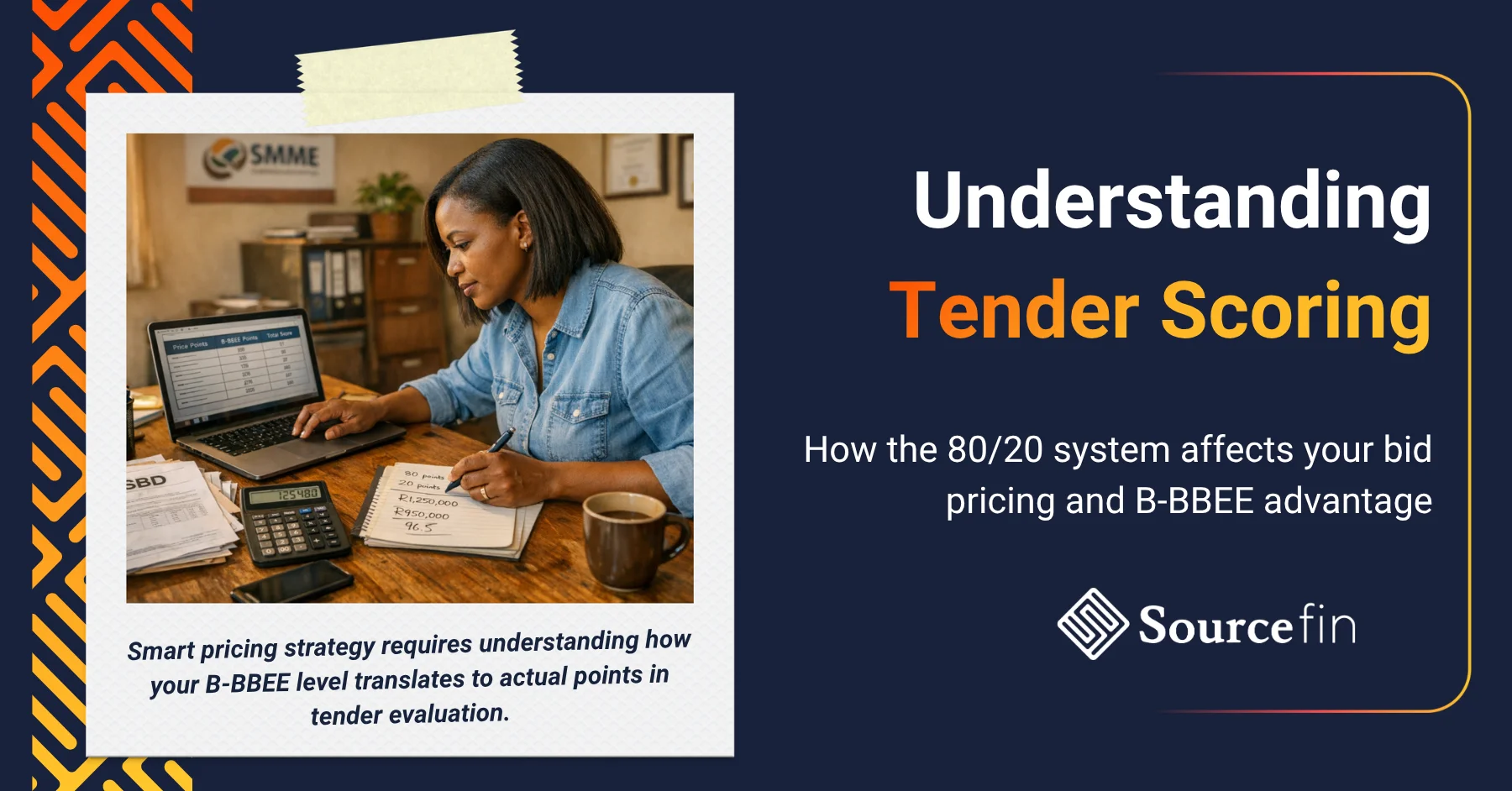

The 80/20 preference point system applies to South African government tenders valued from R30,000 up to R50 million. Under this system, price receives maximum 80 points (lowest bidder gets 80), whilst B-BBEE status receives maximum 20 points (Level 1 gets 20). Tenders above R50 million use the 90/10 system. The 80/20 preference point system ensures highest total score wins the contract.
Government tenders aren’t awarded to the cheapest bid. If you’ve been avoiding tendering because you can’t match the lowest prices, you’re misunderstanding how tender evaluation actually works in South Africa. The Preferential Procurement Policy Framework Act requires organs of state to use the 80/20 preference point system (or 90/10 for high-value contracts) that considers both price and transformation goals.
The 80/20 and 90/10 systems determine how your tender submission gets scored. Understanding the mathematics behind these systems changes how you approach pricing – you’ll know exactly when your B-BBEE level gives you room to price higher, and when you need to sharpen your pencil regardless of your transformation credentials.
This isn’t abstract policy. These are the actual formulas that procurement officials use to calculate your score. Getting the maths right affects whether you win or lose.
When Each System Applies
The R50 million threshold determines which preference points system evaluates your bid. National Treasury’s 2022 Preferential Procurement Regulations establish this clearly – tenders from R30,000 up to R50 million (including all applicable taxes) use the 80/20 system. Tenders above R50 million use 90/10.
Before 2017, the threshold sat at R1 million, which meant the 90/10 system applied to most tenders. That gave price overwhelming dominance and made B-BBEE points almost irrelevant for larger opportunities. The shift to R50 million means the vast majority of government procurement now happens under 80/20, where transformation points carry more weight.
The tender advertisement will state which system applies. You’ll see language like “the estimated value of this tender is R15 million and therefore the 80/20 preference points system applies” in the bid documents. If you’re unsure whether a tender sits above or below R50 million, the procurement office has already made that determination before advertising – they’ll tell you which system they’re using.
Both systems follow the same principle: you get points for price and points for B-BBEE status, which combine to a total score out of 100. The difference is the weighting between the two components.
How the 80/20 Preference Point System Scoring Works
Under the 80/20 preference point system, the lowest acceptable bidder receives 80 points automatically. Everyone else gets fewer price points based on how much more expensive their bid is compared to that lowest bid. The formula is: Price Points = 80 × (1 – (Your Price – Lowest Price) / Lowest Price)
This means if the lowest acceptable bid is R1 million and you quoted R1.2 million (20% higher), your price points would be 80 × (1 – 0.2) = 64 points. You’ve lost 16 price points because you’re 20% more expensive than the lowest bidder.
The B-BBEE component allocates maximum 20 points based on your level. Level 1 contributors get 20 points, Level 2 gets 18 points, Level 3 gets 14 points, Level 4 gets 12 points, and so on down to Level 8 (1 point) and non-compliant (0 points). The scale isn’t linear – the gap between Level 1 and Level 2 is 2 points, but the gap between Level 2 and Level 3 is 4 points.
Your total score adds your price points and B-BBEE points together. The highest total wins, regardless of whether that bidder submitted the lowest price. This is where transformation credentials can overcome pricing disadvantages – or where weak B-BBEE status forces you to price aggressively to compensate.
Worked Example: When B-BBEE Overcomes Price
Consider a tender where Company A (Level 1 B-BBEE) bids R1.02 million and Company B (Level 4 B-BBEE) bids R1 million. Company B submitted the lowest price, so they get 80 price points and 12 B-BBEE points, totalling 92 points.
Company A’s price is 2% higher. Their price points are 80 × (1 – 0.02) = 78.4 points. But they’re Level 1, so they get 20 B-BBEE points. Their total is 98.4 points. Company A wins despite being more expensive, because their 8-point B-BBEE advantage (20 vs 12) overcame their 1.6-point price disadvantage.
Now consider the same companies but Company A bids R1.2 million instead. Company B still gets 92 points total. Company A’s price is now 20% higher, giving them 80 × (1 – 0.2) = 64 price points. Adding their 20 B-BBEE points gives 84 points total. Company B wins this time – the 8-point B-BBEE advantage couldn’t overcome a 16-point price gap.
The lesson: B-BBEE points matter, but they can’t save uncompetitive pricing. Under the 80/20 preference point system, an 8-point B-BBEE advantage (Level 1 vs Level 4) translates to roughly 10% price tolerance. Price more than 10% above the lowest bid, and your transformation credentials won’t rescue you.
How 90/10 Changes the Calculation
The 90/10 system works identically to 80/20, just with different weightings. Price receives maximum 90 points, B-BBEE receives maximum 10 points. The lowest bidder gets 90 price points automatically, others get proportionally fewer. Level 1 B-BBEE gets 10 points, Level 2 gets 9 points, Level 3 gets 6 points, Level 4 gets 5 points, and so on.
The narrower B-BBEE spread makes price more dominant. A Level 1 contributor’s advantage over Level 4 shrinks from 8 points (under 80/20) to 5 points (under 90/10). That 5-point advantage translates to roughly 5-6% price tolerance before you lose to a cheaper competitor with weaker B-BBEE.
High-value tenders above R50 million use 90/10 because these contracts typically involve infrastructure, construction, or complex services where price competitiveness matters more than transformation points. The government wants value for money on major capital projects, even whilst maintaining transformation goals. The 90/10 weighting reflects that priority.
For businesses with weak B-BBEE credentials, 90/10 tenders are actually more accessible than 80/20 opportunities. Your transformation deficit matters less when B-BBEE only contributes 10% of the total score. If you can price competitively, you can win even as a non-compliant bidder – though you’re starting from a disadvantage.
What Your B-BBEE Level Means in Points
Your B-BBEE certificate or affidavit shows your level, which directly converts to points. Under 80/20: Level 1 gets 20 points, Level 2 gets 18, Level 3 gets 14, Level 4 gets 12, Level 5 gets 8, Level 6 gets 6, Level 7 gets 4, Level 8 gets 2, and non-compliant gets 0.
Under 90/10: Level 1 gets 10 points, Level 2 gets 9, Level 3 gets 6, Level 4 gets 5, Level 5 gets 4, Level 6 gets 3, Level 7 gets 2, Level 8 gets 1, and non-compliant gets 0.
You claim these points by completing SBD 6.1 form (Preference Points Claim Form) and attaching your B-BBEE proof. If you don’t submit B-BBEE documentation with your tender, procurement assumes you’re claiming zero B-BBEE points – you’ll score only on price, which puts you at severe disadvantage against competitors who did claim points.
The points table isn’t negotiable. Procurement officials don’t have discretion to award partial points or adjust levels. Your certificate states your level, the regulations specify the points for that level, and that’s what you receive. This is why getting your B-BBEE documentation right matters – it’s not just compliance paperwork, it’s points that directly affect your competitive position.
Compliance Comes First
Preference points only matter if your bid passes the compliance evaluation stage first. Disqualification happens before scoring begins. Missing mandatory documents, unsigned forms, late submissions, expired certificates – any compliance failure eliminates your bid regardless of how strong your price or B-BBEE points would have been.
Some tenders include a functionality threshold before the points system applies. The tender might require bidders to score minimum 70% on technical capability, experience, or methodology. Only bids that meet the functionality threshold advance to the price-plus-B-BBEE scoring stage. Your functionality score isn’t added to your points – it’s a gate you must pass, after which only price and B-BBEE matter.
The evaluation sequence is: compliance check, functionality assessment (if required), preference points scoring. You need to clear each stage before the next one matters. Understanding the 80/20 or 90/10 system helps you price strategically, but it doesn’t excuse sloppy compliance or weak technical responses.
Strategic Implications for Pricing
Knowing the 80/20 preference point system changes how you approach bid pricing. If you’re Level 1 B-BBEE and your competitors are Level 4, you have roughly 10% pricing room under this system (or 5-6% under 90/10). You can afford to price slightly higher and still win on points. This matters when your actual costs are marginally higher than competitors – your B-BBEE advantage compensates.
If you’re Level 4 or lower, you need aggressive pricing to overcome the points disadvantage. A Level 4 bidder competing against Level 1 companies needs to price at least 10% cheaper under 80/20 just to equalise the total score. Price the same and you lose by 8 points. Price 5% cheaper and you still lose by 4 points. The mathematics forces you to be genuinely competitive on price.
Non-compliant bidders face severe disadvantage. Starting with zero B-BBEE points means you need to be the cheapest bid to have any chance. Even then, if two other bidders are close on price but have B-BBEE points, their totals will exceed yours. The 80/20 preference point system particularly punishes non-compliance – you’re surrendering 20% of your total possible score before pricing even enters the equation.
This is why tender strategy considers B-BBEE status before you even decide which opportunities to pursue. Your level determines which tenders are realistically winnable and how aggressive your pricing needs to be. Pursuing tenders where your B-BBEE disadvantage requires unsustainably low pricing just wastes time and resources.
Breaking Deadlocks
When two bidders score exactly the same total points, the regulations provide a clear tie-breaking sequence. First, the contract goes to the bidder with higher B-BBEE points. If both scored the same B-BBEE points, it goes to the bidder with higher price points (meaning lower price). If both are still tied, the contract is awarded by drawing lots.
Deadlocks are rare but not impossible. They’re more likely in tenders where multiple bidders hold the same B-BBEE level and quote very similar prices. When it happens, the preference for higher B-BBEE points means transformation wins over price – the regulations prioritise the PPPFA’s transformation objectives even in tie situations.
This tie-breaking sequence reinforces why B-BBEE matters. Even in a perfect pricing tie, your transformation credentials give you the advantage. The system consistently favours businesses that contribute to economic transformation, which is exactly what the policy framework intends.
From Points to Contract Execution
Winning the points calculation gets you the contract. Delivering the contract requires working capital. Government departments pay on 30-day terms, but you need to buy materials, pay suppliers, and cover operations immediately. The gap between contract award and payment receipt can strain cash flow for businesses that bid aggressively on price to win.
This is where purchase order funding changes the equation. You can bid based on your competitive position rather than your bank balance, knowing funding releases when the purchase order is issued. Your B-BBEE points helped you win – proper funding structures help you execute professionally without cash flow constraints.
The preference points system opens opportunities for businesses with strong transformation credentials. Those opportunities only translate to growth when you can actually deliver the work. Understanding the scoring helps you win contracts. Having the working capital to execute them turns winning into sustainable business development.
Sources & References
FAQs
What's the difference between the 80/20 and 90/10 preference points systems?
The 80/20 system applies to tenders from R30,000 up to R50 million, allocating 80 points maximum for price and 20 points maximum for B-BBEE status. The 90/10 system applies to tenders above R50 million, allocating 90 points for price and 10 points for B-BBEE. Both systems add your price points and B-BBEE points to a total out of 100, with highest total score winning. The 90/10 system makes price more dominant because B-BBEE points carry less weight.
Can I win a government tender with a higher price if my B-BBEE level is better?
Yes, but only within limits. Under the 80/20 system, a Level 1 B-BBEE contributor has roughly 10% pricing tolerance over a Level 4 competitor before losing on total points. Under 90/10, that tolerance shrinks to about 5-6%. If you price significantly higher than the lowest bid, even excellent B-BBEE credentials won’t overcome the points gap. B-BBEE helps you win with modest price differences, not uncompetitive pricing.
How many points does each B-BBEE level receive under the 80/20 system?
Under 80/20: Level 1 gets 20 points, Level 2 gets 18 points, Level 3 gets 14 points, Level 4 gets 12 points, Level 5 gets 8 points, Level 6 gets 6 points, Level 7 gets 4 points, Level 8 gets 2 points, and non-compliant contributors get 0 points. The point gaps aren’t equal between levels – moving from Level 2 to Level 1 gains you 2 points, but moving from Level 3 to Level 2 gains you 4 points.
What happens if two bidders get exactly the same total points score?
The tender goes to the bidder with the highest B-BBEE points. If B-BBEE points are also equal, it goes to the bidder with the highest price points (lowest price). If everything is still tied, the contract is awarded by drawing lots. The tie-breaking sequence favours transformation over price, which aligns with the Preferential Procurement Policy Framework Act’s objectives. Deadlocks are rare but the regulations provide a clear resolution process.
Do I get any points if I don't submit B-BBEE documentation with my tender?
No. If you don’t submit B-BBEE proof (certificate or affidavit) with your tender bid, procurement officials assume you’re claiming zero B-BBEE points. You’ll score only on price, which puts you at severe disadvantage. Under 80/20, you’re surrendering 20 possible points. Under 90/10, you’re surrendering 10 points. Even if you’re the cheapest bidder, competitors with B-BBEE points will often beat your total score.
Can non-compliant bidders (no B-BBEE status) win government tenders?
Technically yes, but it’s extremely difficult under the 80/20 system. Non-compliant bidders get 0 B-BBEE points, so they need to be significantly cheaper than competitors to overcome the points deficit. If you’re non-compliant and a Level 1 competitor quotes within 10% of your price, they’ll beat you on total points. The 90/10 system (tenders above R50 million) is slightly more accessible for non-compliant bidders because B-BBEE carries less weight, but you’re still starting from disadvantage.
Does the preference points system apply to all government tenders?
The preference points system applies to tenders from R30,000 upward. Tenders below R30,000 (which are typically quotation processes rather than formal tenders) may use simplified procurement procedures. The system applies to all organs of state – national departments, provincial governments, municipalities, state-owned enterprises, and public entities. The tender advertisement will confirm which preference points system applies (80/20 or 90/10) based on the estimated contract value.