
Invoice Discounting Timeline South Africa: Real Guide
Wondering how long invoice discounting takes to set up in SA? Here's the realistic timeline from application to first advance – and what speeds it up.
On this page
- Key Takeaways
- Invoice Discounting Timeline South Africa: The Realistic Picture
- Stage One: Application to First Contact
- Stage Two: Document Submission to Facility Review Start
- Stage Three: Facility Review and Structured Proposal
- Stage Four: Setup and First Advance
- What Gates the Schedule
- How to Move Your Specific Facility Faster
- How Invoice Discounting Timing Compares to Other Funding Routes
- The Bigger Picture for SA SMMEs
- Frequently asked questions
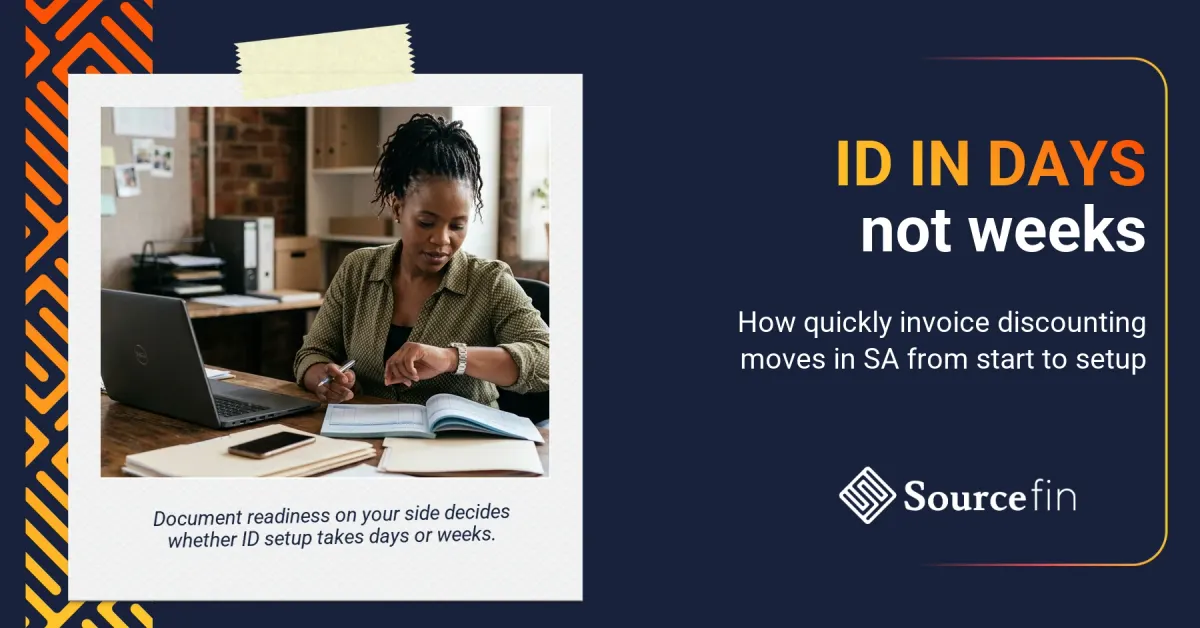
Invoice discounting timeline South Africa moves in days for a straightforward facility when the documents are ready and the receivables book is clean. A typical cycle runs from application submission to first acknowledgement on the same or next business day, through to a structured proposal within several business days, and on to first advance once the proposal is accepted. Document readiness on the SMME side is the biggest variable.
Key Takeaways
- The application form takes a couple of minutes – it is not what gates the timeline.
- A Sourcefin representative follows up shortly after submission to discuss your receivables book.
- Once requested documents are sent, the facility review typically completes within a few business days for clean books.
- Document readiness on the SMME side is the single biggest factor in setup speed.
- Complex facilities (high concentration, unusual sectors, large books) take longer because more verification is needed.
- The actual cash advance follows acceptance of the structured proposal and the agreed customer-payment process.
Invoice Discounting Timeline South Africa: The Realistic Picture
Speed is one of the main reasons SMMEs choose invoice discounting over a traditional bank facility. The structure is built around a defined receivables book rather than a multi-week credit committee process. That said, "fast" still depends on a handful of factors that vary deal to deal. Knowing what shapes the invoice discounting timeline South Africa lets you set realistic expectations and move your specific facility faster.
For broader context on how invoice discounting works, the wider invoice discounting South Africa pillar guide covers the model end to end. This article focuses on the timing.
Stage One: Application to First Contact
The application form itself is short. Name, contact number, WhatsApp if different, email, what kind of funding you need, and how much. Most applicants complete it in a couple of minutes. Submission is online and a confirmation lands in your inbox immediately.
From there, a Sourcefin representative reads the application and follows up. The first contact is usually a phone call or WhatsApp message, not just an automated acknowledgement. The conversation covers your business, your customer base, your typical receivables, and what documents will be needed.
For a sense of what the form actually asks, the how to apply for invoice discounting walkthrough explains the application process step by step.
Stage Two: Document Submission to Facility Review Start
The conversation with the representative determines which documents are needed. The essentials are usually your CIPC certificate and a recent customer list with payment terms. Sending your SARS tax PIN, recent bank statements, sample invoices, and ID copies with the initial document batch moves things faster.
The full requirements picture sits in the invoice discounting requirements South Africa guide. Document readiness on your side is the single biggest factor in how quickly stage two completes. An applicant who has the documents organised and uploaded within hours of the conversation puts the facility review in motion that same day. An applicant who takes a week to gather everything stretches the entire timeline by that week.
Stage Three: Facility Review and Structured Proposal
Once the documents are in, the facility review begins. The funder assesses three areas: trust (your business profile), the receivables book (customer concentration, payment cycles, invoice quality), and the operational fit (how the facility will run alongside your existing banking).
For a straightforward facility – a clean receivables book with creditworthy customers and complete documentation – the review typically completes within a few business days. A structured proposal is built setting out the advance percentage on each invoice, the fee structure, the timing, and the customer-payment process.
The proposal is yours to review. Questions, adjustments, and clarifications happen here. Once accepted, the facility moves to setup.
Stage Four: Setup and First Advance
The first advance follows facility setup, which involves agreeing the customer-payment process, finalising the funding documentation, and sometimes registering with payment-collection systems. For a confidential facility (where customers are not told the funder exists), setup is often faster. Disclosed facilities require a notification step to customers.
From the SMME owner's perspective, the practical timeline is: application submitted on Monday, representative call within hours, documents submitted Tuesday, facility review and proposal by end of week, setup and first advance by the following Monday or Tuesday. That is the rhythm for a straightforward, well-documented facility.
What Gates the Schedule

Five factors most commonly stretch the invoice discounting timeline South Africa beyond the straightforward case.
Document readiness on the SMME side. Missing or out-of-date SARS compliance, no current bank statements, no aged debtors report – any of these stalls the facility review. Time spent gathering documents is time the funder cannot work.
Customer concentration verification. A book with significant exposure to one or two customers needs more verification – the funder may need to validate payment history, contact references, or check trade references – which adds days.
Customer creditworthiness checks. If the funder is unfamiliar with key customers in your book, additional verification is required. Familiar buyers (government departments, SOEs, listed corporates) move faster.
Facility complexity. A simple monthly invoicing pattern moves faster than a multi-currency export facility or a complex retention-and-progress-billing structure.
Disclosure of unusual issues. A credit history that needs explanation, a recent legal dispute, or an unusual ownership structure all require more conversation. Honest, upfront disclosure is faster than partial disclosure that gets caught later in the review.
How to Move Your Specific Facility Faster
The single biggest accelerator is document readiness. Pull together the essentials – CIPC, customer list with payment terms – before submitting. Have the bonus documents (Tax PIN, bank statements, sample invoices, ID copies) ready to send the moment the representative asks for them. A 24-hour document turnaround on your side keeps the facility review running on Sourcefin's side.
The second is honest, specific framing of your receivables book. "Mostly corporate customers" is not enough. Which corporates, what payment terms, what typical invoice value, what monthly turnover, where the concentration sits? Specifics let the funder assess quickly.
The third is choosing the right funder for your book type. The invoice discounting company South Africa guide covers what to look for, including how a funder's familiarity with your sector affects timing. A funder who has done dozens of similar facilities moves faster than one starting from scratch on your customer mix.
How Invoice Discounting Timing Compares to Other Funding Routes
For a receivables-driven cash flow gap, invoice discounting is generally the fastest formal funding route in South Africa. A new bank credit application typically follows committee timelines that run weeks rather than days, and the documentation requirement is heavier. The invoice discounting vs bank overdraft guide walks through the difference.
An existing overdraft is faster still – but limits are often too small for meaningful receivables. PO funding moves on its own track, focused on contract-specific working capital before delivery. Each tool has its place. The right one depends on what you are funding and how fast you need it.
The Bigger Picture for SA SMMEs
South Africa's SMME funding landscape has been moving faster overall in recent years. The IFC's recent SA SMME finance partnership work highlights how alternative routes – invoice discounting among them – have widened access at the speeds that working-capital-driven SMMEs actually need. For an SMME with a meaningful receivables book and a real cash flow gap, the ability to move from application to first advance in days rather than weeks can be the difference between operating cleanly and chasing payments.
To set up an invoice discounting facility for your business, the Sourcefin funding application form is the starting point. The Sourcefin invoice discounting service page sets out the full process from there.
Sources & References
Frequently asked questions
How long does invoice discounting take from application to first advance in South Africa?
For a straightforward, well-documented facility with a clean receivables book, the cycle runs from same-day application to first advance within a working week. The application form takes a couple of minutes, a Sourcefin representative follows up shortly after, the facility review completes within a few business days once documents are submitted, and setup follows once the structured proposal is accepted.
What is the single biggest factor in how fast invoice discounting moves?
Document readiness on the SMME side. The funder cannot start the facility review until the requested documents are submitted. An applicant who has the customer list, recent invoices, and standard compliance pack ready to send within hours of the conversation puts the facility review in motion the same day. Slow document gathering stretches the entire timeline.
Can invoice discounting move faster than a bank overdraft application?
For a new facility, yes. Bank credit applications follow committee timelines that run weeks, with comprehensive documentation and security verification stages. Invoice discounting is built around a defined receivables book and does not require security registration, so it moves in days rather than weeks. An existing overdraft is faster to draw on, but is often too small for meaningful receivables.
What kind of facility stretches the timeline beyond the standard case?
Five things commonly add days: incomplete documentation on the SMME side, unverifiable customer concentration, customers the funder is unfamiliar with (requiring extra credit checks), facility complexity (multi-currency, retention provisions, unusual structures), and unusual issues that need explanation. Honest upfront disclosure of any complications is faster than discovery later.
Is there an express or rush option for urgent invoice discounting setup?
There is no separate fast-track product. The standard process is structured to move quickly when documents are ready. The practical rush option is for the SMME to have everything organised before the conversation, send documents within hours of the request, and be available to answer questions immediately. That keeps the facility review running on the funder's side without delay.
When does the actual cash advance get paid out?
After facility setup, the first advance against your invoices typically follows within hours of agreeing the customer-payment process and finalising the funding documentation. For confidential facilities (where customers are not told the funder exists), setup is often faster. Disclosed facilities require a notification step to customers, which adds a small amount of time.
How long does invoice discounting take for a first-time applicant?
First-time applicants are not slower in any structural sense. The facility review covers the same areas regardless of application history. What can take an extra step or two is the trust pillar – the funder may want a longer conversation about your business background, customer relationships, and why you are looking for the facility now. Honest, specific framing speeds this up significantly.

Sourcefin is a South African alternative finance provider that offers purchase order funding and invoice discounting to SMMEs, enabling businesses to fulfil confirmed purchase orders or tenders and unlock cash flow without collateral. Unlike traditional lenders or banks, Sourcefin also provides end-to-end support including supplier sourcing, logistics, project management, and risk oversight.