
Invoice Discounting vs Trade Finance: Smart SA Comparison
Invoice discounting vs trade finance in South Africa. How the two products differ, when each fits, and how SA SMMEs choose the right one for their deal.
On this page
- Key Takeaways
- Where invoice discounting vs trade finance sits in the picture
- What invoice discounting actually is
- What trade finance covers that invoice discounting does not
- When invoice discounting vs trade finance: invoice discounting is the right tool
- Invoice discounting vs trade finance: when the broader toolkit fits better
- How invoice discounting and broader trade finance work together
- Where Sourcefin lands
- Frequently asked questions
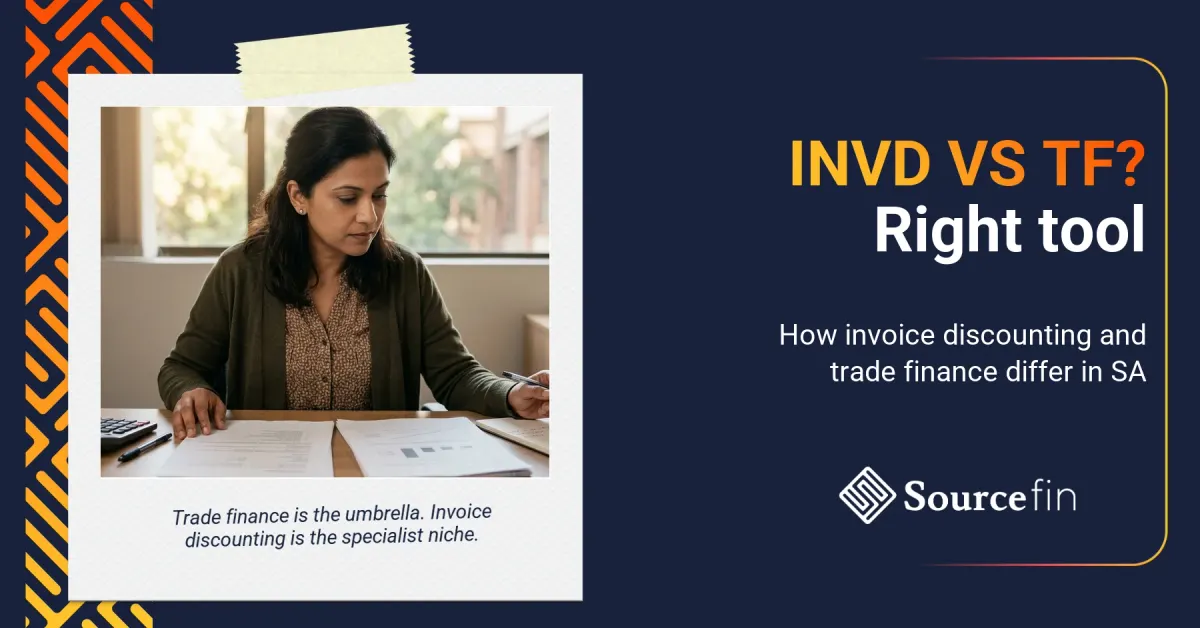
Invoice discounting vs trade finance is not really a one-or-the-other choice – it is a question of which product inside a broader category fits the deal in front of the SMME. Trade finance is the umbrella term for the full set of tools banks and specialist funders use to facilitate trade: letters of credit, bank guarantees, structured commodity finance, supply chain finance, and receivables products. Invoice discounting is one specialist product inside that umbrella, focused on funding receivables once goods or services have been delivered. For SA SMMEs invoicing local corporate or government customers, invoice discounting is usually the practical entry point.
Key Takeaways
- Invoice discounting vs trade finance is a category-vs-product distinction. Trade finance is the umbrella; invoice discounting is one specialist receivables product inside it.
- Trade finance includes letters of credit, bank guarantees, structured commodity finance, supply chain finance, and receivables products such as invoice discounting and factoring.
- Invoice discounting funds a specific receivable after delivery – not a credit line, not collateral against a balance sheet.
- For SA SMMEs invoicing local customers, invoice discounting is usually the practical entry product. Broader trade finance instruments come in on larger structured or cross-border deals.
- The right product is the one that fits the deal – the question is not which is better in the abstract.
Where invoice discounting vs trade finance sits in the picture
Trade finance is the broad family of products that funds the movement of goods and services through a supply chain. The International Chamber of Commerce publishes the reference standards (UCP for documentary credits, URC for collections, URDG for demand guarantees) that govern most of these instruments globally.
Inside that family sit several distinct products, each suited to a different point in the trade cycle:
- Letters of credit (LCs) – a bank's conditional payment promise, used most often in cross-border trade.
- Bank guarantees and bonds – performance, advance payment, and retention guarantees backing contractual obligations.
- Structured commodity finance – pre-export, pre-payment, and inventory-backed deals for high-value commodity flows.
- Supply chain finance (approved-payables finance) – the buyer's bank advances early payment against approved supplier invoices.
- Purchase order funding – supplier-side funding for raw materials and production before delivery, against a confirmed purchase order.
- Invoice discounting – funding the receivable after the SMME has delivered the goods or completed the service, against a valid customer invoice.
- Invoice factoring – a related receivables product where the funder takes over collections from the customer.
Inside that landscape, invoice discounting vs trade finance is best understood as "which specific tool fits this deal", not as a binary choice.

What invoice discounting actually is
Invoice discounting funds a receivable that already exists. The SMME has delivered the goods or completed the service, an invoice has been issued, and the customer is on a payment term – typically 30, 60, or 90 days. Sourcefin advances against that invoice, and the customer's payment settles the deal when it arrives.
Key characteristics:
- Deal-based, not balance-sheet-based. The assessment is on the invoice and the customer paying it.
- The SMME retains the customer relationship and collections. The customer pays the SMME, not the funder.
- Sourcefin verifies the invoice with the customer to confirm it is valid, processed, and on track for payment.
- Cost is a discount cost on the advance – no separate service fee on Sourcefin's pricing model.
- SA-based customers only. Invoice discounting at Sourcefin does not fund invoices on international end buyers.
For a deeper look at the mechanics, see invoice discounting requirements in South Africa.
What trade finance covers that invoice discounting does not
The other instruments inside the trade finance family do work invoice discounting cannot:
- Cross-border payment security. A letter of credit backed by the customer's bank gives an SMME exporter payment certainty against documentary evidence. Invoice discounting does not provide payment security – it advances cash against a receivable that still depends on the customer paying.
- Performance and advance-payment guarantees. Bank guarantees protect the customer if the SMME fails to perform. Invoice discounting is not a contractual undertaking on performance.
- Pre-delivery working capital on confirmed orders. Purchase order funding (a related supplier-side product) funds raw materials, sub-contractor payments, and production costs before delivery. Invoice discounting only kicks in after delivery.
- Whole-of-supply-chain solutions. Supply chain finance programmes run through the buyer's bank against approved-payables files – usually for established large-corporate supplier panels.
When the working-capital need is supplier-side (raw materials, sub-contractor advances), the right product is purchase order funding, not invoice discounting. The companion guide PO funding vs invoice discounting covers that comparison.
When invoice discounting vs trade finance: invoice discounting is the right tool
Invoice discounting fits when:
- The SMME has delivered the goods or completed the service.
- The invoice is valid, processed by the customer, and uncontested.
- The customer is SA-based and credit-credible.
- The funded amount is meaningful – most Sourcefin-funded deals start at around R250,000.
- The SMME has the operational capacity to keep the customer relationship and collections in-house.
This is the practical entry point for SA SMMEs invoicing local corporate or government customers on standard payment terms.
Invoice discounting vs trade finance: when the broader toolkit fits better
The broader trade finance instruments fit when the deal sits outside what invoice discounting covers:
- The end buyer is international – the right tool is a letter of credit or export credit insurance, not invoice discounting.
- The customer requires a performance guarantee, advance payment guarantee, or retention bond – a bank guarantee fits, not invoice discounting.
- The deal is pre-delivery and the SMME needs working capital for production – purchase order funding fits.
- The deal is part of a buyer-led supplier-finance programme – the buyer's supply chain finance platform handles it.
Banks remain the natural home for letters of credit, bank guarantees, and supply chain finance. Banks are built for stability and infrastructure; specialist funders like Sourcefin are built for speed on specific deals. Both have a place – the question is what the deal in front of the SMME needs.
How invoice discounting and broader trade finance work together
In real SMME life, the two often run side by side, not against each other. A common pattern:
- The SMME wins a contract and the customer requires a performance guarantee – the bank issues the guarantee.
- The SMME needs working capital for production before delivery – purchase order funding from a specialist funder covers the supplier-side cost.
- Once delivered, the invoice is issued on a 30 or 60-day customer term – invoice discounting funds the gap until the customer pays.
The right answer to invoice discounting vs trade finance is not exclusivity – it is layering the right tool at the right point in the deal.
Where Sourcefin lands
Sourcefin has deployed R3 billion-plus in working capital to South African SMMEs since 2020 with a 100% delivery rate on funded deals, and was named NSBC Funder of the Year 2026. The Sourcefin invoice discounting model is deal-based, SA-customer-focused, and built to slot alongside the broader trade finance instruments banks provide – not against them.
For broader context, the Department of Small Business Development publishes SA small-business policy, and the IFC SME Finance Forum publishes the global MSME Finance Gap database.
If your SMME is sitting on uncontested customer invoices and the deal needs working capital after delivery, invoice discounting is the practical tool. Start at the funding application page or read more about how invoice discounting works at Sourcefin.
Sources & References
- International Chamber of Commerce – Trade finance reference standards (UCP, URC, URDG).
- Department of Small Business Development – SA small-business policy and reporting.
- IFC SME Finance Forum – Global MSME Finance Gap database, World Bank Group.
Frequently asked questions
What is the difference between invoice discounting vs trade finance?
Trade finance is the broad umbrella term for products that facilitate trade – letters of credit, bank guarantees, structured commodity finance, supply chain finance, purchase order funding, and receivables products. Invoice discounting is one specialist receivables product inside the trade finance family. Invoice discounting funds a specific invoice after delivery; trade finance covers the broader toolkit across the whole trade cycle.
Is invoice discounting cheaper than other trade finance products?
Cost depends on the deal, not on the product label. Invoice discounting carries a discount cost on the advance and no separate service fee on Sourcefin's model. Letters of credit, bank guarantees, and structured commodity deals carry different fee structures because they cover different risks. Comparing cost across products is only meaningful when comparing like-for-like deal economics.
Can an SMME use invoice discounting and other trade finance products at the same time?
Yes. In practice the products often layer on the same deal. A bank may issue a performance guarantee, purchase order funding may cover production costs before delivery, and invoice discounting may fund the receivable after delivery. The right answer is rarely one product – it is the right tool at the right point in the deal.
Does invoice discounting work for international customers?
Sourcefin's invoice discounting funds SA-based customer invoices only. International receivables sit in cross-border trade finance territory – typically letters of credit, export credit insurance, or specialist cross-border receivables structures. For local SA customer invoices, invoice discounting is the practical product.
Is trade finance only available from banks?
Letters of credit, bank guarantees, and supply chain finance programmes are typically bank products, because they require a banking infrastructure to issue. Receivables products like invoice discounting and purchase order funding are widely available from specialist funders. Banks are built for stability and infrastructure; specialist funders are built for speed on specific deals. The two work alongside each other.
Where should an SA SMME start when choosing between invoice discounting vs trade finance?
Start with the deal in front of you. If the deal is post-delivery, on an SA customer, with a clean invoice – invoice discounting is the entry point. If the deal is cross-border, requires a guarantee, or needs pre-delivery production finance – the broader trade finance toolkit applies. Sourcefin's deal team helps SMMEs work out the right structure for the specific deal.

Sourcefin is a South African alternative finance provider that offers purchase order funding and invoice discounting to SMMEs, enabling businesses to fulfil confirmed purchase orders or tenders and unlock cash flow without collateral. Unlike traditional lenders or banks, Sourcefin also provides end-to-end support including supplier sourcing, logistics, project management, and risk oversight.