
Purchase Order Funding for Imports: SA Practical Guide
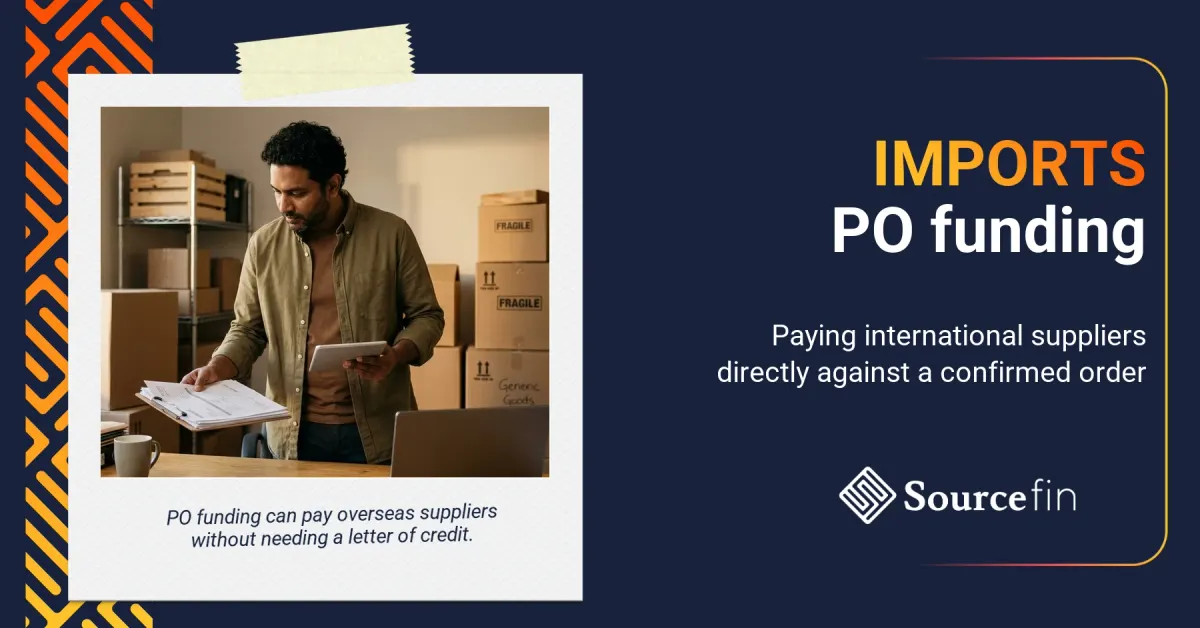
Purchase order funding for imports in South Africa. How Sourcefin pays international suppliers directly against a confirmed order without an LC.
On this page
- Key Takeaways
- How purchase order funding for imports works in practice
- Why purchase order funding for imports does not need a letter of credit
- Common import scenarios SA SMMEs fund with purchase order funding
- FX risk in purchase order funding for imports
- Customs, duties, and VAT on imported orders
- What Sourcefin needs to assess a purchase order funding for imports deal
- How to apply for purchase order funding for imports
- Frequently asked questions
Purchase order funding for imports is how South African SMMEs fund the supply side of confirmed orders that require international sourcing. When the supplier sits overseas and needs payment before shipping, Sourcefin can pay that supplier directly against the confirmed order. No letter of credit needed, no documentary infrastructure layered on top – just the four-question deal assessment applied to an imported supplier path. The SMME imports, delivers, the customer pays, and Sourcefin is repaid from that payment.
Key Takeaways
- Purchase order funding for imports pays the international supplier directly against a confirmed order – without requiring a letter of credit.
- Sourcefin's pre-vetted supplier network spans multiple countries, so verifying overseas suppliers is part of the standard assessment.
- The same four-question deal model applies: confirmed order, credible customer, fundable supplier path, capacity to deliver.
- SA SMMEs use purchase order funding for imports across consumer goods, components, raw materials, specialist equipment, and capital items.
- Apply at the funding application page with the confirmed order, supplier quotation, and basic business documents.
How purchase order funding for imports works in practice
The journey from confirmed order to delivered import looks like this:
- Confirmed order. The SMME wins or receives a verifiable purchase order from an SA customer – government, corporate, or established private-sector buyer.
- Supplier identified. The supplier sits overseas. The supplier quotation specifies the price, the lead time, and the payment terms (often a deposit upfront, balance before shipping).
- Application. The SMME applies to Sourcefin via the funding application, uploading the confirmed order, supplier quotation, and basic business documents.
- Assessment. Sourcefin's deal team verifies the order with the SA customer, assesses the overseas supplier (Sourcefin's pre-vetted network of 2,000+ suppliers worldwide helps here), and confirms the SMME's operational capacity to receive, clear, and deliver the imports.
- Funding decision. Where approved, Sourcefin pays the overseas supplier directly against the confirmed order – in the supplier's required currency where applicable.
- Production and shipping. The supplier produces and ships. Standard import processes apply – customs clearance, duties, VAT on imports.
- Delivery and payment. The SMME delivers to the SA customer. The customer pays on the agreed terms. Sourcefin is repaid from that payment.
For a fuller introduction to the broader Sourcefin model, see the purchase order funding service page.

Why purchase order funding for imports does not need a letter of credit
Letters of credit (LCs) are the traditional bank instrument for cross-border trade. They guarantee payment to the overseas supplier subject to documentary conditions – bills of lading, certificates of origin, inspection certificates, and so on. LCs are well-codified internationally and remain the right tool for many complex cross-border transactions.
For SMME-scale confirmed orders where the SA buyer is identified and credible, an LC often adds documentary weight without proportional benefit. Purchase order funding works differently: Sourcefin pays the overseas supplier directly against the confirmed order from the SA customer. The supplier-payment risk is funded by Sourcefin, not by a bank-issued LC.
This is one of the key practical differences between purchase order funding and broader bank trade finance.
Common import scenarios SA SMMEs fund with purchase order funding
Typical patterns Sourcefin sees:
- Consumer goods retailers – stock orders placed with overseas manufacturers, sold on to SA retailers or directly to consumers.
- Component and parts importers – components needed to fulfil an SA assembly or manufacturing contract.
- Raw materials importers – specialist materials sourced overseas to fulfil an SA manufacturing order. See PO funding for manufacturing SMMEs for the manufacturing-vertical view.
- Specialist equipment importers – capital items sourced overseas against a confirmed SA buyer.
- Branded distributorships – SMMEs holding SA distribution rights for international brands, funding stock orders against confirmed customer demand.
The common thread: a confirmed SA order, an overseas supplier, and a supply-side cash flow gap that purchase order funding closes.
FX risk in purchase order funding for imports
Foreign exchange movement between order date and supplier payment date is a real risk in any import transaction. Practical handling:
- The supplier quotation typically locks the foreign-currency price at the time of quote – but the ZAR equivalent can drift if the SA rand moves against the supplier currency before payment.
- Where the SA customer pays in ZAR on the agreed PO terms, the SMME's margin is exposed to FX movement between quote and customer payment.
- Some SMMEs use forward exchange contracts or other hedging tools through their bank for larger or longer-dated import transactions.
- Sourcefin's assessment includes the FX exposure as part of the deal review – not to remove it, but to size it realistically before funding.
This is a real-world consideration in purchase order funding for imports. It does not block the deal, but it should be factored into the SMME's pricing of the order to the customer.
Customs, duties, and VAT on imported orders
SA imports attract customs duties and VAT, with rates and tariff classifications governed by the South African Revenue Service. The relevant resources are:
- SARS Customs and Excise – publishes SA customs and import regulations.
- ITAC – publishes import permits and tariff information.
Customs duties and VAT on imports are typically the SMME's responsibility, paid on clearance. These costs should be factored into the SMME's pricing of the SA order. Sourcefin's funding focuses on the supplier payment, not on clearance costs.
What Sourcefin needs to assess a purchase order funding for imports deal
The core document set:
- Business registration documents (CIPC)
- Proof of business address and bank account
- The confirmed purchase order from the SA customer
- Supplier quotation(s) from the overseas supplier (with price, currency, and terms)
- ID for the company directors
For sector-specific eligibility detail, see Purchase Order Funding Requirements in South Africa.
How to apply for purchase order funding for imports
The path is direct:
- Open the funding application page and complete the online form.
- Have the confirmed purchase order, overseas supplier quotation, and basic business documents ready.
- Sourcefin's deal team will be in touch to discuss the order, the supplier, and the FX considerations.
For broader context on the SA SMME funding landscape, the Department of Small Business Development publishes SA small-business policy, and the IFC SME Finance Forum publishes the global MSME Finance Gap database covering emerging markets.
For South African SMMEs holding confirmed orders that require international sourcing, purchase order funding for imports is the model built for that exact deal shape – pay the overseas supplier, deliver to the SA customer, get paid, repay the funder.
Sources & References
- SARS Customs and Excise – SA customs and import regulations.
- ITAC – SA import permits and tariff information.
- Department of Small Business Development – SA small-business policy.
- IFC SME Finance Forum – Global MSME Finance Gap database, World Bank Group.
Frequently asked questions
Can Sourcefin pay an overseas supplier for an imported order?
Yes. Sourcefin's purchase order funding for imports pays international suppliers directly against a confirmed SA purchase order. The supplier is paid in the agreed currency, the SMME receives and clears the imports, delivers to the SA customer, and Sourcefin is repaid from the customer payment. No letter of credit is required.
Do I need a letter of credit to import using purchase order funding?
No. One of the practical advantages of purchase order funding for imports is that it does not require an LC. Sourcefin pays the overseas supplier directly against the confirmed SA order. Letters of credit remain the right tool for more complex cross-border structures, but for SMME-scale confirmed import orders, PO funding usually does the same job with less documentary weight.
What about foreign exchange risk on imported orders?
FX risk between the supplier quote and payment is a real consideration in any import transaction. Sourcefin's assessment includes FX exposure in the deal review. Some SMMEs use forward exchange contracts or other hedging tools through their bank for larger or longer-dated deals. The exposure should be factored into the SMME's pricing of the SA order.
Does Sourcefin cover customs duties and VAT on imports?
Sourcefin's funding focuses on the supplier payment side of the deal. Customs duties and VAT on imports are typically the SMME's responsibility, paid on clearance. These costs should be factored into the SMME's pricing of the SA order. SARS publishes the current rates and tariff classifications.
Which industries use purchase order funding for imports?
Common patterns include consumer goods retailers placing stock orders with overseas manufacturers, component and parts importers, raw materials importers for SA manufacturing contracts, specialist equipment importers, and SMMEs holding SA distribution rights for international brands. The shared shape is a confirmed SA order with an overseas supplier.
What documents does Sourcefin need for purchase order funding for imports?
Business registration documents (CIPC), proof of business address and bank account, the confirmed purchase order from the SA customer, supplier quotation(s) from the overseas supplier with price, currency, and terms, and ID for the company directors. Additional documents may be requested depending on the deal.

Sourcefin is a South African alternative finance provider that offers purchase order funding and invoice discounting to SMMEs, enabling businesses to fulfil confirmed purchase orders or tenders and unlock cash flow without collateral. Unlike traditional lenders or banks, Sourcefin also provides end-to-end support including supplier sourcing, logistics, project management, and risk oversight.