
Diesel Tender Funding South Africa: Practical SMME Playbook
Diesel tender funding South Africa: how SMMEs bid and deliver diesel-supply tenders using PO funding, invoice discounting and clean SARS, CSD and BBBEE files.
On this page
- Key Takeaways
- What Diesel Tender Funding South Africa Actually Covers
- How a Diesel Supply Tender Is Actually Structured
- The Upfront Cash-Flow Problem on Diesel Tenders
- How Purchase Order Funding Works on a Diesel Tender
- The Compliance Gate: What You Need Before You Bid
- Realistic Deal Sizes and the R250,000 Floor
- Where Invoice Discounting Picks Up the Tender Billing Cycle
- Building a Credible Bid File for a Diesel Tender
- What to Do in the Two Weeks Before Bid Submission
- Frequently asked questions
Diesel tender funding South Africa is the working-capital answer for SMMEs that win a diesel-supply contract with a government department, municipality, state-owned entity or large corporate but cannot front the upfront fuel cost from their own balance sheet. The two products that do most of the work are purchase order funding for the upfront supply leg and invoice discounting for the recurring monthly delivery billing that follows. Used in sequence they cap the SMME's exposure to one stage of the contract at a time. The compliance file matters as much as the funding line itself. CSD registration, current SARS tax compliance status, valid CIPC filing and a current B-BBEE certificate are the gate to almost every diesel tender award.
Key Takeaways
- Diesel tenders combine an upfront supply leg with monthly delivery billing over a 12 to 36 month term. The cash-flow shape is predictable, which is why working-capital funders are comfortable behind the right contract.
- Purchase order funding pays the fuel supplier directly. Invoice discounting picks up the recurring monthly billing once delivery has happened.
- CSD, SARS, CIPC and B-BBEE need to be current before bid submission. Where the SMME also moves the diesel, DMRE fuel transport licensing applies.
- Realistic deal sizes sit from a R250,000 floor for short municipal supply orders up to R30 million for multi-year SOE and large-corporate contracts. Most active deals fall between R2 million and R30 million.
- The credibility of the bid file rests on clean compliance, a verified creditworthy buyer, and a funding letter from a recognised funder.
- A blended PO funding plus invoice discounting structure caps SMME exposure to one stage of the contract at a time.
What Diesel Tender Funding South Africa Actually Covers
The phrase covers the working-capital products SMMEs use to bid on, fund and deliver diesel-supply contracts. The two products that matter are purchase order funding for the upfront supply leg and invoice discounting for the recurring monthly billing. Each is built around a verified contract or invoice rather than the SMME's own balance sheet, which is what makes them usable for businesses that have won real work but cannot front the cash.How a Diesel Supply Tender Is Actually Structured
Most South African diesel-supply tenders follow a recognisable pattern. The buyer publishes a request for proposals or quotations, sets out a forecast monthly diesel volume, defines the delivery sites and frequency, and specifies payment terms. Government and SOE tenders are published through the National Treasury eTender Publication Portal, with municipal opportunities surfacing on individual municipal sites. Private corporate tenders typically run through a vendor list or the buyer's own portal. The contract itself almost always splits into two billing legs. The supply leg: each delivery is preceded by a purchase order against the master agreement, the SMME procures the diesel from a wholesale fuel supplier, and the diesel is delivered to the buyer's site. The billing leg: at month-end the SMME invoices the buyer for the volume actually delivered, on payment terms typically running 30, 60 or 90 days. Government and SOE buyers tend to sit on the longer end of that range, with the Public Finance Management Act setting the broader payment framework that National Treasury publishes for departmental compliance. The cash-flow shape is predictable. The SMME outlays cash on each delivery, then waits 30 to 90 days for the corresponding invoice to clear. Across a 12 to 36 month contract, that pattern repeats every cycle. The funder's job is to absorb the gap so the SMME can keep delivering.The Upfront Cash-Flow Problem on Diesel Tenders
Diesel is a low-margin, high-volume product. Wholesale fuel suppliers do not extend long credit terms on bulk orders, particularly to younger or smaller bidders. The practical reality for an SMME holding a fresh diesel supply tender award is that the supplier wants payment on or near delivery, while the buyer pays on standard tender terms 30 to 90 days later. That gap is the working-capital problem that diesel tender funding south africa products are built to absorb. The size of the gap scales with the contract. A small municipal supply contract of 20,000 litres a month carries a monthly fuel cost in the high hundreds of thousands of rands. A medium SOE contract of 200,000 litres a month sits in the low millions. A large multi-site contract of 500,000 litres a month and up runs into the high single-digit millions per cycle. Multiply any of those by an open invoice book of two to three months and the working capital required quickly outstrips what most SMMEs can hold on balance sheet. This is the situation purchase order funding was designed for. The pillar guide on business fuel loans in South Africa covers the full basket of working-capital products. The cluster article on purchase order funding for fuel tenders walks through a worked tender scenario.How Purchase Order Funding Works on a Diesel Tender
Purchase order funding fits the upfront supply leg of a diesel tender almost exactly. The mechanics are straightforward. The SMME wins a verified diesel-supply contract with a creditworthy buyer. Sourcefin reviews the contract, the buyer's payment record and the SMME's compliance file. Once the facility is approved, Sourcefin pays the wholesale fuel supplier directly for the diesel attached to a specific purchase order. The SMME never has to front the cash, and the supplier ships against a confirmed payment from a known funder. Repayment is taken from the buyer's payment when it lands on its normal terms. The security the funder holds is the contract and the buyer's payment, not the owner's house or vehicle. That is the structural difference between a working-capital facility built around a verified order and a traditional asset-backed loan. The Sourcefin product page on purchase order funding covers the application steps and documentation. For a diesel tender, that pack typically includes the signed contract or letter of award, the relevant purchase order, a quote from the wholesale fuel supplier, and the SMME's compliance documents.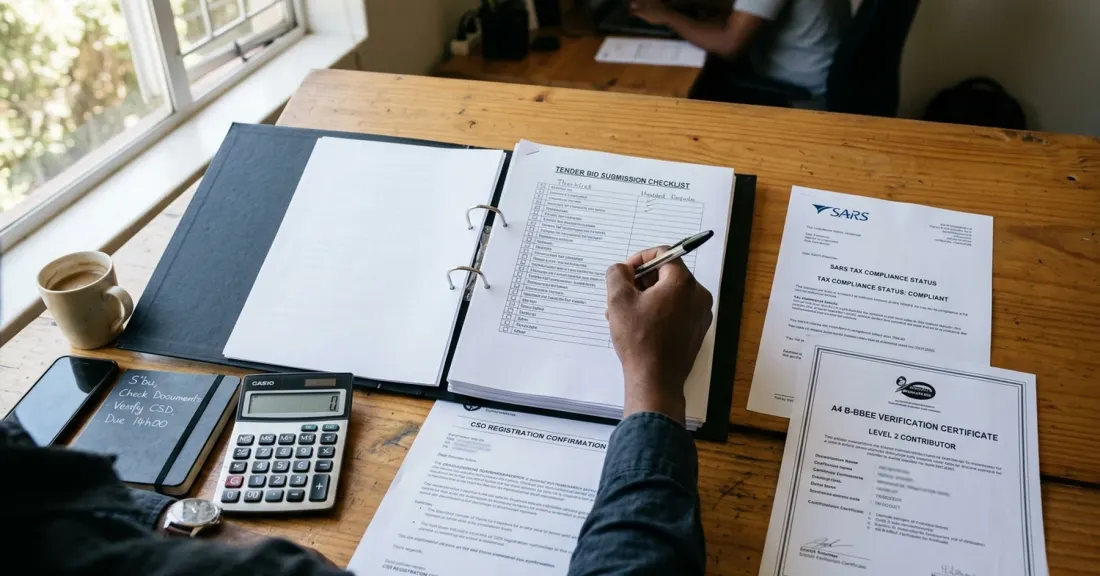
The Compliance Gate: What You Need Before You Bid
Compliance is the single most common point at which diesel tender bids fall over. The file needs to be current before the bid is submitted, not assembled after award. The non-negotiables are:- CSD registration. The Central Supplier Database is the National Treasury system holding verified supplier records for government and most SOE procurement. CSD is verified directly off the database during bid evaluation. Process documented on the National Treasury Central Supplier Database.
- SARS tax compliance status. Buyers verify status directly through the SARS interface, not from a printed letter. Current rules on the tax compliance status portal. An expired status will fail evaluation.
- CIPC filing. Annual returns and beneficial-ownership filings need to be current. Out-of-date filings are an avoidable disqualifier.
- B-BBEE certificate. Most diesel tenders carry a B-BBEE preference points scoring framework under the Preferential Procurement Policy Framework Act. A current certificate is required for the SMME to be scored.
- Fuel transport licensing where relevant. If the SMME is also moving the diesel, licensing through the Department of Mineral Resources and Energy applies. The DMRE publishes the framework on the department portal.
Realistic Deal Sizes and the R250,000 Floor
Active funded diesel tender deals tend to fall into a few recognisable bands.- R250,000 to R2 million. Short municipal supply orders, single-site SOE supplies and small-corporate fuel contracts. Often three to six month terms with a single delivery cycle a month.
- R2 million to R10 million. Mid-sized SOE and provincial department contracts running over 12 months, with multiple delivery sites and a defined monthly volume forecast. This is where most files sit.
- R10 million to R30 million. Multi-site SOE, large corporate and longer-duration municipal contracts running over 24 to 36 months. Funding structure is usually blended.
Where Invoice Discounting Picks Up the Tender Billing Cycle
Once delivery has happened and the SMME has invoiced the buyer, the funding model shifts. The contract is no longer about securing diesel at the supplier. It is about waiting for a 30, 60 or 90 day payment to land while the next delivery cycle is already in motion. That is the situation invoice discounting was built for. Invoice discounting advances most of the invoice value within days of the invoice being issued and verified. Repayment is taken from the buyer's payment on normal terms. For a 12 month diesel supply contract, the SMME can keep its cash position close to neutral cycle to cycle, drawing the next month's working capital from the previous month's invoice. The Sourcefin product page on invoice discounting walks through the documentation and process. The cluster article on fuel tender cash flow management covers the operational mechanics of running a fuel tender cycle in more detail.Building a Credible Bid File for a Diesel Tender
A credible diesel tender bid file rests on three pillars. First, clean compliance, covered above. Second, evidence that the SMME can actually deliver: a track record on smaller contracts, signed supplier agreements with a recognised wholesale fuel supplier, and where applicable transport arrangements that match the volume. Third, evidence that the SMME has access to working capital to fund the upfront supply leg. That third pillar is where a funding letter or expression of support from a recognised funder makes a meaningful difference. A bid file that names the funder and confirms a working-capital line is in place ahead of award reads very differently to a bid file that says funding will be sourced after award. Buyers are conscious of historical failures where awarded SMMEs could not actually finance the first delivery, and the bid evaluation now reflects that. For SMMEs that want to discuss a funding letter ahead of submission, the Sourcefin funding application form is the right starting point.What to Do in the Two Weeks Before Bid Submission
Diesel tenders run to tight timelines. The practical actions that matter in the final fortnight are the ones that protect the bid from avoidable failure.- Refresh the full compliance pack. CSD profile, SARS tax compliance status, CIPC filings and B-BBEE certificate, all current.
- Get a written quote or pro-forma invoice from the wholesale fuel supplier you intend to use, dated within the validity window of the tender.
- Confirm in writing that your transport arrangement is in place if you are moving the diesel yourself, with the relevant DMRE licensing referenced.
- Speak to your funder before submission. The funder will need to see the bid documents the buyer published, the volume forecast and the payment terms.
- Build the cash-flow forecast for the first three delivery cycles assuming the longest payment term in the buyer's bid documents. If the numbers work at 90 days they work at 30.
Sources & References
- National Treasury eTender Publication Portal – central listing of South African government and SOE tender opportunities.
- Public Finance Management Act – National Treasury, the broader payment and procurement framework for departmental and SOE contracting.
- Central Supplier Database – National Treasury, the verified supplier register used for government and most SOE procurement.
- Tax Compliance Status – South African Revenue Service.
- Department of Mineral Resources and Energy – fuel transport licensing and the broader regulatory framework for the South African petroleum industry.
- Engineering News fuel coverage – sector reporting on the South African diesel and fuel-supply market.
Frequently asked questions
What is diesel tender funding in South Africa?
What compliance documents do I need to bid on a diesel tender?
How big does a diesel supply contract need to be for funding to make sense?
Can I use both PO funding and invoice discounting on the same diesel tender?
Do I need to win the tender before applying for funding?
Where are South African diesel tenders published?

Sourcefin is a South African alternative finance provider that offers purchase order funding and invoice discounting to SMMEs, enabling businesses to fulfil confirmed purchase orders or tenders and unlock cash flow without collateral. Unlike traditional lenders or banks, Sourcefin also provides end-to-end support including supplier sourcing, logistics, project management, and risk oversight.