
What Invoices Qualify Invoice Discounting South Africa: Real
Not every invoice qualifies for discounting. Here's what makes an SA invoice fundable, what disqualifies one, and how funders read your receivables book.
On this page
- Key Takeaways
- What Invoices Qualify Invoice Discounting South Africa: The Three Tests
- What Typically Qualifies
- What Typically Does Not Qualify
- Invoice Quality Checklist
- How Customer Concentration Affects Fundability
- The Difference Between an Eligible Invoice and a Fundable Facility
- The Bigger Picture for SA SMMEs
- Frequently asked questions
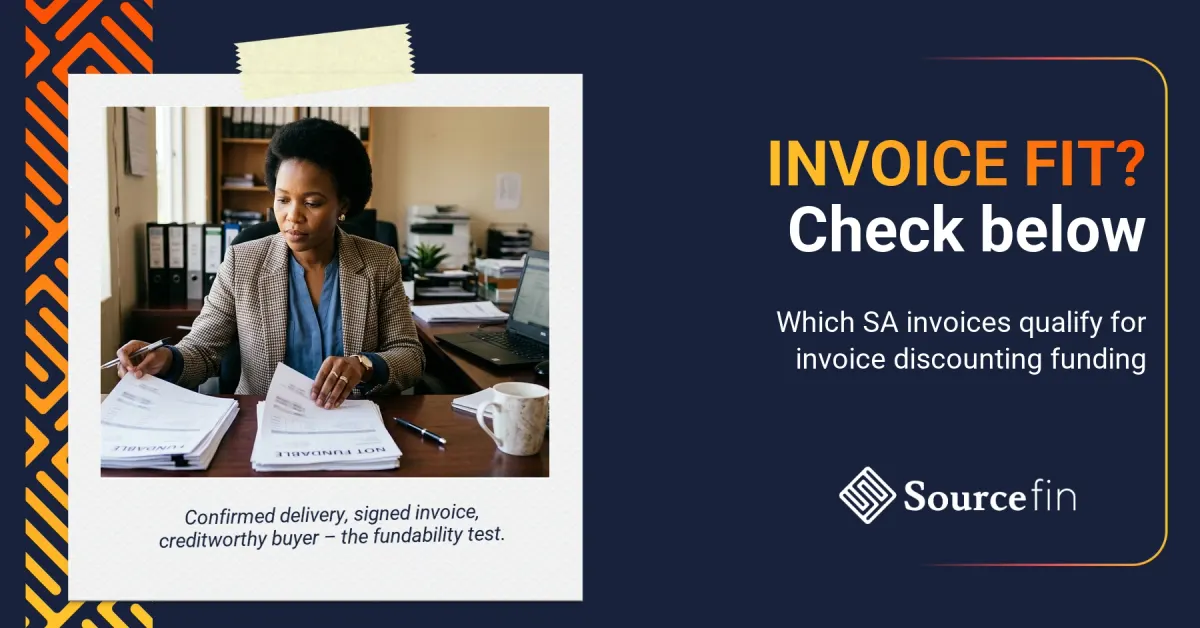
What invoices qualify invoice discounting South Africa comes down to three simple tests: the work has been completed and accepted, the invoice is properly structured against a real contract, and the customer is creditworthy enough that payment is reliably expected. Not every invoice on your debtors list meets all three. The funder reads the receivables book against this filter when sizing a facility.
Key Takeaways
- Three tests determine fundability: work delivered and accepted, clean invoice structure, creditworthy customer.
- Government, SOE, and major corporate invoices typically qualify – payment ability is well documented.
- Invoices for partial work, disputed deliveries, or contested amounts are usually not fundable.
- Concentration matters – a book where 80% of value sits with one customer needs separate structuring.
- Payment terms of 30, 60, or 90 days fit the model. Open or undefined terms do not.
- The funder assesses the receivables book as a whole, not just individual invoices in isolation.
What Invoices Qualify Invoice Discounting South Africa: The Three Tests
Three things determine whether a specific invoice can be funded.
The work must be completed and accepted. Invoice discounting funds against delivered work, not promised work. If the goods or services have been delivered and the customer has accepted them (or at least not formally disputed them), the invoice is in scope. If the work is still in progress or held up in dispute, the invoice is not yet fundable.
The invoice must be properly structured. A real invoice issued under a real contract, dated, with clear payment terms, referencing the underlying agreement and the work delivered. A vague invoice without contract reference, ambiguous payment terms, or missing tax information is harder to fund.
The customer must be creditworthy. The funder needs reasonable confidence that the customer will actually pay. Government departments, SOEs, listed corporates, and well-established mid-market businesses generally qualify. Small private customers with no payment history are much harder.
An invoice that passes all three tests is fundable. One that fails any of them needs more work or a different funding tool. For broader context on how invoice discounting works, the wider invoice discounting South Africa pillar guide explains the model end to end.
What Typically Qualifies
The most common scenarios for fundable invoices in SA include:
- Government department invoices for delivered supplies or services. Standard PFMA-aligned payment terms, clear contracting, established procurement entity. The invoice discounting for government contracts guide covers this category in depth.
- SOE invoices for delivered work. Eskom, Transnet, Rand Water, and similar entities. Contractually defined payment cycles. Funding straightforward.
- Listed corporate invoices. JSE-listed customers paying on standard 30 or 60-day terms.
- Established mid-market private business invoices. Mid-sized customers with documented payment history, often regular monthly invoicing.
- Tender invoices for delivered milestones. Where the SMME has won a tender and is invoicing against completed milestones. The invoice discounting for tender winners guide covers this specifically.
- Service contract invoices. Cleaning, security, facilities management, professional services invoiced monthly against agreed service-level agreements.
What Typically Does Not Qualify
Some invoice patterns reliably fall outside fundability.
Partial-work or progress invoices on disputed contracts. If the customer is contesting whether the work has been completed correctly, the invoice cannot be reliably funded. The dispute needs resolution first.
Speculative or pre-delivery invoices. Invoices issued before the work is done are not in scope for invoice discounting. PO funding (a different model) handles pre-delivery funding. The PO funding vs invoice discounting guide covers the difference.
Invoices to small private customers with no payment history. Without a way to assess payment ability, the funder cannot confidently advance. The book may need to be selective – fundable invoices to creditworthy buyers, others left out of the facility.
Invoices with retention or hold-back provisions. Heavy retention can complicate the structure. The funder typically advances only against the non-retained portion, with the retained sum addressed separately.
Open-ended or undefined payment terms. "Net payable" or "payment by arrangement" without specific timing makes the receivable difficult to size and recover.
Invoice Quality Checklist

Before approaching a funder, run your invoice book through this checklist. The cleaner the answers, the smoother the facility setup.
- Has the work been delivered, accepted, and (where applicable) signed off?
- Is the invoice issued under a real, written contract with the customer?
- Are the payment terms clearly stated (30, 60, or 90 days from invoice)?
- Is the customer financially capable of paying when due?
- Does the invoice carry a unique reference, date, VAT details, and clear billing information?
- Are there any contested amounts or pending disputes on the invoice?
- Does retention or any hold-back provision affect the invoice?
- How does this invoice fit into the broader concentration of your customer book?
For the full document picture for an invoice discounting application, the invoice discounting requirements South Africa guide covers what the funder asks for.
How Customer Concentration Affects Fundability
An individual invoice might pass all three tests perfectly – but if it represents 80% of your receivables book, the funder will look at the concentration risk that comes with it. Losing that single customer would collapse the cash flow the facility relies on. The result is usually a more conservatively sized facility or a structured discussion about diversifying the book over time.
This is not a disqualifier. Many SA SMMEs have concentrated books, particularly those dependent on a major government contract or SOE relationship. The facility is structured to work around the concentration rather than refuse it. The invoice discounting limits guide explains how facility sizing actually works.
The Difference Between an Eligible Invoice and a Fundable Facility
It is worth distinguishing two related concepts. An individual invoice can be eligible (it passes the three tests). A facility is fundable when the receivables book as a whole produces a meaningful, sustainable advance over time.
Sourcefin's typical facilities start at R250,000 across the receivables book. A book made up of a handful of small individually-eligible invoices may not reach that threshold. A book with one large invoice but no follow-on flow is similarly hard to structure as an ongoing facility. The invoice discounting vs bank overdraft guide covers the alternatives for sub-threshold cases.
The Bigger Picture for SA SMMEs
South Africa's SMME funding gap is well documented. The IFC's recent SA SMME finance partnership work shows that traditional credit access remains constrained even for SMMEs with strong receivables books. Knowing what invoices qualify invoice discounting South Africa lets you assess your own book honestly before approaching a funder, and lets you present the strongest case for a clean facility.
To explore an invoice discounting facility against your specific receivables book, the Sourcefin funding application form takes a couple of minutes, and a representative will follow up to walk through your customer mix and invoicing patterns. The Sourcefin invoice discounting service page sets out the full process.
Sources & References
Frequently asked questions
What invoices qualify for invoice discounting in South Africa?
Invoices that pass three tests: the work has been delivered and accepted, the invoice is properly structured against a real contract with clear payment terms, and the customer is creditworthy enough that payment is reliably expected. Government, SOE, and major corporate invoices typically qualify naturally. Invoices to small private customers with no payment history are much harder to fund.
Are partial-work or progress invoices fundable?
Generally no. Invoice discounting funds against delivered work, not work in progress. If the customer has not yet accepted the delivery, or if the invoice is for an incomplete milestone, the receivable is too uncertain to fund. Once the work is signed off and the invoice is properly issued for completed work, it becomes fundable.
What if my customer is disputing an invoice?
Disputed invoices are typically excluded from the facility until the dispute is resolved. The funder cannot reliably advance against an invoice the customer is contesting. Resolving the dispute brings the invoice back into scope. The rest of your receivables book can usually still be funded around the disputed item.
Do invoices to small private customers qualify?
It depends on the customer. Established mid-market businesses with documented payment history can qualify. Very small private businesses with no payment record are usually outside the funder's risk tolerance. The book may be funded selectively – fundable invoices to creditworthy buyers in scope, others left out. The total fundable book size determines whether a facility makes sense.
Does customer concentration affect what qualifies?
An individual invoice can be eligible while the broader book carries concentration risk. If 80% of your invoice value sits with one customer, the facility is sized more conservatively to absorb the risk. Concentration does not disqualify you – it shapes the structure. Many SA SMMEs have concentrated books, particularly those dependent on a major government or SOE contract.
What payment terms work for invoice discounting?
Standard 30, 60, or 90-day payment terms work well. The funder needs predictable timing to size the advance and recovery. Open-ended terms ('net payable' or 'payment by arrangement') without specific timing make the receivable difficult to fund. If your customer payment terms are vague, tightening them in writing before approaching the funder helps.
How does retention or hold-back affect invoice fundability?
Retention complicates the structure but does not exclude the invoice. The funder typically advances against the non-retained portion of the invoice, with the retained sum addressed separately. For construction or infrastructure invoices with standard 5-10% retention, this is usually accommodated cleanly. Heavy or unusual retention provisions need separate discussion with the funder.

Sourcefin is a South African alternative finance provider that offers purchase order funding and invoice discounting to SMMEs, enabling businesses to fulfil confirmed purchase orders or tenders and unlock cash flow without collateral. Unlike traditional lenders or banks, Sourcefin also provides end-to-end support including supplier sourcing, logistics, project management, and risk oversight.