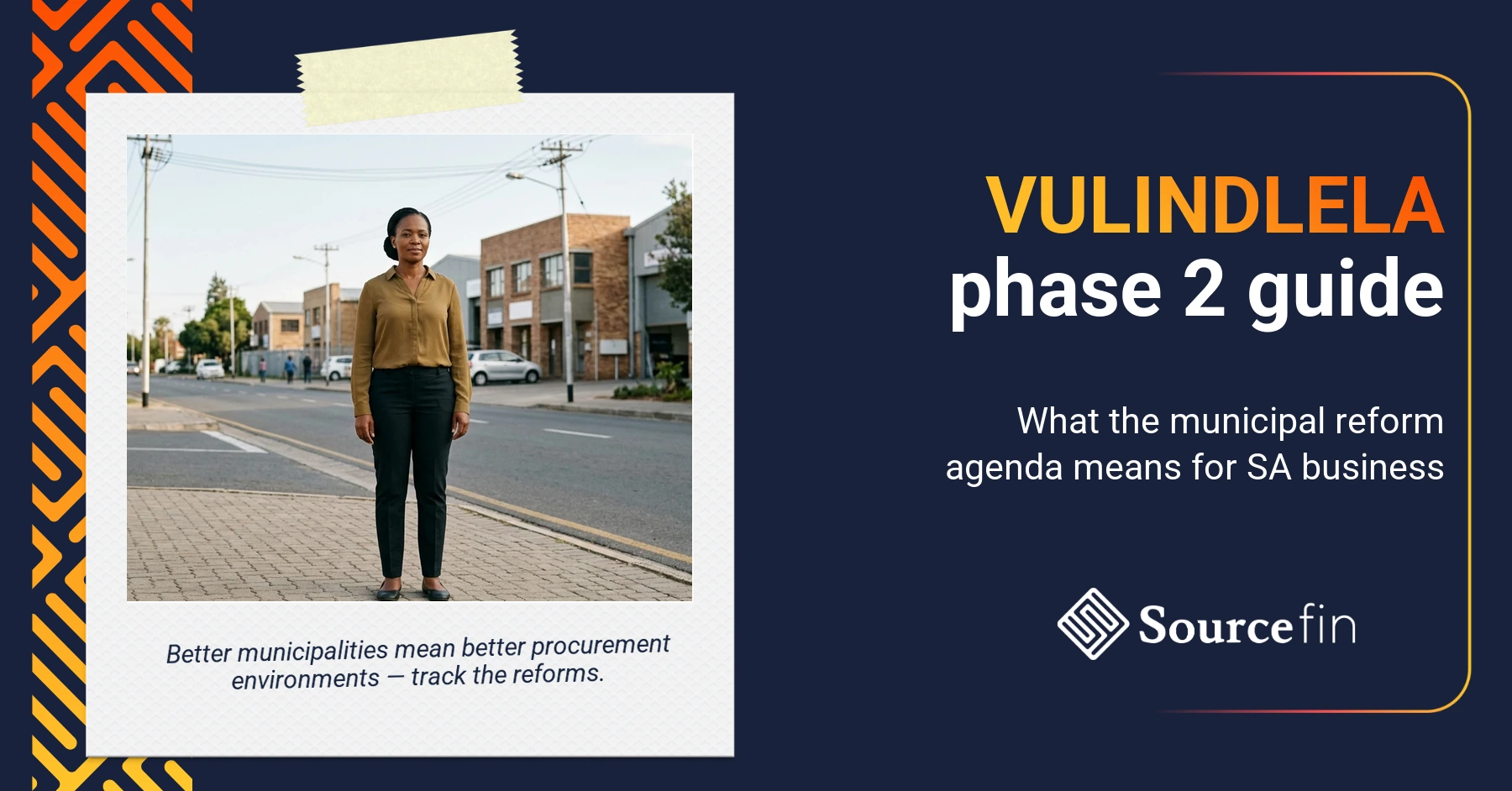

Operation Vulindlela Phase 2 South Africa launched on 7 May 2025 under President Ramaphosa, extending the structural reform programme into three new areas: spatial inequality, local government performance, and digital transformation. Where Phase 1 focused on electricity and logistics – and secured R500 billion in new investment alongside a 22,500 MW renewable energy pipeline – Phase 2 targets the municipal environment that most directly affects how businesses operate day-to-day and how government procurement functions at a local level.
Key Takeaways
- Operation Vulindlela Phase 2 South Africa launched 7 May 2025, targeting spatial inequality, municipal performance, and digital transformation
- Phase 1 achieved 94% completion of its reforms, driving R500 billion in new investment and a 22,500 MW renewable energy pipeline
- R27.7 billion in medium-term performance-linked incentives (part of a R54 billion total package) is available for metros that meet water, electricity, and waste management targets
- Six metros are implementing Performance Improvement Action Plans – ring-fencing water and electricity services in the first year
- Better-run municipalities mean more predictable procurement cycles, faster supplier payments, and more reliable services for businesses operating in or supplying local government
- The digital transformation pillar – government services online, digital identity, rapid payments infrastructure – directly reduces friction for businesses registering, complying, and transacting with government
Operation Vulindlela Phase 2 South Africa is not a tender programme – it is a structural reform initiative. But structural reform creates the conditions in which tenders are issued, contracts are honoured, and suppliers get paid. For SMMEs working in or supplying local government, the quality of the municipal environment is not background noise – it determines whether procurement happens on a predictable schedule or collapses into delayed payments and cancelled projects. For the full 2026 budget context, read our Budget 2026 South Africa SMME guide.
What Phase 1 Built and Why Phase 2 Follows
Operation Vulindlela was established in 2020 as a joint Presidency and National Treasury initiative to remove structural constraints on economic growth – bottlenecks so embedded in the system that normal departmental processes couldn’t resolve them. Phase 1 targeted electricity, freight logistics, water, and the visa and spectrum regimes.
By the time Phase 2 launched, 94% of Phase 1 reforms had been completed or were progressing. The outcomes were measurable: R500 billion in new investment secured, a 22,500 MW renewable energy pipeline established, the Transport Economic Regulator created through passed legislation, and the Trusted Employer Visa Scheme launched to ease skills shortages in critical sectors.
Phase 2 extends the model into three areas that Phase 1 left largely untouched: the spatial patterns that concentrate poverty far from economic opportunity, the municipal performance failures that undermine service delivery and procurement, and the digital infrastructure gap that keeps government transactions slow and manual.
The Three Reform Pillars of Operation Vulindlela Phase 2 South Africa
Spatial inequality. The poorest South Africans spend approximately 40% of their income on transport to reach economic opportunity – a direct legacy of apartheid spatial planning that placed black communities far from urban employment centres. Phase 2 addresses this through public land release for social housing, enabling affordable home access in areas with genuine economic activity. The practical effect for businesses is a larger, less transport-burdened labour pool closer to economic centres over time.
Local government performance. This is the pillar most immediately relevant to businesses. Six metros are implementing Performance Improvement Action Plans under Vulindlela Phase 2 oversight. In the first year, water and electricity services are being ring-fenced within these metros – creating financial and operational separation between trading services and the broader municipal budget. This prevents the common pattern where revenue from electricity and water cross-subsidises unrelated municipal spending, leading to infrastructure maintenance failures and billing system collapse.
Digital transformation. Government services are being moved online – identity applications, business registration, compliance submissions. A digital identity system and rapid payments infrastructure are being established. For SMMEs, this means fewer trips to Home Affairs and SARS branches, faster compliance processing, and eventually a government procurement system with faster payment cycles built on modern payments rails.
The R27.7 Billion Utility Incentive – What It Is
To accelerate the municipal performance pillar, government has structured a R54 billion performance-linked incentive package – with R27.7 billion available over the medium term. Metros access these funds by meeting targets they set themselves for water delivery, electricity distribution, and waste management performance. Funds are withheld if targets are missed and released when they are met.
The self-set target model is deliberate: it creates municipal ownership of the improvement trajectory rather than imposing centrally determined benchmarks. The R27.7 billion medium-term allocation represents a meaningful incentive for metros – large enough to fund real infrastructure maintenance and upgrade cycles when released, consequential enough to be withheld for underperformance.
Finance Minister Godongwana referenced this model explicitly in the February 2026 budget speech, positioning it as a central mechanism for restoring metro trading service sustainability.
What Phase 2 Means for Businesses Supplying Local Government
Dysfunctional municipalities are among the most significant constraints on SMME growth in South Africa. Late supplier payments, cancelled contracts mid-delivery, and unpredictable procurement timelines all flow directly from municipal governance failures. Operation Vulindlela Phase 2 South Africa targets exactly this – but the improvement will be gradual, not instant.
For SMMEs supplying metros with cleaning, security, maintenance, or facilities services, improved ring-fencing of trading services means more predictable cash flow within those entities – which flows through to more reliable supplier payment. A metro that manages its electricity and water revenue properly has greater capacity to honour its 30-day supplier payment obligations.
For businesses monitoring where procurement opportunities are most likely to materialise, metros actively implementing Performance Improvement Action Plans are the ones most likely to issue infrastructure-related tenders in the near term – maintenance upgrades, metering infrastructure, pipe replacement, and electrical network work all flow from the performance improvement programmes.
How to Position Your Business for the Reform Dividend
Operation Vulindlela Phase 2 South Africa creates a better operating environment over time – it is not a quick-fix procurement programme. Positioning your business to benefit requires tracking the right entities, maintaining full compliance, and having the capital to execute when procurement opens up.
Follow the six metros implementing Performance Improvement Action Plans – their tender publications, particularly in water, electricity, and waste management services, are where the Vulindlela-linked procurement will appear first. Combine this with the broader infrastructure tender pipeline from our water infrastructure guide and the SONA 2026 overview for the full picture of where government is directing capital.
Compliance remains non-negotiable. CSD registration, a current SARS tax compliance pin, and a valid B-BBEE certificate are verified in real time on every tender evaluation. The digital transformation pillar also means compliance systems will increasingly be checked electronically – keeping your records current and accessible digitally reduces friction at every submission. Our full tendering guide for South Africa covers both compliance and submission strategy.
And when the award comes, execution capital matters. Government procurement pays on 30-day terms in theory – municipal procurement can stretch significantly longer in practice. Tender funding options, including purchase order funding, bridge the gap between award and payment so you can deliver without waiting on the municipality’s payment cycle. If your business is building toward the opportunities Phase 2 will create, apply for funding now – before the tender you want to win is on the table.
Sources & References
- Address by President Ramaphosa at the Launch of Operation Vulindlela Phase II | The Presidency
- Operation Vulindlela Phase 2 – Focusing on Key Reforms | SA News
- Budget 2026: Godongwana Takes Aim at Badly-Run Municipalities | GroundUp
- Budget 2026 South Africa: Practical Guide for SMMEs | Sourcefin
Frequently Asked Questions
What is Operation Vulindlela Phase 2 in South Africa?
Operation Vulindlela Phase 2 is the second phase of a joint Presidency and National Treasury structural reform programme, launched by President Ramaphosa on 7 May 2025. It targets three areas Phase 1 left largely untouched: spatial inequality (apartheid-legacy geography), local government performance (dysfunctional municipal utilities and procurement), and digital transformation (government services online, digital identity, rapid payments infrastructure).
What did Operation Vulindlela Phase 1 achieve?
Phase 1 achieved 94% completion of its reform targets. Verified outcomes include R500 billion in new investment unlocked, a 22,500 MW renewable energy pipeline established, the Transport Economic Regulator created through passed legislation, and the Trusted Employer Visa Scheme launched to ease skilled worker shortages. Phase 1 focused primarily on electricity, freight logistics, water regulation, and visa reform.
What is the R27.7 billion utility incentive under Operation Vulindlela Phase 2?
Government has structured a R54 billion performance-linked incentive package for municipalities, with R27.7 billion available over the medium term. Metros access these funds by meeting targets they set themselves for water delivery, electricity distribution, and waste management performance. Funds are withheld for underperformance and released when targets are met — creating a financial incentive for metros to restore trading service sustainability.
Which municipalities are implementing Operation Vulindlela Phase 2 reforms?
Six metros are implementing Performance Improvement Action Plans under Vulindlela Phase 2 oversight. In the first year of the programme, these metros are ring-fencing their water and electricity services — creating financial separation between trading services and the broader municipal budget to stop cross-subsidisation that leads to infrastructure maintenance failure.
How does Operation Vulindlela Phase 2 affect businesses supplying local government?
Better-run municipalities create more predictable procurement cycles and more reliable supplier payment. A metro that ring-fences trading service revenue has greater capacity to honour 30-day payment terms. Metros actively implementing Performance Improvement Action Plans are also more likely to issue infrastructure-related tenders in the near term — maintenance, metering upgrades, pipe replacement, and electrical network work all flow from the performance programmes.
What does the digital transformation pillar of Operation Vulindlela Phase 2 mean for SMMEs?
Government services are moving online — identity applications, business registration, compliance submissions. A digital identity system and rapid payments infrastructure are being developed. For SMMEs, this means fewer manual transactions with government agencies, faster compliance processing, and eventually a procurement system where payment cycles run on modern payments infrastructure rather than manual cheque and EFT processes.